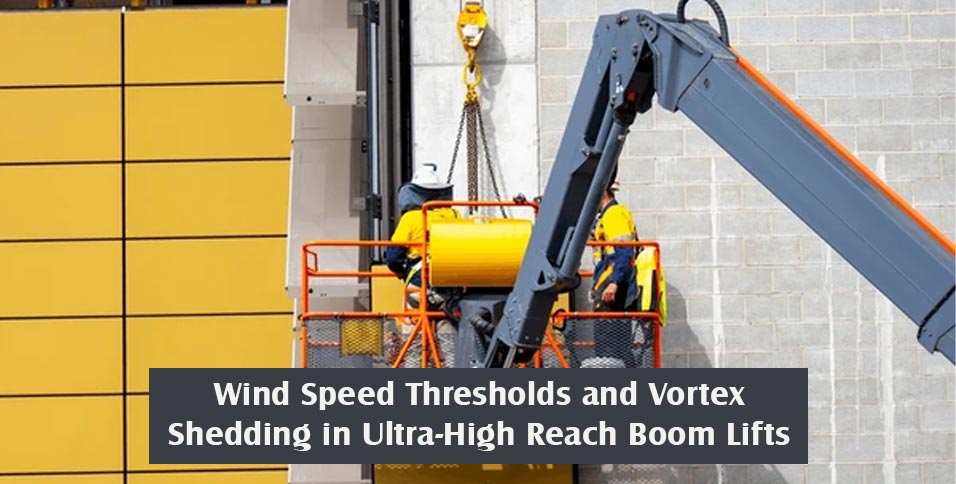
Working at an elevated reach platform requires a deep understanding of structural engineering and atmospheric principles. Often, wind speeds at 300 feet can increase the velocity at ground level due to lower friction. Engineers refer to this as the wind gradient effect, which increasingly affects the stability of any large boom structure.
The ambiance at higher elevations keeps the platform under ongoing pressure fluctuations that can lead to unanticipated swaying or structural fatigue over time. Operators can continuously monitor anemometers to ensure they remain in a secure, operational space for certain devices.
Wind threshold and boom lift safety
The makers of a boom aerial lift provide a robotics rating based on their stated max lift height for use on the boom lift, as per their redundancy check. Many ultra-high boom lifts may allow operation at wind gusts of 28 miles per hour (45 km/h) before the safety sensors/alarm triggers are activated. This is to prevent damage to the boom lift structure from excessive side loads and to prevent the bucket from shifting during operation.
If you operate at or beyond these recommendations, you risk the boom lifting, tipping over, or experiencing mechanical failure due to excessive side loading on the lift. Always verify the specific load chart and your wind rating before lifting personnel to the maximum vertical reach.
What is the principle behind vibration and vortex shedding?
The phenomenon of vortex shedding occurs when air passes a blunt object, creating alternating zones of low pressure that generate a cyclic vibration of the structure. Long slender booms can exhibit a susceptibility to a type of operation called galloping or “harmonic” resonance. It occurs with periodic uplift and downward motion when the boom’s natural frequency coincides with the wind.
The boom’s oscillation can increase substantially as the wind passes over it. Engineers can solve this problem by using an aerodynamic boom design and by constructing it from high-tensile steel, thereby improving the overall longitudinal rigidity. Proper knowledge of these vibrations can help operators detect boom instability during maintenance at high altitude.
Crucial factors in advanced stability
Maintaining stability at a height of 90 meters requires multiple technical variables working together to keep the work platform at the ideal level. The following pointers are crucial here:
- The wide outrigger can spread and disperse the gravity center atop a vast surface area for security.
- Innovative sensors can compensate for minor chassis shifts to maintain proper vertical centering.
- A well-controlled boom extension can ensure the hefty sections remain lowered to the ground, improving counterweighting.
- Systems manage the weight in a basket along with the extension angle to avoid over-reaching.
Conclusion
Therefore, when safely dealing with wind threshold limits and vortex shedding, you need advanced technology and an operator with rigorous training. Access to wind turbines and tall buildings for maintenance can be achieved with ultra-long-reach lifts, but they must still respect Earth’s natural physics. By continuously monitoring weather conditions and adhering to the manufacturer’s limitations and guidelines, teams can perform complex tasks while ensuring the crew’s safety at all times. For advanced, high-access project equipment and technical guidance, you can browse the websites of leading names such as https://www.bladeplatforms.com/to check out the solutions they offer, and choose wisely.