Every professional has been there. You walk out of a conference with a stack of paper business cards stuffed into your pocket, and by the next morning, half of them have already been forgotten. The people behind those cards had real potential, but the connection never went anywhere. This is a problem that has stayed with traditional networking for decades, and it is one that the smart business card is now beginning to solve in a meaningful way.
As B2B networking grows more competitive and relationship-driven than ever, professionals are looking for tools that actually help them build lasting connections rather than just exchanging contact details. The smart business card fits right into that need, and it is changing the way businesses think about first impressions.
What Has Changed in B2B Networking
The Limits of Paper Cards
Paper business cards have served their purpose for well over a century. They are simple, cheap, and easy to hand out. But in a world where everything from sales pipelines to client communication is managed digitally, there is a growing gap between how professionals exchange information and how they actually manage it afterward.
Think about what typically happens after a networking event. Someone hands you their card, you glance at it, maybe tap a note into your phone, and then set the card down somewhere. A week later, the context is gone. You cannot remember where you met, what you talked about, or why that person mattered to your work. The physical card gave you data but not connection.
Beyond the memory problem, there is also the practical issue of outdated information. Job titles change, companies pivot, phone numbers get updated. A paper card printed six months ago might already be inaccurate by the time someone tries to use it.
A Shift Toward Smarter Tools
The broader shift in the business world toward digital-first tools has made its way into networking. Professionals today expect the tools they use to be connected, trackable, and integrated with the other systems in their workflow. That expectation has created room for a new kind of networking tool, one that works the way modern business actually does.
How the Smart Business Card Works
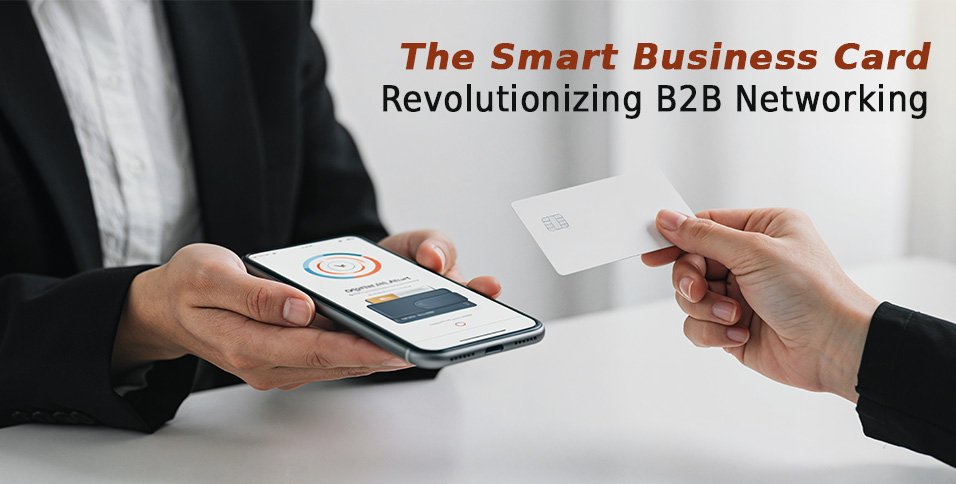
At its core, a smart business card is a physical card, often made of metal, wood, or durable plastic, embedded with NFC (Near Field Communication) technology or a QR code. When someone taps the card against a smartphone or scans the code, they are taken directly to a digital profile. That profile can include contact details, social media links, a portfolio, a booking link, or any other information the cardholder wants to share.
What makes this genuinely useful is not just the tap-to-share function. It is everything that comes with it. The person receiving the information can save it directly to their contacts without typing anything. The cardholder can update their digital profile at any time without printing new cards. And depending on the platform, both parties can receive follow-up tools to help them actually stay in touch.
The Role of Data and Analytics
One of the most interesting aspects of the smart business card in a B2B context is the data layer it introduces. Unlike a paper card, which disappears the moment it leaves your hand, a digital card can tell you things. Some platforms let users see how many times their card has been viewed, which links were clicked, and even when someone engaged with their profile.
For sales professionals and business developers, this kind of data is genuinely useful. It helps prioritize follow-ups. It shows which parts of a profile are drawing interest. It turns a one-time introduction into something with a measurable trail, which makes it much easier to manage relationships at scale.
Why This Matters for B2B Relationships Specifically
Building Credibility From the First Moment
In B2B sales and partnership development, credibility is everything. The first impression you make with a potential client or partner sets the tone for the entire relationship. Handing someone a smart business card sends a quiet but clear signal that you pay attention to how you show up professionally.
It also creates an immediate experience. Instead of waiting for someone to look you up later, you are putting your full professional presence in front of them right there in the moment. That immediacy matters when people are meeting dozens of professionals at a conference or event.
Reducing Friction in the Follow-Up Process
One of the most common failures in networking is not the introduction. It is the follow-up. People have good conversations, exchange cards, and then never reconnect because the friction of reaching out after the fact is just high enough to let the moment pass.
Digital cards reduce that friction considerably. When contact information goes directly into someone’s phone, the barrier to sending a follow-up message drops. Some platforms even allow users to add a personalized note at the point of sharing, so the context of the meeting is preserved right alongside the contact details.
Sustainability as a Professional Value
This might seem like a secondary concern, but it is increasingly relevant in B2B circles. Many companies today have sustainability commitments, and the professionals who represent them are thinking about how their choices reflect those values. Replacing disposable paper cards with a reusable digital alternative is a small but meaningful step, and it is one that tends to resonate with environmentally conscious clients and partners.
Practical Considerations for Adopting This Technology
Choosing the Right Platform
Not all smart business card solutions are built the same way. Some focus primarily on the tap-to-share experience, while others offer more robust features like CRM integration, team management, and analytics dashboards. For individual professionals, a simple setup might be enough. For sales teams or organizations managing large volumes of client relationships, deeper integrations are worth looking for.
It is also worth thinking about the design of the physical card itself. A well-made card still communicates something about your brand. The materials, finish, and design all contribute to the impression it makes when handed to someone for the first time.
Making the Digital Profile Work for You
The card itself is just the entry point. What matters most is the profile it leads to. A cluttered or incomplete digital profile undermines the experience. The best approach is to keep it focused, making sure the most important information is easy to find and that the profile reflects how you actually want to be known professionally.
It also helps to update the profile regularly. One of the biggest advantages of this format is that it stays current, but only if you treat it that way.
Conclusion
Networking has always been about people, and that will never change. What changes over time is the quality of tools professionals have to support those human connections. Today, those tools are smarter, more connected, and more capable of helping people turn a brief introduction into a lasting professional relationship. That is a shift worth paying attention to, and for many professionals, it is already changing how they show up in the room.