I bought a red light panel on the strength of a product page, which is a poor way to spend money. It said clinical studies but named none, so I stopped reading marketing copy and read the trials.
The most valuable finding is not that light works. It is that the dose has to match the band. Pooled trial data puts the effective range at roughly 4 to 8 joules per treatment spot between 785 and 860nm, but only 1 to 3 joules per spot at 904nm. Same joint, same outcome scale, energy requirement different by a factor of five. That fact explains most of why these studies appear to contradict each other.
What matters when you read these studies
Three variables decide whether a trial says anything about a device you can buy: wavelength, dose per treatment spot, and delivery method. I kept the spec tables at Red Light Panel Index open alongside the trial evidence for joint pain, graded.
One caveat, stated plainly and once. Almost every trial below used a laser, not an LED panel. Laser and LED differ in coherence, spot size and power density, so a home panel carrying the same wavelength is a reasonable extrapolation of a wavelength finding, not a proven equivalent of the trial device.
The studies
22 trials, 1,063 participants, and the dose rule
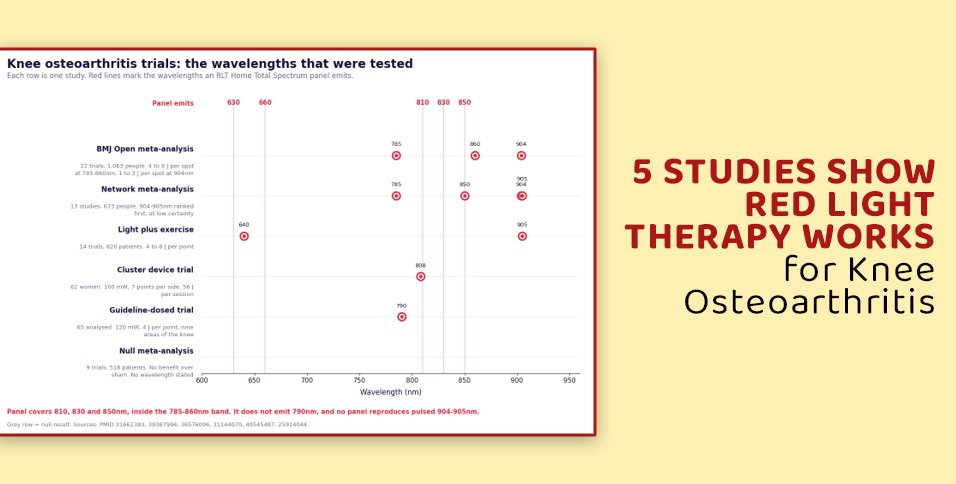
A 2019 meta-analysis of randomized placebo-controlled trials in BMJ Open (PMID 31662383) pooled 22 trials at 785, 860 and 904nm. Pain fell 14.23mm on a 100mm visual analog scale versus placebo at end of therapy and 15.92mm at follow-up one to twelve weeks later. Trials using the doses recommended by the World Association for Laser Therapy, 4 to 8 joules per spot at 785 to 860nm and 1 to 3 at 904nm, reached 18.71mm and peaked at 31.87mm beyond placebo two to four weeks later. Disability improved too, with no adverse events.
13 studies, 673 participants, ranked by band
A 2024 network meta-analysis in Aging Clinical and Experimental Research (PMID 39367994) put 785, 850, 904 and 905nm in competition. Light beat sham for pain (SMD 0.96, 95 percent CI 0.31 to 1.61) but not for function or stiffness. The ranking placed 904 to 905nm first at 86.90 percent, multi-wavelength second at 56.43 percent and 785 to 850nm third at 54.97 percent, with certainty rated low for the winner and very low for the rest.
14 trials, 820 patients, light added to exercise
A 2023 meta-analysis in Somatosensory and Motor Research (PMID 36576096) tested what light adds to an exercise program, at 640 and 905nm, 4 to 8 joules per point over 10 to 16 sessions. Pain fell significantly immediately after therapy (SMD minus 0.58) and at follow-up (SMD minus 1.35). Range of motion, strength and knee function showed no added benefit.
62 women, 808nm delivered by cluster
A 2020 randomized placebo-controlled trial in Lasers in Medical Science (PMID 31144070) treated 62 female volunteers with 808nm at 100 mW, seven points each side, 56 joules per session, over 16 sessions. Both active groups had a significant fall in pain versus placebo, but the light added nothing beyond exercise for walking distance or muscle strength.
65 knees dosed to the guideline
A 2025 double-blind randomized controlled trial in Lasers in Medical Science (PMID 40545487) enrolled 73 people and analyzed 65 against both a sham device and a no-intervention control, using 790nm at 120 mW and 4 joules per point across nine areas of the knee. Pain, WOMAC stiffness and functional limitation improved significantly in the active group while sham and control did not move.
What the wavelengths tell you
The positive trials sit in two places: continuous near-infrared between 785 and 860nm, where 790nm and 808nm land, and pulsed output at 904 to 905nm, ranked first but at low certainty.
They are not interchangeable, and the reason is dose. Run an 850nm device at 904nm energies and you have barely dosed the joint. Read the null results with that in mind and a good share of them start looking like a protocol problem rather than proof of nothing.
Where the evidence disagrees
The field is genuinely split, and anyone telling you otherwise has not read it.
The 2015 meta-analysis in Osteoarthritis and Cartilage (PMID 25914044) pooled 9 randomized trials and 518 patients and found no significant benefit over sham on visual analog scale pain immediately after therapy (SMD minus 0.28, 95 percent CI minus 0.66 to 0.10), none at 12 weeks, and none on WOMAC pain, stiffness or function. It concluded the best available evidence did not support the treatment. That paper states no wavelength anywhere, so I will not attach a band to it and wave it away.
So: the 2015 pooling said no, the 2019 pooling said yes but only at the correct doses, and the 2024 network analysis said yes for 904 to 905nm at low certainty. Add that two studies above found no gain in strength or function, and the defensible claim narrows to pain relief.
The device that matches the research
If the reproducible band is 785 to 860nm continuous, the question is which home device emits inside it. The RLT Home Total Spectrum line carries seven wavelengths in every panel: 480nm blue, 630nm, 660nm red, 810nm, 830nm, 850nm and 1064nm deep near-infrared. Three of those, 810nm, 830nm and 850nm, sit inside the band the pooled dose analysis treated as one group, and the brand publishes the share of LEDs at each, roughly 19 percent at 810nm and 14 percent at 830nm on the MAX. Irradiance was lab measured by Electropossible Ltd on an HP350IR spectrometer at 6 inches, 100.53 mW/cm2 on the RLT Home Total Spectrum MAX at $1,795. Sizes run from 72 to 864 LEDs and $595 to $4,595, with a 60 day trial, a 3 year warranty, a stand and two types of eye protection.
The limits, stated plainly. No panel reproduces the pulsed 904 to 905nm laser output of the other successful arm, and the panel does not carry 790nm either. The lab testing was commissioned by the brand and no unaffiliated reviewer measurement is on file. It is expensive next to a knee wrap, the panels are vertical so stand position matters for a seated knee, and there is no companion app.
No rectangular red light panel is FDA approved. The strongest accurate status is FDA registered, a listing of device and manufacturer, not a clearance, an approval or an endorsement. Talk to your clinician first, particularly if you take a photosensitizing medication or you are pregnant.
FAQ
How long before a knee routine is worth judging?
The pooled trials ran 10 to 16 sessions at about two a week, and the largest dose-matched effect appeared two to four weeks after therapy ended.
Does red light rebuild cartilage?
Nothing here measured cartilage. These trials measured pain scales, WOMAC subscores, walking distance and strength. Pain improved. Strength and function largely did not.
Is a panel a substitute for strength work?
No. The 808nm trial and the 14-trial meta-analysis both found light added pain relief on top of exercise, with no extra gain in strength or function.