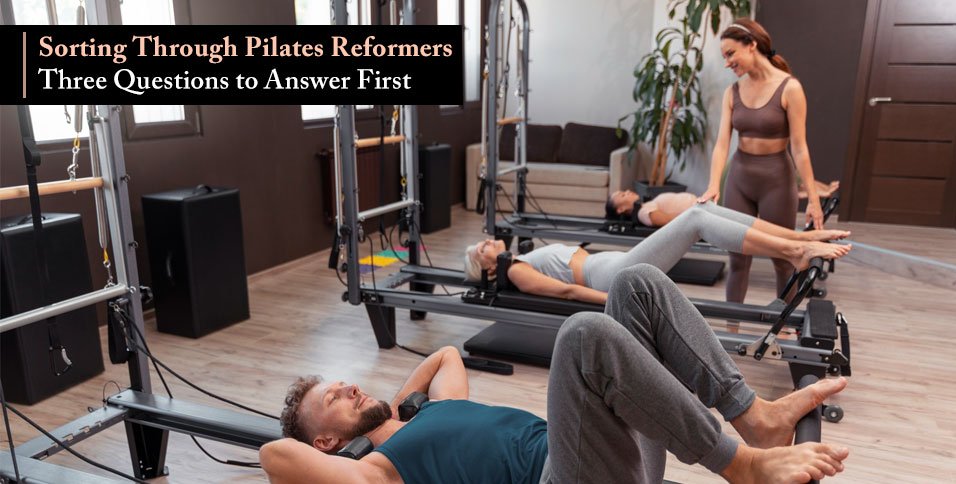
Search this equipment category, and you’ll drown in options within minutes.
Dozens of brands. Wildly different price points. Specs that blur together by the fifth product page.
Answer three questions honestly first, though, and most of that noise just disappears.
Question One: How Much Floor Space Do You Really Have?
Not how much space you’d like to have, or how much a spare room could theoretically hold once you move some boxes.
The real, measured footprint, including clearance at both ends of the carriage for full extension.
If space is genuinely tight
Look at foldable frames specifically. Fold one up, slide it under the bed or stand it in a closet, and the space problem’s gone. You do give up a bit of frame rigidity compared to fixed-frame models; that’s the trade-off. For an apartment or a shared room, most people find it’s worth it.
If you have a dedicated room or corner
A fixed frame tends to win out long-term. No daily fold-and-unfold routine to deal with, and that routine really does get skipped often enough that workouts get skipped right along with it. Be honest with yourself here. Small friction adds up faster than people expect.
Question Two: What’s the Real Budget, Accessories Included?
Base price almost never tells the whole story. Some brands bundle jump boards, extra risers, and strap attachments in.
Others sell every one of those separately, and that gap alone can add several hundred dollars once you’ve built a usable setup.
Roughly, here’s how the market splits by price:
| Price Range | What You’re Typically Getting |
| Under $500 | Basic frame, fewer spring options, accessories usually sold separately |
| $500–$1,500 | Solid mid-range build, decent spring range, some bundled accessories |
| $1,500–$3,000 | Studio-adjacent quality, fine spring adjustment, most accessories included |
| $3,000+ | Commercial-grade construction built for daily, heavy use |
Most home users land comfortably in the middle two tiers. The top tier makes sense mainly for anyone running a small studio or training multiple people regularly, where daily wear justifies the jump in build quality.
Don’t sleep on shipping costs either; nobody thinks to check that one until checkout’s already staring back at them.
These machines ship freight, not standard parcel, so you might end up booking a delivery window or dealing with curbside drop-off instead of a box just appearing on your porch. Not a dealbreaker, not even close.
Just one of those details that blindsides first-time buyers when nobody bothers mentioning it beforehand, and it can add a surprising chunk to the total once it lands on the invoice.
Question Three: Where Does Your Experience Level Really Sit?
Beginners and people coming off years of studio classes need genuinely different machines, even when the marketing pitches both groups the exact same way.
- New to reformer work entirely: Go simple. A clear, well-labeled spring system wins over one with a dozen fine-tuned adjustments you don’t even know how to use yet. Instructional content included with the machine helps too; a beginner left to figure things out alone tends to pick up form habits that need fixing down the road.
- Experienced from studio classes: Prioritize carriage length and smoothness of glide instead. You already know what a quality studio machine feels like, and a noticeably shorter or rougher home version will be obvious within the first session. Spring range matters more here as well, since someone coming from regular classes is usually working closer to the top of a beginner machine’s resistance capacity from the start.
A study measuring core muscle activation during reformer exercises, published through the National Center for Biotechnology Information, found that experienced practitioners engaged stabilizing muscles differently than beginners performing identical movements, activating deeper muscles more consistently.
That gap tends to close with practice regardless of which machine someone starts on, but it’s one more reason a beginner shouldn’t necessarily buy toward advanced features on day one.
Physiopedia’s overview of core stability training notes that unstable, resistance-based equipment, the exact category a reformer’s sliding carriage falls into, plays a meaningful role in building the kind of deep muscular control that supports posture and injury prevention over time.
That’s a solid baseline reason to take the equipment seriously regardless of which price tier or frame style ends up being the right fit.
Putting the Three Answers Together
Someone with a small apartment, a moderate budget, and zero reformer experience is looking at a very different shortlist than someone with a dedicated home gym, a bigger budget, and five years of studio classes behind them.
Neither shortlist is objectively better. They’re just solving different problems.
Once those three answers are clear, it becomes much easier to compare the right machines. You can browse The Core Collab’s range of Pilates reformers with your space, budget, and experience level in mind, rather than treating every model as though it were made for the same buyer.
The Question Nobody Asks Early Enough
One more question, and it’s the one almost nobody bothers asking before they buy: how many times a week is this thing really going to get used, once the excitement of a new purchase wears off and the routine of ordinary life sets back in?
Be honest. Not aspirational.
A machine bought for daily use that only sees two sessions a week isn’t a failure, but it does mean a mid-range option probably made more sense than the premium tier someone talked themselves into.
Matching the equipment to real, lived habits, not projected ones, is usually what separates a purchase someone’s still happy with a year later from one quietly listed for resale.
This applies just as much to accessories as it does to the base machine itself. It’s tempting to add every available attachment at checkout, jump boards, extra risers, a full strap set, on the assumption that more options means more value down the line.
Most people settle into two or three go-to exercises in practice and barely touch anything else.
Buy the base setup first, then add accessories once your real habits show themselves; you’ll almost always end up spending less than if you’d bundled the works on day one.