Mirror Review
July 10, 2026
The Volkswagen Group officially presented its 12-initiative future plan to its supervisory board, triggering nationwide worker protests across Germany.
To secure its long-term survival, management is targeting severe operational changes, including a huge reduction in product variety and factory output.
This Volkswagen Restructuring 2026 program outlines aggressive measures to stabilize the automaker amid rising geopolitical tensions, intense Chinese competition, and shrinking profit margins.
Moreover, leaked details regarding massive employee layoffs and potential domestic plant shutdowns have drawn fierce resistance from labor unions and local political leaders.
Why Is the Volkswagen Restructuring 2026 Happening Now?
The global automotive sector is undergoing a major transformation, and Europe’s largest carmaker is facing heavy economic pressure.
Between 2021 and 2025, a combination of strict regulatory demands, high domestic energy costs, and new tariffs cut Volkswagen’s profit margins nearly in half.
Additionally, aggressive electric vehicle manufacturers from China are rapidly capturing market share, forcing the German giant to revamp its traditional business model.
As noted in the official statement by Chief Financial Officer Arno Antlitz, previous cost reduction efforts are no longer enough in the current geopolitical climate.
The company must fundamentally change its structural overhead to remain viable.
Chief Executive Officer Oliver Blume summarized the goal by stating that the Volkswagen 2026 plans aim to make the group faster, more resilient, and more competitive through leaner management and less complexity.
The Core Blueprint of Volkswagen 2026 Plans
To build a sustainable foundation for the next decade, the executive board mapped out a strict operational overhaul focused entirely on its core automotive brands.
The Volkswagen company realignment relies on three distinct pillars to reduce corporate bloat and boost financial efficiency:
1. Massive Volkswagen Model Lineup Cuts
As one of the world’s biggest manufacturers of automobiles, Volkswagen intends to concentrate its portfolio strictly on the most profitable market segments.
Under the new directive, Volkswagen will execute the following product changes:
- Streamlining the vehicle catalog: The group will reduce its active model lineup by up to 50%.
- Slashing configuration options: Offering complexity, such as individual equipment packages and equipment variants, will drop by up to 75%.
- Harmonizing tech platforms: Development teams will unify software landscapes and electronic architectures to eliminate duplicate systems between Eastern and Western markets.
2. Reducing Global Production Capacity
Before the pandemic, Volkswagen maintained an industrial network scaled for 12 million vehicles annually, solidifying its status as the biggest automaker in the world in terms of production. It has already removed 2 million units of capacity, but the updated plan sets a tighter cross-brand target of approximately 9 million vehicles per year. Adjusting these technical capacities will require winding down underutilized assembly lines across Europe and China.
3. Divesting Non-Core Financial Assets
To increase its balance sheet flexibility, Volkswagen is trimming its equity portfolio. A key example is the late-June divestiture of its majority stake in Everllence, which generated a cash inflow of approximately 7.4 billion euros. Management plans to use these funds to offset the upfront expenses associated with its upcoming factory overhauls.
Workers Fight Back Against Volkswagen Cost Cuts
While the executive board focused its public announcements on structural efficiencies, the specific details regarding Volkswagen’s job cuts sparked immediate outrage. Reports indicate that management is looking at letting go of up to 100,000 workers globally to meet profit targets, marking one of the biggest layoffs in 2026.
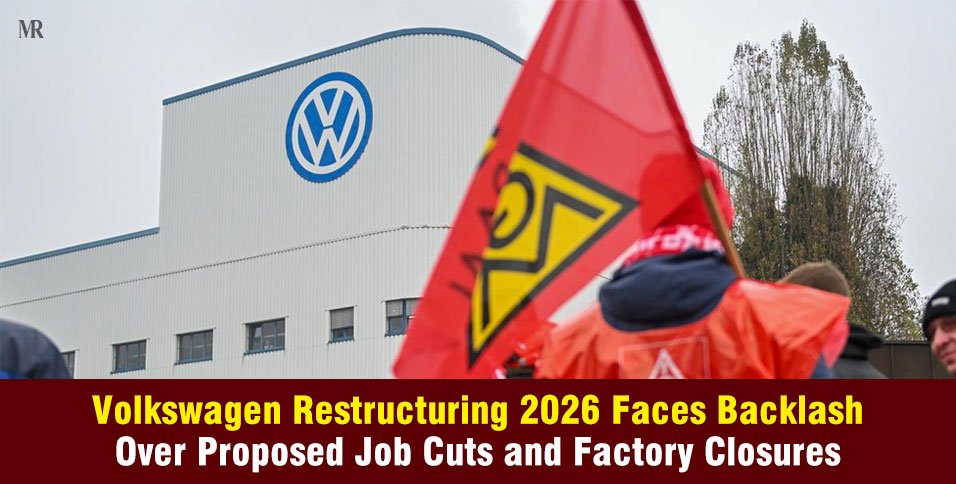
On July 9, the influential German metalworkers’ union, IG Metall, organized synchronized demonstrations at 18 manufacturing facilities across the country. Thousands of shop stewards, works council members, and assembly employees walked off the job to voice their anger. Protesters at various sites blew whistles and held banners reading “United to fight for our future” to send a clear message to executives.
Christiane Benner, the chair of IG Metall, publicly warned that the workforce would not take the blame for recent boardroom missteps.
Union leaders emphasized that passing the financial burden onto factory workers is entirely unacceptable.
At the Zwickau facility, a protester dressed as the Grim Reaper stood at the entrance gates to symbolize the economic devastation that local communities face if production lines stop.
Which Factories Face Closure Under the Volkswagen Restructuring 2026?
The most contentious part of the Volkswagen job cuts involves the potential shutdown or phase-out of four major German manufacturing sites.
According to internal sources, the factories currently under review include:
- Hanover: A prominent site specializing in commercial vehicles and components.
- Emden: A plant heavily involved in passenger car production.
- Zwickau: A specialized facility that underwent an expensive conversion to build electric vehicles.
- Neckarsulm: A high-tech assembly plant operated by the group’s luxury brand, Audi.
Together, these four locations employ roughly 43,000 personnel. Shutting them down completely would trigger massive financial charges and severance payouts.
To minimize direct conflict, CEO Oliver Blume may choose to phase out production gradually over the medium term by refusing to allocate new vehicle models to these lines.
Another alternative under discussion involves selling the underutilized facilities to European defense firms looking to expand their manufacturing footprint.
Power Struggles on the Supervisory Board
Implementing the Volkswagen layoffs initiative is highly complicated due to the unique corporate governance structure of the firm.
Under the historic Volkswagen Act, the company operates under a power-sharing system where labor representatives hold half of the seats on the supervisory board.
The local state government of Lower Saxony owns a 20% voting stake, giving it the power to block major corporate decisions.
Because closing a domestic plant covered by the Volkswagen law requires a two-thirds majority vote, labor unions possess a functional veto over closures at sites like Hanover and Emden.
However, the Zwickau and Neckarsulm facilities do not fall under this protective legislation. Management could theoretically close them without board approval, though doing so would undoubtedly provoke catastrophic, costly national strikes.
Industry analysts noted that the supervisory board meeting concluded without specific agreements on headcount reductions.
Lower Saxony Premier Olaf Lies confirmed that while political leaders acknowledge the critical international environment, they are determined to work with management to find solutions that protect local jobs.
The Road Ahead for Volkswagen
The Volkswagen Restructuring 2026 program represents a historic turning point for the European auto industry.
Management is determined to push through a lean, software-driven corporate model, but they cannot easily bypass the deep-rooted political and union ties that govern German manufacturing.
Over the next few months, executives and labor leaders will enter tense negotiations to compromise on factory capacity and severance packages.
The final outcome of these talks will decide whether Volkswagen can successfully reinvent itself or if it will face prolonged industrial warfare at home.
Maria Isabel Rodrigues