Mirror Review
April 29, 2026
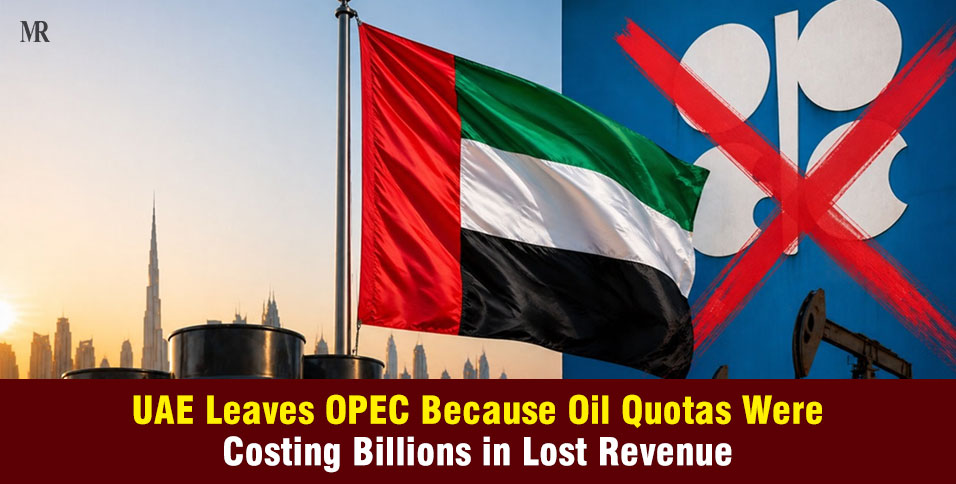
The United Arab Emirates, the second-largest producer in OPEC with one of the highest spare production capacities, has officially announced its departure from the Organization of the Petroleum Exporting Countries (OPEC). This abrupt exit comes after the UAE spent years investing in production capacity that it was not allowed to use under the group’s restrictive quota system. As the UAE leaves OPEC, they aim to regain control over its oil exports and maximize national revenue during a time of significant regional tension.
What is OPEC?
OPEC is an intergovernmental organization of mainly Gulf oil exporters that coordinates petroleum policies among its members to stabilize oil markets. The primary OPEC meaning centers on its ability to control the global price of crude oil by collectively increasing or decreasing production levels.
OPEC+ is an extended alliance that includes OPEC members plus additional major oil producers like Russia. This broader group works together to manage global oil supply more effectively, especially during market disruptions, by coordinating production cuts or increases beyond OPEC alone.
Why is the UAE Leaving OPEC and OPEC+?
The decision for the UAE to leave OPEC and OPEC+ is driven by a mix of economic frustration and long-term strategic goals. While the UAE has been a member since 1967, its current priorities no longer align with the group’s restrictive nature.
- Lost Revenue: The UAE was limited to producing between 3 million and 3.5 million barrels per day. These quotas meant the country was losing billions of dollars in potential income.
- Massive Investment: The country has invested heavily in its energy infrastructure and wants to use its full capacity. Officials plan to target a production level of 5 million barrels per day by 2027.
- Regional Tensions: Ongoing hostilities involving Iran and drone attacks on shipping in the Strait of Hormuz have strained the UAE’s relationship with other OPEC members.
- Unfair Burden: Emirati officials felt they were making disproportionate sacrifices while other countries, such as Iraq and Russia, frequently exceeded their agreed-upon quotas.
Oil Prices and Market Impact of UAE Leaving OPEC
The immediate impact of the UAE leaving opec on oil prices has been relatively muted because the Strait of Hormuz remains largely closed due to conflict. However, the long-term outlook suggests a significant shift in how oil is priced, especially as coordinated actions like recent OPEC+ output increases have influenced global fuel prices.
| Metric | Current Status | UAE Future Target |
| Production Quota | 3 – 3.5 Million bpd | 5 Million bpd |
| Spare Capacity | Second-highest in OPEC | Fully utilized |
| Global Price Impact | Muted due to blockades | Potentially bearish/lower prices |
Rystad Energy analyst Jorge Leon noted that there’s a heavy blow to the cartel as the UAE leaves OPEC. He stated that the UAE exiting OPEC “removes one of the core pillars underpinning OPEC’s ability to manage the market”.
What Happens After the UAE OPEC Exit?
Once the UAE OPEC exit is complete, the country will have the freedom to set its own production levels based on global demand rather than cartel agreements.
- Increased Output: The UAE will likely bring more oil to the market in a measured way.
- New Infrastructure: Abu Dhabi is focusing on new pipelines to the port of Fujairah to bypass the Strait of Hormuz.
- Economic Competition: Saudi Arabia may respond with a price war to maintain market share.
- Diversification: The UAE will use its oil wealth to further fund its tourism and financial services sectors.
Energy Minister Suhail Al Mazrouei clarified the intent behind the timing of the move. He told CNBC that the United Arab Emirates announces exit from OPEC and OPEC+ at a time designed to limit disruption to other producers.
The Fall of OPEC and Shifting Power
The UAE in OPEC was once a symbol of the cartel’s unity. Now, experts suggest the organization is becoming “structurally weaker”.
In the 1970s, OPEC controlled 85% of internationally traded oil, but today that share has dropped to roughly 50%.
As the world looks toward electrification and renewable energy, many nations feel the pressure to sell their reserves quickly.
China’s massive investments in electric vehicles have already reduced global oil demand by roughly 1 million barrels per day.
This trend suggests that the era of oil cartels holding the world to ransom is coming to an end.
Which Country Has Recently Left OPEC?
The UAE follows a pattern of several nations seeking independence from the group.
- Qatar left OPEC in 2019 to focus on its liquefied natural gas production.
- More recently, Angola exited OPEC in early 2024 following disagreements over production quotas.
These departures show a growing trend of nations prioritizing domestic economic growth over the collective goals of the cartel.
End Note
The fact that the United Arab Emirates leaves OPEC marks a turning point in energy history.
By choosing revenue and sovereign control over group quotas, the UAE is preparing for a future where oil demand may eventually plateau.
While the world currently watches oil prices hover around $110 per barrel due to regional conflict, the UAE’s departure creates a path toward a market where prices are dictated by supply and demand rather than political consortiums.
This UAE OPEC news confirms that even the most loyal members are now looking beyond the age of oil.
Maria Isabel Rodrigues