Mirror Review
January 29, 2026
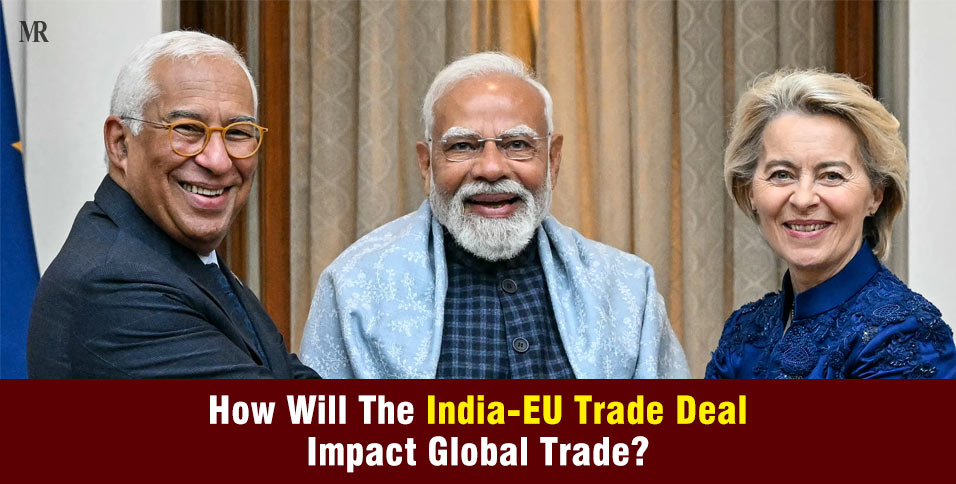
On January 27, 2026, India and the European Union concluded negotiations on a long-pending Free Trade Agreement (FTA), widely described by officials as the“Mother of All Deals”.
This deal is one of the largest rules-based trade partnerships in the world, representing a combined market of about $24 trillion and nearly two billion consumers together.
At its heart, the India-EU FTA aims to give Indian exporters easier access to Europe while opening India’s market gradually to European goods, services, and investments.
What Exactly Is the India EU Trade Deal?
The India-EU Trade Deal is a comprehensive Free Trade Agreement covering goods, services, investment, mobility of professionals, and regulatory cooperation.
At a time when global trade is being “weaponized” through unilateral tariffs and fragmented supply chains, the India-EU FTA serves as a stabilizing force. It moves beyond traditional “buying and selling” to focus on three pillars:
- De-risking Supply Chains: Reducing over-reliance on single manufacturing hubs (China) and volatile partners (US).
- Economic Complementarity: Merging India’s demographic dividend and service prowess with Europe’s high-tech capital and industrial machinery.
- Rules-Based Certainty: Providing a legal shield against sudden policy shifts, ensuring long-term investment safety.
According to India’s Commerce Ministry factsheet, the agreement delivers preferential market access for over 99% of India’s exports by trade value, while allowing safeguards for sensitive domestic sectors
India-EU Trade Deal Details: The “Mother of All Deals”
The scale of the agreement becomes clearer when viewed against existing trade flows:
- India EU merchandise trade stood at about $136.5 billion in 2024–25.
- India exported roughly $75.9 billion worth of goods to the EU.
- Trade in services reached about $83.1 billion.
- Under the deal, India gains preferential access across 97% of EU tariff lines, covering 99.5% of export value.
These figures show that the agreement is not about creating trade from scratch. It is about unlocking untapped potential between two already large trading partners.
- The Breakthrough in Goods: Cars, Wine, and Beyond
One of the most significant hurdles in the two-decade-long negotiation was the high tariff wall India maintained to protect domestic industries. The 2026 deal finally dismantled these through a “phased liberalization” approach:
- Automobiles: In a historic concession, India will slash tariffs on European cars from 110% to 10% over five years. This is limited to an annual quota of 250,000 vehicles, providing immediate relief for top car companies like Volkswagen, BMW, and Mercedes-Benz.
- Wines & Spirits: European wine, previously taxed at 150%, will see duties drop to 20% for premium ranges and 30% for mid-range bottles. Spirits will see a reduction to 40%, significantly lowering the shelf price for European labels in India.
- Industrial Goods: Tariffs on machinery (currently up to 44%), chemicals (22%), and pharmaceuticals (11%) will be almost entirely eliminated.
- Economic Impact: The EU estimates these cuts will save European companies approximately €4 billion ($4.35 billion) in annual duties.
- The Services Revolution: IT and Social Security
While goods are getting cheaper, the real “win” for India lies in the Services and Mobility chapter, which addresses the primary friction point for Indian professionals.
The EU has committed market access across 144 services subsectors, including IT, IT-enabled services, professional services, education, and business consulting. This matters because services are already India’s fastest-growing export segment.
- Social Security Portability: For the first time, the FTA includes a constructive framework to fast-track Social Security Agreements (SSAs) with the remaining 13 EU member states within five years. This prevents Indian IT professionals from “double-paying” social security taxes and allows them to bring their contributions back to India. This is a move expected to save the Indian tech sector billions.
- “Mode 4” Mobility: The deal secures predictable access for Indian professionals across 144 services subsectors. It introduces a streamlined mobility framework for intra-corporate transferees and contractual suppliers, including entry and work rights for spouses and dependents.
- EU Legal Gateway: To simplify the process, a dedicated “EU Legal Gateway Office” will open in New Delhi in April 2026 to act as a one-stop help-desk for Indian talent and employers navigating EU work permits.
- Protecting Farmers, MSMEs, and Strategic Interests
Despite its scale, the agreement is not an open-door arrangement. Both India and the European Union secured protections for their most sensitive sectors, ensuring that liberalisation does not come at the cost of domestic stability.
Key safeguards and protections include:
- Agricultural safeguards for India: Sensitive sectors such as dairy, cereals, poultry, and soymeal remain protected, preventing sudden import surges that could hurt small and marginal farmers.
- Preferential access for Indian farm exports: Products including tea, coffee, spices, grapes, gherkins, marine products, and processed foods gain easier entry into EU markets, improving income prospects for export-oriented farmers.
- MSME-friendly trade rules: Simplified rules of origin and self-certification reduce compliance costs, enabling micro, small, and medium enterprises to participate in cross-border trade instead of being crowded out by large exporters.
- Geographical Indication protection: A parallel agreement safeguards over 400 GIs, ensuring that only authentic products such as Darjeeling Tea and Champagne can be sold under those names, preserving brand value and regional identity.
This balanced approach reflects India’s effort to expand trade while protecting livelihoods and strategic domestic interests.
- Immediate Gains for Indian Exports
Over 90.7% of India’s exports to the EU will move to zero tariff immediately, providing an overnight edge to labor-intensive sectors:
- Textiles & Apparel: Removal of 8–12% duties allows India to compete directly with zero-duty nations like Bangladesh and Vietnam.
- Leather & Footwear: Slashing 17% tariffs opens a $100 billion European market to Indian artisans.
- Gems & Jewellery: Duty-free access is expected to double bilateral trade in this sector within three years.
How the Deal Changes Global Supply Chains
Global trade is shifting away from heavy dependence on single countries. Companies now want diversified and reliable supply chains.
The India-EU Trade Deal directly supports this shift.
- For Europe, India becomes a stronger alternative manufacturing and sourcing hub, especially in textiles, chemicals, engineering goods, pharmaceuticals, and electronics.
- For India, Europe offers stable demand, high-value markets, and integration into advanced value chains.
Tariff elimination of up to 26% on labour-intensive Indian exports like textiles, leather, footwear, gems, jewellery, and marine products improves India’s cost competitiveness overnight.
This makes Indian goods more attractive compared to suppliers from regions facing higher duties or trade restrictions.
Top Voices Reacting to the India EU FTA
Prime Minister Narendra Modi has framed India’s trade strategy as one focused on confidence and self-interest. Speaking earlier about India’s global trade direction, Modi said India is now engaging the world “from a position of strength, not compulsion,” a view that aligns closely with the structure of the India–EU agreement.
From the United States, the response has been more critical. US investor and former Treasury advisor Scott Bessent expressed frustration over Europe’s move, saying he was “very disappointed” with the EU for pushing ahead with a major trade deal with India while broader transatlantic trade negotiations remain unresolved. His comment highlights growing US concern over Europe securing long-term access to fast-growing markets.
European Commission President Ursula von der Leyen described the deal as a cornerstone of Europe’s economic future in Asia, saying the EU is committed to building “reliable, trusted partnerships with countries that share our belief in rules-based trade.” Her remarks underline Europe’s intent to reduce dependency on single-market supply chains and deepen ties with India as a growth partner.
What Global Trade Can Learn From This Agreement
The India-EU Trade Deal sends three important signals to the world.
- First, large economies still believe in rules-based trade, even as protectionism rises elsewhere.
- Second, modern trade deals are no longer just about tariffs. They now cover digital trade, intellectual property, sustainability standards, and regulatory cooperation.
- Third, future trade growth will likely come from partnerships between complementary economies rather than rivals. India offers scale, growth, and talent. The EU offers technology, capital, and high-value markets.
The Bottom Line for Global Trade
The India-EU Trade Deal is more than a bilateral agreement. It is a signal that large economies can still cooperate to shape fairer and more resilient global trade.
By combining market access, services liberalisation, talent mobility, and regulatory cooperation, the deal sets a template for future trade partnerships. If implemented smoothly, it could influence how global trade evolves in an era defined by uncertainty, diversification, and strategic alignment.
In that sense, the India EU FTA does not just impact trade between the two regions. It quietly reshapes the rules of global commerce.
Maria Isabel Rodrigues