Mirror Review
June 12, 2026
Anthropic recently launched Claude Corps, a national fellowship program backed by a $150 million investment to help nonprofits adopt artificial intelligence. The initiative will train 1,000 early-career fellows in the effective use of the Claude AI chatbot and place them full-time inside at least 400 nonprofit organizations across the United States. This year-long, in-person program seeks to equip resource-constrained civic organizations with advanced technical tools while providing practical, high-value AI skills to young professionals entering the workforce.
The launch of Anthropic Claude Corps coincides with the ongoing public conversation regarding the fast economic shifts triggered by generative AI.
While corporations rapidly implement machine learning to boost margins, public service and charitable organizations often lag due to a lack of technical talent and restricted budgets.
By providing dedicated technical personnel directly to these entities, the Anthropic Claude Corps program creates a practical path to modernize community services without draining local operational budgets.
What Exactly is the Claude Corps by Anthropic?
The Claude Corps by Anthropic operates as a partnership between three distinct entities to bridge the digital divide in the social sector.
While Anthropic provides the primary funding, strategic guidance, and technical platform expertise, CodePath acts as the official employer of record.
CodePath, which is the largest provider of collegiate computer science education in the United States, handles the recruitment, mentorship, and ongoing training of the fellows.
Social Finance, a nonprofit investment advisor, oversees the measurement, performance evaluation, and long-term financial modeling to help the program scale globally.
The underlying philosophy of the Claude Corps reflects a distinct corporate structure.
Anthropic operates as a public benefit corporation, a legal framework designed to balance commercial success with broader social impact. And this launch follows the company’s recent confidential filing for an initial public offering (IPO) at a valuation of $965 billion.
Alongside this deployment initiative, the company committed an additional $200 million to study and build economic frameworks for workers displaced by automation.
Fellowship Compensation and Support By Claude Corps
Participants in the Anthropic Claude Corps receive a highly competitive compensation package designed to make public service viable for top-tier talent.
The program lowers financial barriers for applicants while ensuring host organizations receive dedicated, high-quality attention.
- Annual Salary: Each fellow receives a full-time salary of $85,000 plus comprehensive benefits.
- Direct Grant: Host organizations receive a $10,000 grant and free Claude token credits to offset technical adoption costs.
- Ongoing Training: Fellows spend five hours each week in continuing technical education, backed by direct technical office hours with Anthropic engineers.
- Dedicated Mentorship: CodePath provides individual industry mentors to guide fellows through their professional development.
How Nonprofits Plan to Apply the AI Tool
The participating host organizations represent a diverse cross-section of American civic life, ranging from environmental conservation to food security and workforce development.
Rather than treating AI as a replacement for human staff, these organizations use the technology to handle heavy administrative data loads, allowing human workers to focus on direct community engagement.
| Host Organization | Location | Operational Focus & AI Application |
| Montgomery County Food Bank | Conroe, Texas | Streamlining distribution logistics across 100 local pantries to feed children and seniors. |
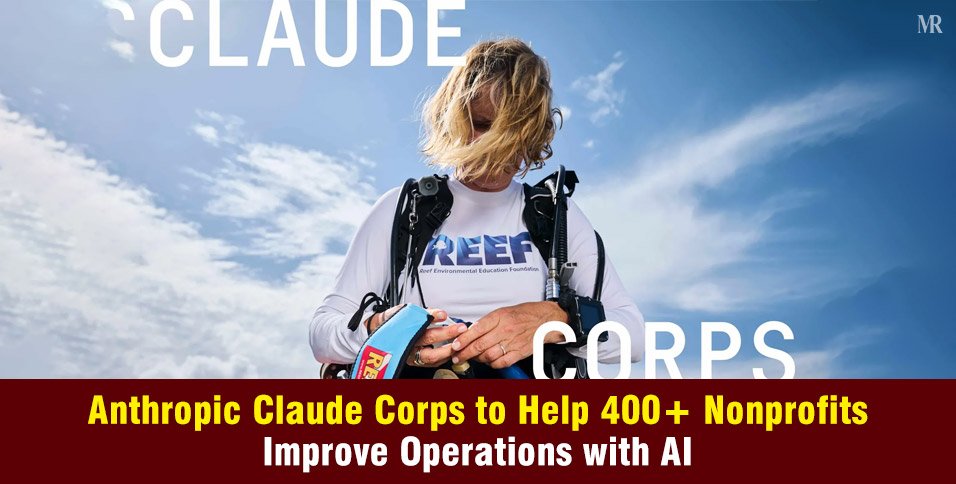
| Reef Environmental Education Foundation | Key Largo, Florida | Organizing marine conservation data and underwater surveys to protect coral reefs. |
| SoundOff | San Antonio, Texas | Managing secure, anonymous access pathways for veterans seeking mental health support. |
| StriveTogether | Cincinnati, Ohio | Standardizing data analysis across 27 states to track youth economic advancement. |
| Braven | Chicago, Illinois | Optimizing career-readiness models for first-generation and lower-income students. |
Jennifer Blatz, CEO and president of StriveTogether, emphasized the collaborative nature of the initiative:
“AI can help us work smarter, but trust building and community collaboration, that’s a deeply human part of the work. And that’s not going away just because we use this tool.”
Claude Corps Timeline and Application Requirements
The Anthropic Claude Corps fellowship explicitly focuses on accessibility to build a diverse pipeline of technical talent.
The application process removes traditional gatekeeping metrics like specific university degrees, focusing instead on practical capability and a desire to serve.
- Eligibility: Applicants must be at least 18 years old, authorized to work in the United States, and have less than two years of full-time work experience.
- Cohort 1: Applications close on July 17, 2026, for the first group of 100 fellows, who will start their roles in October 2026.
- Future Cohorts: Rolling applications are open for the second and third cohorts, which are scheduled to begin in January 2027 and August 2027.
- Relocation: Fellows must be willing to work in-person at their host organization, with relocation assistance provided by the program.
Tech Philanthropy vs. Public Regulation
The launch of the Anthropic Claude Corps is a classic tension in American industrial history between corporate-led philanthropy and public regulatory oversight.
The model mirrors elements of historic public-private initiatives, such as the federal AmeriCorps program or early tech-for-good fellowships. However, critics note that relying on technology firms to fix the disruptions they cause presents unique structural challenges.
Bella DeVaan, director of the Charity Reform Initiative at the Institute of Policy Studies, voiced skepticism regarding self-regulated corporate benevolence:
“The fox can’t guard the henhouse. They can’t be responsible for their own regulation or for their own definition of what their altruistic mandate is. That has to be determined by the public.”
This perspective aligns with growing calls from civil society, labor organizations, and international figures for formal government guardrails rather than voluntary corporate programs.
While Anthropic has participated in policy discussions and cooperated with external figures on regulatory frameworks, the debate continues over whether private capital can adequately address systemic workforce shifts.
Moving Toward a Replicable Model
The long-term goal of the Anthropic Claude Corps extends beyond its initial 12-month timeline. Anthropic plans to open-source the underlying infrastructure and operational framework of the fellowship. By making these tools public, the company hopes to provide a blueprint that other corporations, international governments, and non-governmental organizations can copy to ease tech transitions worldwide.
The success of the initiative will ultimately depend on how effectively these early-career fellows translate raw computing power into real, localized benefits for the communities they serve.
If the framework succeeds, the Anthropic Claude Corps could establish an influential precedent for how the tech sector handles its broader social obligations during times of rapid economic change.