Employee retention used to hinge on compensation. Offer a higher salary, better bonuses, or stronger benefits, and employees would stay. That model no longer holds.
In today’s hybrid workplace, employees expect flexibility as a baseline and increasingly prioritise connection, purpose, and a sense of belonging.
As a result, companies are rethinking how they engage their teams. Instead of relying solely on financial incentives, many are turning to shared experiences to strengthen culture and improve retention.
Even simple, themed activities like St. Patricks day office games can help distributed teams reconnect through meaningful, low-pressure interaction.
Why Employee Retention Has Changed in the Hybrid Era
Compensation Is No Longer the Differentiator
Salary still matters, but it is no longer the deciding factor it once was. Most professionals now expect competitive pay as a given. When every employer offers similar compensation packages, it becomes harder for pay alone to create loyalty.
Instead, employees evaluate how they feel within a company. If the day-to-day experience lacks engagement or connection, higher pay often fails to offset that gap.
Retention, therefore, depends less on what employees earn and more on how they experience their work environment.
Employees Now Prioritise Connection and Meaning
The shift to hybrid and remote work has changed what employees value. Without consistent in-person interaction, people place greater importance on feeling connected to their teams and aligned with company culture.
Employees are more likely to stay when they feel recognised, included, and part of something larger than their individual role. This emotional connection is difficult to build through meetings alone, especially in distributed teams.
The Hidden Cost of Disconnection
Disconnection is one of the most overlooked drivers of turnover. When employees feel isolated, engagement drops. Collaboration weakens, and misunderstandings become more common.
Over time, this leads to a fragmented culture where individuals feel detached from both their colleagues and the organisation. In a hybrid setup, this risk is amplified, making intentional engagement strategies essential.
What Is Experiential Team Building and Why It Works
Definition and Key Characteristics
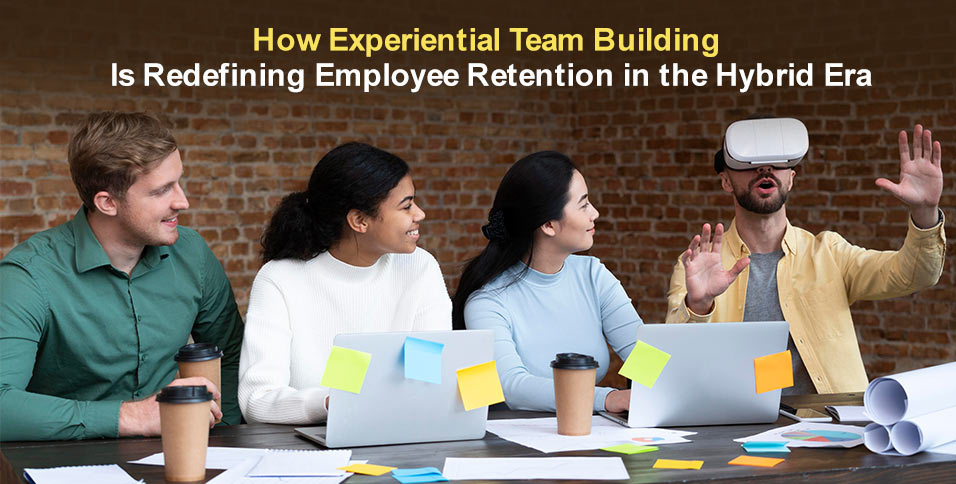
Experiential team building focuses on shared, interactive activities designed to engage employees on a deeper level.
Unlike traditional approaches, which often involve passive participation, experiential activities require collaboration, problem-solving, and real-time interaction.
These experiences are not just events. They are designed moments that encourage employees to connect, contribute, and engage with one another in meaningful ways.
Why Experiences Create Stronger Engagement
Experiences leave a stronger impression than routine interactions. When employees actively participate in a shared activity, they form memories tied to positive эмоtions. This makes the interaction more impactful than a standard meeting or presentation.
Additionally, experiential activities create opportunities for authentic communication. Employees interact more naturally, which helps build trust and familiarity across teams.
Examples That Fit Hybrid Teams
Experiential team building can take many forms, especially in hybrid environments. Virtual escape rooms, themed challenges, and collaborative games are all effective options.
These formats allow employees to engage regardless of location while still creating a sense of shared participation.
The Link Between Shared Experiences and Retention
Building Psychological Safety
Psychological safety plays a critical role in retention. Employees who feel safe speaking up, sharing ideas, and making mistakes are more likely to stay engaged.
Shared experiences help create this environment. When employees collaborate in low-pressure settings, they become more comfortable interacting with one another. This comfort often carries over into daily work, improving communication and teamwork.
Strengthening Relationships Across Teams
In hybrid workplaces, relationships do not form as easily as they do in physical offices. Experiential activities bridge this gap by giving employees a reason to interact outside of task-driven conversations.
These interactions help break down silos and encourage cross-team collaboration. Over time, stronger relationships lead to better teamwork and a more cohesive organisation.
Reinforcing Culture in a Distributed Workplace
Culture is no longer defined by office space. In hybrid environments, it is shaped by shared experiences and consistent interaction.
Experiential team building allows employees to actively participate in company culture rather than simply observe it. This makes culture more tangible and helps reinforce a shared identity, even when teams are physically apart.
Practical Ways to Implement Experiential Team Building
Prioritise Consistency Over One-Off Events
One of the most common mistakes organisations make is treating team building as a one-time activity. While large events can be impactful, consistency is what drives long-term results.
Regular, smaller experiences create ongoing opportunities for connection. This helps maintain engagement and reinforces relationships over time.
Align Activities With Moments That Matter
Timing plays an important role in engagement. Activities tied to seasonal events, company milestones, or team achievements tend to feel more relevant and meaningful.
These moments provide a natural opportunity to bring teams together and celebrate shared experiences.
Design for Inclusivity and Accessibility
Effective team building considers the diverse needs of employees. This includes accommodating different time zones, communication styles, and comfort levels.
Activities should be easy to join and flexible enough to encourage participation without pressure. Inclusivity ensures that more employees feel comfortable engaging.
Measure What Actually Impacts Retention
To understand the effectiveness of experiential team building, organisations need to track the right metrics. Engagement surveys, participation rates, and retention trends can all provide valuable insights.
These data points help leaders refine their approach and focus on what delivers the most impact.
Common Mistakes That Undermine Team Building Efforts
Even well-intentioned efforts can fall short if not executed properly. Treating team building as a checkbox activity often leads to low engagement. Overly complex activities can discourage participation, while infrequent scheduling limits long-term impact.
Another common issue is failing to gather employee feedback. Without input from participants, it becomes difficult to understand what works and what does not. Avoiding these mistakes helps ensure that team building efforts remain effective and relevant.
Conclusion
Employee retention has evolved beyond compensation. In the hybrid era, employees are looking for connection, purpose, and a sense of belonging. Shared experiences play a key role in meeting these expectations.
By investing in experiential team building, organisations can create stronger relationships, reinforce culture, and improve long-term engagement. Retention is no longer just about what companies offer. It is about how employees experience their work every day.