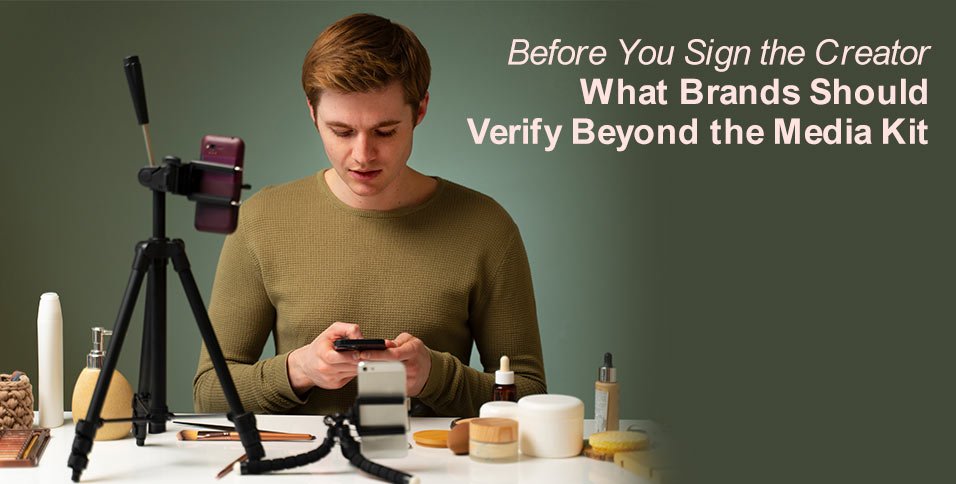
A creator sends over a polished media kit. The audience size looks strong. Engagement appears healthy. The content is on-brand. The rate is within budget.
At that point, many partnerships move straight to negotiation.
That is also where brands can make expensive mistakes.
A media kit is useful, but it is still a curated view of an account. It tells a brand how the creator presents their reach, audience and previous work. It does not automatically answer a more important question: whether the creator makes sense for this particular campaign.
For small collaborations, that gap may not matter much. For larger campaigns, recurring partnerships or ambassador deals, it does.
Creator selection increasingly deserves the same basic discipline companies apply to other commercial decisions: verify the important assumptions before signing.
A Good-Looking Account Can Still Be the Wrong Fit
Most creator evaluations start with visible numbers.
Followers. Likes. Views. Engagement rate. Average reach.
These metrics are easy to compare, which is exactly why teams lean on them so heavily.
But commercial fit is rarely that neat.
A creator can have impressive reach and still attract an audience that is too broad for a niche campaign. Another may produce strong engagement but have little connection to the buyer group a brand actually wants. A smaller creator, meanwhile, may sit at the center of a highly relevant community that never looks spectacular on a spreadsheet.
This is where surface metrics start to lose their authority.
The question is no longer simply whether an account performs well.
The better question is whether the account performs well for the brand’s objective.
A fashion retailer launching in a new city, for example, should care about more than total reach. A B2B software company working with a business creator should not treat a large lifestyle audience as automatically valuable. A fitness brand may prefer a creator followed by trainers, wellness professionals and highly engaged niche accounts over one with a much larger but less focused following.
The same numbers can support very different business outcomes.
The Media Kit Should Start the Conversation, Not End It
Most creator media kits include some form of audience summary.
That information is useful and often enough for an initial shortlist. But a serious partnership usually deserves at least one independent check.
Brands already do this instinctively in other areas.
They read customer reviews before signing with a vendor. They check references before making senior hires. They review traffic sources before buying media.
Creator partnerships should not be treated as an exception simply because they happen on social platforms.
The verification process does not need to become invasive or overly complicated. In many cases, it is enough to look at the public environment around the account.
Who regularly engages with the creator?
Which businesses or creators appear repeatedly?
Does the surrounding community make sense for the category?
Are there signs that the account has built a genuine position inside a specific niche, or does the audience appear disconnected from the content being sold to brands?
None of these observations provides a perfect answer. Together, however, they can expose a mismatch before the contract does.
Audience Fit Is Easier to See When You Stop Looking One Profile at a Time
This is where creator research often becomes inefficient.
A marketing manager opens a few follower profiles, checks several accounts, takes some notes, gets interrupted and comes back later. Another person on the team repeats part of the same process.
The problem is not access to information. Much of what is being reviewed is already public.
The problem is organization.
For campaigns where follower composition matters, teams can use an to move supported public follower information into a list that is easier to review. That list can then be filtered for whatever matters to the campaign rather than forcing researchers to repeatedly move between individual Instagram profiles.
This is not a substitute for platform analytics, nor is it a shortcut to identifying “buyers.”
It is simply a way to make one part of the due diligence process less manual.
That distinction matters because good creator selection is not about collecting the most data. It is about checking the assumptions that could materially affect a campaign.
The Most Useful Signals Are Usually Contextual
Imagine two creators being considered for the same campaign.
Both have roughly 80,000 followers.
Both post consistently.
Both show respectable engagement.
On paper, the choice looks close.
Now the brand looks deeper.
Creator A has a broad audience spread across unrelated interests. Creator B is followed by a noticeable number of smaller creators, specialist accounts and businesses operating in the same category the brand wants to enter.
That does not automatically make Creator B better.
But it gives the marketing team something meaningful to investigate.
Perhaps Creator B has stronger credibility inside the niche. Perhaps their content circulates among people who actually influence buying decisions. Perhaps the audience is smaller but commercially closer to the campaign.
Those are far more useful questions than asking which profile has the larger headline number.
And importantly, they are questions that emerge only when the team moves beyond the creator’s own presentation of the account.
Not Every Campaign Needs the Same Level of Scrutiny
A one-off product seeding campaign does not need the same diligence as a six-month ambassador agreement.
That should sound obvious, but many brands still use roughly the same evaluation process for both.
The amount of research should reflect the commercial stakes.
For a low-cost test, basic content review and engagement checks may be enough.
For a larger partnership, a team may want to compare several creators, examine public follower patterns, look at previous sponsorships and assess whether the surrounding audience appears relevant to the market.
When several creators are being evaluated at once, using another can make side-by-side review easier, particularly when the team wants to organize public follower information under the same criteria instead of relying on screenshots and scattered notes.
Again, the point is not to produce a giant database.
The point is consistency.
If every creator is judged differently, the final choice tends to reflect whoever presented themselves most convincingly rather than whoever best fits the campaign.
Brands Also Need to Know What the Data Cannot Tell Them
This is where discipline matters.
A follower list does not reveal purchasing intent.
It does not prove loyalty.
It does not show whether someone noticed a sponsored post, trusted it or acted on it.
It should not be used to infer private characteristics that are not publicly stated.
Public follower information is most useful as context. It can help a brand notice patterns, ask better questions and identify possible mismatches. It cannot replace campaign strategy or human judgment.
The same applies to every other creator metric.
Engagement rate can be misleading without context. Views can spike because of one viral post. A polished media kit may emphasize the strongest period in an account’s history.
No single measure deserves to become the decision.
Creator Partnerships Are Business Decisions Now
Influencer marketing has matured well beyond the point where brands can justify partnerships with “the account looked popular.”
Creators are increasingly treated as media partners, brand representatives and long-term commercial collaborators.
That raises the standard for selection.
A brand does not need a forensic investigation before every campaign. But when the investment is meaningful, it should know what it is buying beyond a follower number and a collection of screenshots.
The media kit can open the door.
The real decision begins after that.