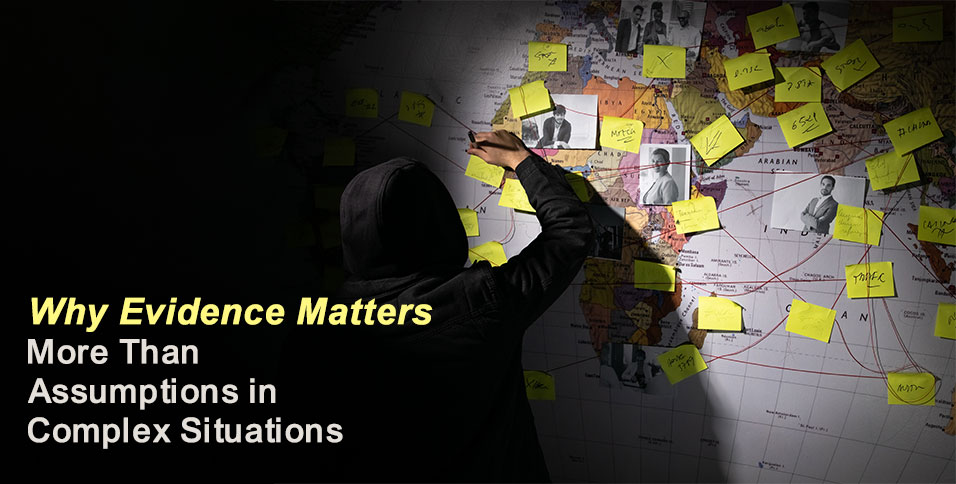
When life is simple, assumptions can feel like a harmless shortcut. You notice a pattern, you fill in the blanks, and you move on. But complexity changes the rules. In high-stakes situations—workplace disputes, family conflicts, fraud concerns, safety issues, or even just “something feels off” moments—assumptions don’t merely risk being wrong. They can steer you toward the wrong problem, the wrong person, and the wrong solution.
Evidence, by contrast, doesn’t guarantee certainty, but it does something far more useful: it constrains your thinking. It forces you to work with what’s true, not what’s plausible. And in complex situations, plausibility is cheap; accuracy is everything.
The Hidden Cost of Assumptions in Complex Situations
Complex situations have two features that make assumptions especially dangerous: too many variables and incomplete information. When the picture is messy, the human brain does what it’s designed to do—reduce complexity into a story. That story often feels coherent because it borrows from past experiences and familiar narratives. The trouble is that coherence is not the same as correctness.
Complexity creates “convincing” stories
Assumptions usually aren’t random; they’re built from signals that look meaningful:
- A colleague is suddenly guarded and you assume misconduct.
- A partner becomes distant and you assume infidelity.
- A vendor misses deadlines and you assume incompetence.
- A customer complains loudly and you assume bad faith.
Each of these could be true. That’s precisely the trap. In complex environments, multiple explanations fit the same set of surface facts. Without evidence, you’re not choosing the most accurate explanation—you’re choosing the most psychologically satisfying one.
Assumptions accelerate conflict and lock in positions
Once you commit to an assumption, your behaviour changes. You ask leading questions. You interpret neutral events as confirmation. You become less willing to hear alternatives because doing so would threaten the story you’ve already invested in.
This is why assumptions don’t just reflect uncertainty; they actively manufacture it. They turn ambiguous situations into adversarial ones—and in doing so, they make resolution harder, slower, and more expensive.
Evidence as a Discipline: Moving From “I Think” to “I Know”
Evidence-based thinking isn’t about becoming cold or sceptical. It’s about building a decision-making process that can survive pressure, emotions, and partial information. The goal is not omniscience; it’s reliability.
Good evidence reduces the problem space
The most practical value of evidence is that it narrows your options. In complex cases, your real enemy is not ignorance—it’s unstructured ignorance. Evidence gives you structure:
- What happened (and when)?
- Who was involved (directly vs indirectly)?
- What is corroborated (and by what)?
- What remains unknown (and why)?
This structure keeps you from spiralling into speculation. It also makes it easier to bring other people into the process without turning it into a blame game.
Not all “evidence” is equally useful
A critical point: evidence isn’t synonymous with “something someone said” or “something I noticed.” Useful evidence has at least one of the following qualities:
- Verifiable (can someone else confirm it independently?)
- Time-stamped (does it reliably tie to a timeline?)
- Corroborated (do multiple sources converge?)
- Contextual (does it include surrounding circumstances, not just a screenshot or fragment?)
If you’re trying to resolve a dispute or assess a risk, this matters. A single dramatic detail can dominate attention while being misleading in context—especially when it’s emotionally charged.
How to Build an Evidence-First Approach (Without Turning Into a Detective)
You don’t need to be an investigator to think like one. You need a method. The point is to replace “What do I suspect?” with “What can I substantiate?”
Step 1: Separate observations from interpretations
Start by writing down two columns:
- Observations: what you directly saw, heard, or documented.
- Interpretations: what you think it means.
This small move often reveals how much of your certainty comes from interpretation rather than fact. It also shows where you need additional information, rather than additional conviction.
Step 2: Test your story against alternatives
Ask yourself: “What else could explain this?” Then force yourself to produce at least two credible alternatives. This isn’t about being indecisive; it’s about preventing premature closure.
A missed meeting could indicate avoidance, yes. It could also indicate a calendar error, anxiety, illness, or a genuine emergency. Evidence is what tells you which explanation survives contact with reality.
Step 3: Use proportionate verification
Evidence gathering should match the stakes. If the consequences are minor, a simple clarification is enough. If the consequences are significant—legal exposure, reputational harm, safeguarding issues, major financial loss—verification should be more rigorous.
In some scenarios, that may mean consulting legal or HR professionals. In others, it may mean seeking specialist support to establish facts properly. For example, when individuals or organisations need discreet, compliant fact-finding, speaking with trusted private investigators in the UK can be a practical way to move from suspicion to substantiated understanding—particularly where documentation, timelines, or potential misconduct are involved. The key is not “who to blame,” but “what is true, and what can we prove?”
Where Assumptions Most Commonly Go Wrong
Certain environments practically invite assumption-making. If you recognise these patterns, treat them as a prompt to slow down and gather better evidence.
High emotion, low visibility
Family disputes, interpersonal conflict, and sensitive workplace issues tend to have limited direct visibility. People fill the gaps with intuition, and intuition tends to follow fear or resentment. Evidence helps you avoid escalating the wrong narrative.
Digital fragments without context
Modern life generates constant “proof-like” artefacts—messages, screenshots, location pings, partial emails. But fragments can mislead. A message can be sarcastic, coerced, or taken out of sequence. A timestamp can be misunderstood. Evidence requires context and corroboration.
Echo chambers and second-hand certainty
When multiple people repeat the same rumour, it starts to feel true. Yet repetition is not verification. In complex situations, the popular explanation is often the easiest, not the most accurate.
Evidence Doesn’t Just Find Truth—It Protects Relationships and Outcomes
There’s a quiet benefit to evidence-first thinking that people underestimate: it reduces unnecessary damage.
When you act on assumptions, you tend to:
- accuse too early,
- overcorrect,
- punish the wrong behaviour,
- or miss the real issue entirely.
Evidence gives you the option to respond proportionately. Even when the truth is uncomfortable, being able to say “here’s what we know, here’s what we don’t, and here’s how we verified it” changes the tone of difficult conversations. It signals fairness. It creates a path to resolution that doesn’t rely on dominance, guesswork, or whoever tells the most compelling story.
Complexity demands humility. The most capable decision-makers aren’t the ones with the strongest hunches; they’re the ones who can hold uncertainty long enough to replace it with facts. In the moments that matter most, evidence isn’t bureaucracy—it’s clarity.