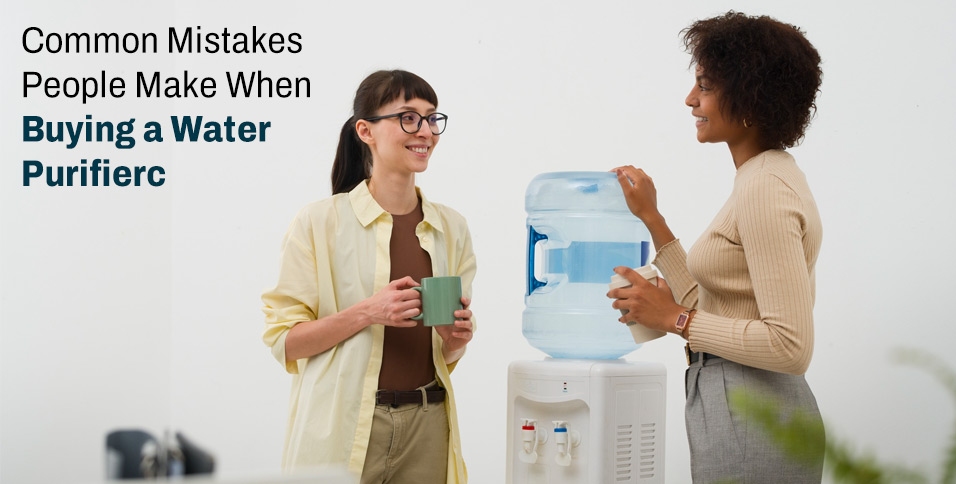
You finally decide to get an RO water purifier. You’ve compared some, read reviews, and selected one that seems strong. It arrives, gets installed, and half a year later, the water tastes a little off, and a technician is knocking at your door, charging for a filter replacement that no one warned you about.
Most people make this purchase once every five to seven years. And they make the same mistakes every single time, not because they are careless, but because no one ever instructed them on what to look for.
Here are the most common ones.
Mistake 1: Not Testing Your Water First
People assume all tap water is roughly the same. It isn’t. Borewell water in a dry region can push TDS levels above 1,200 ppm. Municipal supply in a metro might sit at 100-400 ppm. Tanker water fluctuates unpredictably by season.
According to BIS IS 10500:2012, the acceptable TDS limit for drinking water in India is 500 mg/L, and 2000 mg/L if no alternate source is available.
A basic TDS meter costs under ₹300. Test your water first, and when you are ready to buy best RO water purifier for your home, you will already know exactly which filtration technology your water needs, instead of just guessing.
| TDS Range (ppm) | Water Quality |
| 0-150 | Very low mineral content |
| 150-300 | Good |
| 300-600 | Acceptable |
| 600-1,200 | Poor, high dissolved salts |
| 1,200+ | Unsafe |
Mistake 2: Picking a Technology That Doesn’t Match Your Water
Many individuals purchase an RO water purifier when their water actually does not require it. The same applies in the other way: when someone has 800 ppm borewell water, they will install a UV-only unit, and wonder why it still tastes bad.
- RO eliminates chemical contamination, heavy metals, and dissolved salts.
- UV handles microbial contamination in relatively soft water.
- UF takes care of suspended particles. These aren’t interchangeable.
When you know what is actually in your water, it makes all the difference regarding what RO water purifier, or combination of technologies, is appropriate for your home.
Mistake 3: Ignoring Water Wastage
RO systems reject water during purification. There are older models that consume three or four litres of water per litre of production. In regions of India where there is a seasonal water shortage, this translates into a considerable amount.
Always check the ratio of waste to output before choosing any RO water purifier. Find the ones that can switch to UF mode or UV mode automatically when TDS in the incoming stream already reaches safe levels. Running a full RO cycle on clean water wastes more than is necessary.
Mistake 4: Underestimating After-Sales Costs
The purchase price is only the beginning.
- Pre-filters need replacing every 6-12 months.
- The RO membrane typically lasts two to three years.
- Carbon filters also need attention every 12 months.
If the brand has limited service reach in your city, each of these becomes expensive and slow.
When purchasing any RO water purifier, make sure that there are certified service centres in the area, understand what an annual maintenance agreement involves, and the price of spare parts. Brands that do not have AMC as a mandatory requirement are becoming a better bet for long-term, hassle-free ownership.
Mistake 5: Assuming All RO Water Purifiers Are the Same
They aren’t. Two purifiers at the same price can perform very differently based on:
- Membrane quality
- TDS calibration
- How well the unit retains essential minerals after filtration
Stripping the output water down to 20-30 ppm removes contaminants, but it also removes calcium and magnesium that your body actually needs. The WHO considers less than 300 ppm TDS as excellent, and 300-600 ppm as good.
A well-designed RO water purifier should clean your water without over-purifying it. Some newer models analyse incoming TDS before each cycle and activate only the stages that are actually needed. The Atomberg Intellon – India’s 1st Adaptive Water Purifier, works on this principle.
- Full RO for hard water
- UF + UV when incoming water is already within acceptable limits.
The result is better mineral retention, less water wastage, and longer filter life.
| Feature | Atomberg Intellon |
| Purification Technology | RO + UF + UV + Alkaliser |
| Storage Capacity | 8 Litres |
| Warranty | 2 Years |
| Filtration Mode | Adaptive (TDS-Based) |
| Mineral Enhancement | Yes (Alkaliser + TasteTune™) |
| Purification Stages | 7 Stages (Dynamic) |
| AMC | No mandatory AMC |
| Smart Connectivity | Yes (IoT Enabled) |
Conclusion
Water quality in India varies sharply by city, season, and source. What works in Chennai may fall short in Jaipur. The purifier that handled your old apartment’s municipal supply may struggle entirely with the borewell water in your next one.
Test your water. Understand what it contains. Then match the technology to the problem. That is how you avoid paying for features you don’t need or making a purchase that doesn’t do nearly enough.