Mirror Review
October 28, 2026
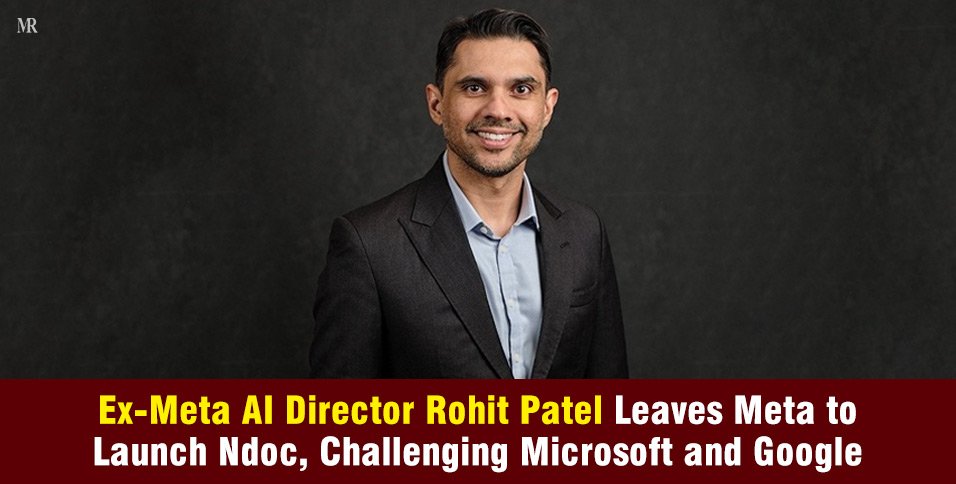
Ex-Meta AI director Rohit Patel has left Meta after eight years to launch Ndoc, an AI-native workspace designed to compete with Microsoft Office and Google Workspace.
The former director at Meta Superintelligence Labs is developing a platform that combines documents, presentations, data analysis, and coding in one place. Unlike traditional office applications with added AI features, Ndoc is designed around artificial intelligence from the beginning.
Patel has launched Ndoc with a three-person team and no external funding. The startup is currently testing its platform with enterprise users, with a wider release planned for 2027.
Who Is Ex-Meta AI Director Rohit Patel?
Rohit Patel is an AI researcher and technology executive who spent eight years at Meta, most recently serving as a director at Meta Superintelligence Labs. During his time at Meta, Patel focused on reinforcement learning and evaluating the reliability of AI-generated results. His work involved assessing how AI systems learn, make decisions, and produce trustworthy outputs.
The Ex-Meta AI director Rohit Patel holds a PhD in Game Theory from Northwestern University and has experience working with senior executives at private equity-owned businesses. He also serves on the Digital Advisory Board of BayPine, where he advises on AI applications across investments and portfolio companies.
The former Meta AI director Rohit Patel is now applying his experience in AI development and evaluation to Ndoc, where users can examine the calculations and code behind AI-generated reports.
Why Did Rohit Patel Leave Meta?
Rohit Patel leaves Meta to pursue his vision of developing an open document format and building an independent AI-powered productivity platform.
Patel explained that introducing an open-source format within a large organization would require discussions and approvals across multiple teams. He wanted to move faster with product development and create a format that other software developers could use.
What Is Rohit Patel’s Ndoc and How Does It Work?
Ndoc is an AI-native workspace that combines document creation, presentations, data analysis, and coding within a single platform.
The Ndoc AI workspace has three main sections: Stage, Narrative, and Model. Stage displays presentations, dashboards, and interactive applications. Narrative contains written analyses, charts, and citations, while Model stores the datasets and Python scripts behind the results.
For example, users can upload sales data and ask Ndoc to identify trends, prepare an analysis, and create a presentation. Users can also inspect the Python scripts behind AI-generated calculations or ask the AI assistant to explain specific formulas.
Explaining Ndoc’s approach to transparency, Patel said,
“There’s nothing hidden behind the curtain here.”
Ndoc also supports contextual memory across users, documents, teams, and organizations. Its .ndoc.html export format allows documents to open in a standard web browser. Patel plans to make the format open-source so other developers can build compatible applications.
How Can Ndoc Help With Everyday Office Work?
Ndoc allows users to complete tasks that typically require several office applications within one workspace.
For example, preparing a monthly business report often involves analyzing figures in Excel, writing explanations in Word, and creating slides in PowerPoint. Ndoc combines these activities, allowing users to work with data, written analysis, and presentations without repeatedly switching between applications.
The platform also includes connectors for importing information from existing workplace tools. Colleagues can access shared work without necessarily creating an Ndoc account.
What Are Rohit Patel’s Plans for Ndoc?
Rohit Patel plans to release a beta version of Ndoc in the coming weeks, followed by a full launch in 2027.
As of October 28, 2026, the Ndoc AI startup is conducting an enterprise pilot and offering limited alpha access through a waitlist. Users can join Ndoc’s waitlist for free, while the platform’s pricing will depend on usage and AI tokens.
Patel has also decided to wait until Ndoc demonstrates customer demand before raising external funding.
Explaining his approach, Patel said,
“I didn’t want to take money until I had some proof that people love the product.”
Ndoc uses a combination of open-source AI models, which Patel says helps reduce operating costs.
How Will Ndoc Compete With Microsoft Office and Google Workspace?
Ndoc aims to compete with Microsoft Office and Google Workspace by offering an AI-native alternative to traditional productivity software. While Microsoft and Google have integrated AI capabilities into their existing applications, Ndoc combines document creation, data analysis, presentations, and supporting code within a single workspace.
For Ex-Meta AI director Rohit Patel, Ndoc’s upcoming beta release will be an important step toward introducing the platform to a wider audience. Its ability to attract users will help determine how effectively it can compete in the established productivity software market.
Gurushanth S Jatti