Mirror Review
July 24, 2026
Intel Q2 2026 results showed the chipmaker’s fastest quarterly revenue growth in more than 15 years, driven by rising demand for AI infrastructure and server processors.
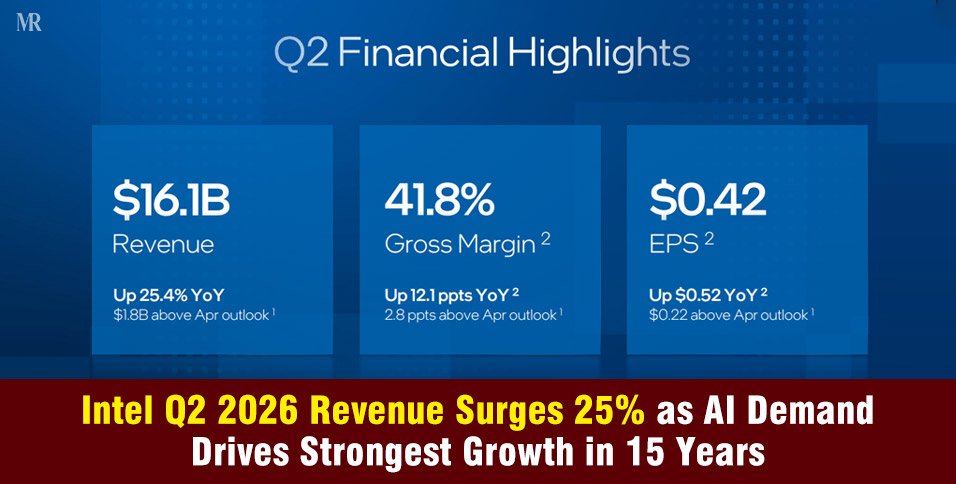
Intel reported $16.1 billion in revenue, up 25% year over year, while adjusted earnings reached $0.42 per share, well above market expectations. Intel also issued stronger-than-expected guidance for the third quarter, reflecting continued demand for AI computing.
According to the official Intel earnings report, improving manufacturing execution, higher factory yields, and growing customer demand helped deliver another quarter of better-than-expected performance, reinforcing Intel’s recovery strategy in the competitive semiconductor market.
Intel earnings reflect growing AI infrastructure demand
The latest Intel quarterly results highlight how artificial intelligence is reshaping the company’s business.
Demand for AI infrastructure, cloud computing, and enterprise servers continued to rise during the quarter, leading to stronger sales across Intel’s product portfolio.
Intel CEO Lip-Bu Tan stated, “AI is driving unprecedented demand for compute, and as we continue to execute, Intel is well-positioned to capture sustainable growth across our CPU franchise, ASICs, advanced packaging and vast wafer foundry network.”
CEO Lip-Bu Tan also described the quarter as Intel’s strongest revenue growth in more than fifteen years, adding that operational improvements, faster decision-making, and closer customer engagement are producing measurable results.
Intel has now exceeded its financial guidance for seven consecutive quarters while continuing its broader transformation strategy.
Intel Q2 earnings 2026: Key financial highlights
According to the official Intel Q2 earnings 2026 release, several financial metrics improved significantly compared with the same quarter in 2025.
| Metric | Q2 2026 | Year-over-Year Change |
| Intel Q2 revenue | $16.1 billion | +25% |
| Non-GAAP EPS | $0.42 | Improved from a loss |
| Gross Margin | 41.8% | Up 12.1 percentage points |
| Cash From Operations | $7.0 billion | Strong operating cash flow |
| Q3 Revenue Guidance | $15.8B to $16.8B | Above analyst expectations |
Intel CFO Dave Zinsner said the company exceeded its own guidance because of robust customer demand, improved factory yields, stronger pricing, and disciplined execution.
He added that AI-related businesses grew by more than 70% year over year and now account for roughly 70% of Intel’s total revenue, demonstrating how AI has become the primary growth driver for the company.
What drove Intel’s business growth in Q2 2026?
Intel’s biggest growth came from its Data Center and AI (DCAI) business, reflecting the industry’s continued investment in AI infrastructure. Revenue from the segment reached $6.3 billion, up 59% year over year, making it Intel’s fastest-growing business. The company said hyperscale cloud providers and enterprise customers increased spending on AI servers powered by Intel Xeon processors.
Intel’s Client Computing and Physical AI Group also remained its largest business, generating $8.9 billion in revenue, a 13% increase from a year earlier.
Meanwhile, Intel Foundry reported $5.8 billion in revenue, up 31%, as higher production volumes and improved manufacturing efficiency boosted results. These gains helped offset ongoing supply constraints across the semiconductor industry.
According to Intel, demand for compute capacity continues to exceed available supply, particularly for AI-focused data center products.
Intel expands AI strategy and manufacturing investments
Beyond strong financial results, Intel used the quarter to strengthen its long-term AI strategy. The company launched Xeon 6+, its first server processor built on the Intel 18A manufacturing process, and expanded collaborations with companies including SambaNova, Foxconn, Google Cloud, and Fortinet.
Intel also reported progress in its foundry roadmap by entering risk production for Intel 18A-P, continuing to improve yields on Intel 18A, and confirming that development of the next-generation Intel 14A process remains on schedule.
To support growing customer demand, Intel raised its 2026 capital expenditure forecast to more than $20 billion, up from its earlier estimate of $18 billion.
Intel also plans to accelerate investments in factory equipment, clean rooms, memory, substrates, and partnerships to expand production capacity over the next two years.
What do Intel’s quarterly results mean for investors?
The latest Intel Q2 2026 earnings suggest the company is gaining momentum after several years of restructuring and heavy investment.
For much of the past decade, Intel struggled with manufacturing delays and increasing competition from rivals in both PCs and data centers. The rapid rise of generative AI has now created a new opportunity, with demand shifting toward high-performance processors, AI servers, advanced packaging, and semiconductor manufacturing.
Intel expects this trend to continue into the second half of 2026. The company forecast third-quarter revenue between $15.8 billion and $16.8 billion and adjusted earnings per share of $0.38, both above analysts’ expectations.
Management also noted that server CPU demand remains stronger than available supply, while long-term customer agreements provide greater visibility into future sales.
Investor confidence has also been influenced by the U.S. government’s stake in Intel, highlighting the company’s strategic role in strengthening the domestic semiconductor supply chain.
Following the announcement, Intel stock gained in after-hours trading as investors welcomed stronger-than-expected Intel Q2 profit, higher revenue, and an optimistic outlook for AI-driven growth.
Maria Isabel Rodrigues