Mirror Review
July 23, 2026
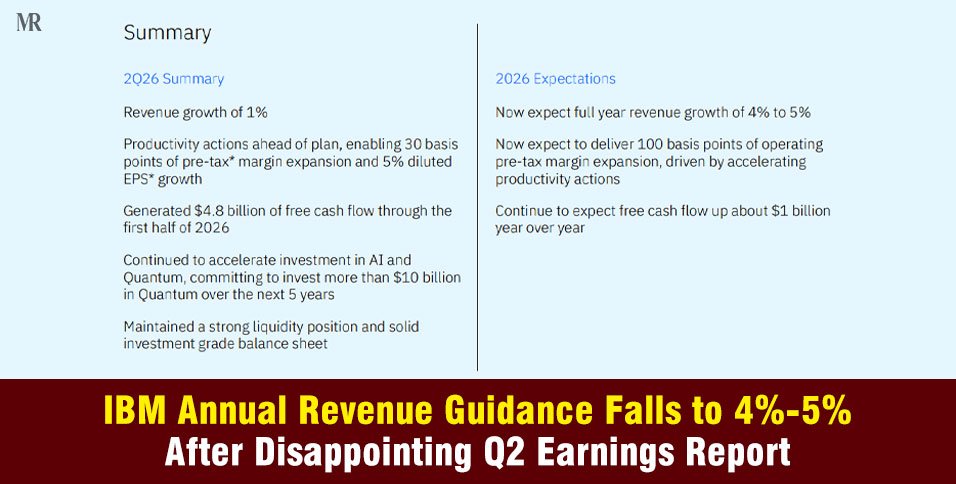
IBM has lowered its annual revenue guidance for 2026 after reporting weaker-than-expected second-quarter results. IBM now expects constant currency revenue growth of 4% to 5%, down from its earlier forecast of more than 5%.
The revised IBM Annual Revenue Guidance follows softer demand for IBM Z mainframes, delayed customer deals, and a shift in enterprise spending toward AI infrastructure.
Despite the lower IBM full year 2026 forecast, IBM maintained its free cash flow outlook and said it remains confident in its long-term AI, software, and quantum computing strategy.
Why did IBM cut its annual revenue guidance?
The biggest reason behind the revised IBM guidance was a disappointing second quarter, especially in its infrastructure business.
According to IBM’s earnings report, second quarter revenue reached $17.2 billion, up just 1% year over year. While software continued to grow, infrastructure revenue declined sharply, pulling down overall performance.
IBM CEO Arvind Krishna explained that the company faced several unexpected challenges during the quarter.
He said customers shifted more of their budgets toward servers, storage, and memory systems to secure AI infrastructure before expected price increases.
At the same time, organizations delayed purchases because of industry-wide cybersecurity concerns. IBM also admitted it failed to close several large deals on schedule.
In a statement, Krishna said: “We now expect constant currency revenue growth in the range of four-to-five percent, and we continue to expect free cash flow to increase by about $1 billion year over year for the full year.”
The updated IBM full year 2026 forecast reflects management’s expectation that these challenges will weigh on revenue growth during the rest of the year.
What happened in IBM’s Q2 earnings report?
The c showed mixed results across its business segments.
| Metric | Q2 2026 |
| Revenue | $17.2 billion |
| Revenue growth | 1% |
| Adjusted EPS | $2.93 |
| Software revenue growth | 5% |
| Consulting revenue growth | Flat (1% constant currency) |
| Infrastructure revenue | Down 7% |
| IBM Z revenue | Down 42% |
| Free cash flow (first half) | $4.8 billion |
The software division remained IBM’s strongest business.
Software revenue increased 5%, supported by Red Hat, which grew 11%. Data software also performed well, rising 19%, while recent acquisitions including HashiCorp and Confluent contributed to growth.
The biggest weakness came from infrastructure.
Revenue from the segment fell 7%, mainly because IBM Z mainframe revenue dropped 42%. Transaction Processing software also declined as fewer enterprise customers completed purchases during the quarter.
Why are customers prioritizing AI infrastructure?
One of the most important takeaways from IBM’s earnings was the change in customer spending behavior.
Instead of investing in traditional enterprise systems, many organizations accelerated purchases of AI infrastructure. Businesses increased spending on servers, storage equipment, and high-performance computing hardware needed to support artificial intelligence workloads.
This shift affected IBM’s mainframe business during the quarter, even though management believes demand has only been delayed rather than permanently lost.
Krishna said the company remains confident that the z17 platform continues to perform well. According to IBM, the latest mainframe generation is running at nearly 130% program-to-program performance compared with the previous launch, while customers representing 85% of installed MIPS have maintained or increased capacity.
IBM also highlighted that its Distributed Infrastructure business achieved its strongest reported growth ever, rising 37%, with an order backlog of nearly $500 million leaving the quarter.
How is IBM responding to the slowdown?
In accordance with the lowered IBM annual revenue guidance, the company says it is taking several steps to improve growth and profitability during the second half of 2026.
According to IBM, the focus remains on expanding higher growth businesses, improving productivity through AI, and strengthening its sales execution.
The company plans to increase sales coverage across thousands of additional enterprise customers while hiring more technical specialists and client-facing engineers to support large AI deployments.
In a letter to investors, CEO Arvind Krishna said IBM believes businesses are still in the early stages of enterprise AI adoption, stating, “We are confident in IBM’s strategy and portfolio, and in our ability to capture growth opportunities ahead. We fundamentally believe that we are in the early innings of a structural shift for business.”
The company also continues to expect free cash flow to increase by about $1 billion this year, even after lowering its revenue outlook. At the same time, IBM now expects stronger operating pre-tax margin expansion, supported by company-wide productivity initiatives.
IBM continues investing in AI and quantum computing
While IBM Q2 2026 disappointed investors, IBM continues to invest heavily in technologies that it believes will drive long-term growth.
In June 2026, IBM also unveiled the world’s smallest sub-1 nanometer chip technology, highlighting its continued investment in next-generation semiconductors for AI and high-performance computing.
One of IBM’s biggest announcements is Lightwell, a new AI-powered platform designed to help organizations identify and fix vulnerabilities in open source software. IBM said the platform combines its AI capabilities with Red Hat’s open source expertise. During its first two weeks of availability, Lightwell generated more than 7,500 open source patches to improve software security.
IBM is also expanding its leadership in quantum computing.
Earlier this year, the company signed a letter of intent with the U.S. Department of Commerce to build Anderon, described as the world’s first pure-play quantum wafer foundry.
IBM plans to invest more than $10 billion in quantum computing over the next five years and remains on track to deliver its first large-scale fault-tolerant quantum computer by 2029.
These investments reflect IBM’s strategy of balancing near-term financial discipline with long-term innovation, even as customers temporarily redirect spending toward AI infrastructure.
What does the revised IBM guidance mean?
The revised IBM guidance suggests that the company expects slower revenue growth in 2026 than previously projected. However, management believes the weakness reflects changing customer spending priorities rather than a decline in long-term demand for its products.
Several parts of IBM’s business continue to perform well:
- Software revenue increased 5%.
- Red Hat revenue grew 11%.
- Distributed Infrastructure revenue jumped 37%.
- Consulting signings continued to grow, supported by enterprise AI projects.
- IBM maintained its expectation of approximately $1 billion in additional free cash flow this year.
At the same time, management acknowledged that improving sales execution and adapting more quickly to changing customer demand will be critical over the coming quarters.
End Note
The revised IBM annual revenue guidance highlights the challenges technology companies face as enterprise customers shift spending toward AI infrastructure.
Although IBM’s second quarter fell short of expectations because of weaker mainframe sales and delayed deal closures, the company continues to see strong demand for its software, AI offerings, consulting services, and quantum computing initiatives.
Looking ahead, investors will closely watch whether IBM can execute on its updated full-year 2026 forecast, improve sales momentum, and translate its long-term AI investments into stronger financial performance during the remainder of the year.
Maria Isabel Rodrigues