Mirror Review
September 4, 2026
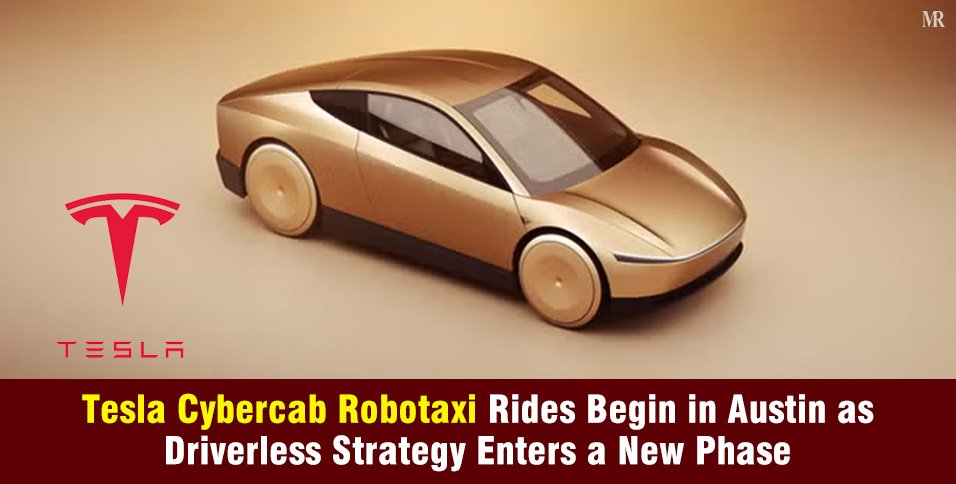
Tesla has begun limited public Tesla Cybercab robotaxi rides in Austin, Texas, putting its purpose-built autonomous vehicle into passenger service. Unlike conventional Tesla models, the two-seat Cybercab has no steering wheel, accelerator pedal, or brake pedal. Riders request trips through Tesla’s Robotaxi app rather than driving the vehicle themselves.
The launch comes as the U.S. National Highway Traffic Safety Administration (NHTSA) evaluates Tesla’s Cybercab rollout. The agency said it is in contact with Tesla, adding a federal regulatory review to the company’s latest step toward expanding driverless transportation.
Tesla Cybercab Austin Launch Puts a Purpose-Built Robotaxi on the Road
The Tesla Cybercab Austin rollout differs from Tesla’s earlier Robotaxi operations because the vehicle was designed specifically for autonomous service.
The Cybercab is a two-seat electric vehicle built without conventional driving controls. Tesla’s Robotaxi system uses an in-car touchscreen for passenger interaction, while the Robotaxi app handles trip requests and ride information.
Key features include:
- Two-passenger interior
- No steering wheel or traditional driving pedals
- Touchscreen-based passenger controls
- Butterfly-style doors
- Autonomous operation through Tesla’s Robotaxi service
- App-based ride requests and trip information
Tesla’s production Cybercab therefore represents more than another vehicle joining the fleet. It is an attempt to design the vehicle around driverless ride-hailing from the beginning.
How Tesla’s Robotaxi Service Has Reached This Point
Tesla’s robotaxi service began before Cybercab entered public operation. The company initially used Model Y vehicles for its Robotaxi network and expanded the service across selected locations.
Tesla’s second-quarter 2026 filing said Cybercab production had started and that the company had conducted engineering test drives of production vehicles on public roads. Tesla also reported employee rides beginning in July and further expansion of unsupervised Robotaxi operations.
The progression can be summarized simply:
| Stage | Development |
| Earlier Robotaxi service | Tesla used Model Y vehicles |
| Cybercab development | Purpose-built autonomous vehicle |
| 2026 production | Cybercab production began |
| Austin rollout | Limited public Cybercab rides began |
| Next challenge | Safety, regulation and wider deployment |
This distinction is important for Tesla’s strategy. The Model Y demonstrates how Tesla can operate a robotaxi service using an existing vehicle, while Cybercab tests whether a vehicle designed specifically for autonomous transportation can support that model at greater scale.
Tesla Full Self-Driving Approach Moves Into a New Vehicle
Tesla has built much of its autonomous-driving strategy around its Full Self-Driving technology and camera-based perception. The Cybercab takes that approach into a vehicle where passengers cannot manually take over because there are no conventional driving controls.
Tesla describes the Cybercab as using camera vision and sensors for autonomous operation. Its Robotaxi service is designed to handle the driving while passengers interact with the vehicle through the touchscreen and app.
That makes the Austin deployment an important operational test for Tesla autonomous driving. A public passenger service has to deal with normal traffic, road conditions, unexpected situations, and the practical demands of transporting people, rather than simply completing controlled demonstrations.
The launch also gives Tesla an opportunity to gather experience with the vehicle and its operating system before attempting a broader expansion.
NHTSA Regulatory Evaluation Adds Another Test
The NHTSA regulatory evaluation is now part of the Cybercab story.
NHTSA said it is evaluating Tesla’s rollout and communicating with the company. The agency has not announced a final determination about the Cybercab’s safety or compliance.
The regulatory question is significant because the Cybercab does not have traditional controls such as a steering wheel and pedals. Wider commercialization of such vehicles can therefore involve federal vehicle-safety requirements as well as state and local rules governing autonomous transportation.
For Tesla, the challenge is not limited to developing the technology. The company also has to operate the service within the regulatory framework governing autonomous vehicles.
Tesla Enters a Growing Robotaxi Competition
The Tesla robotaxi Austin launch places the company alongside established autonomous ride-hailing operators such as Waymo and Zoox.
Tesla’s approach differs from competitors in several technical and operational areas. Its Cybercab is designed without a steering wheel or pedals, while other autonomous vehicle companies have developed their own vehicle and sensor configurations.
The broader market is moving toward purpose-built autonomous vehicles, making the Cybercab rollout relevant beyond Tesla itself. The company now has to show that its vehicle can provide a reliable passenger experience while building a commercially viable service.
For Elon Musk, the deployment also puts a long-running autonomous transportation strategy into a more concrete operating phase.
What the Tesla Cybercab Robotaxi Launch Means
The Tesla Cybercab robotaxi launch in Austin moves Tesla from testing a purpose-built autonomous vehicle toward operating it with public passengers.
The immediate focus will be on how the Cybercab performs in real-world service, how Tesla manages the passenger experience, and how the company responds to regulatory requirements.
The Austin rollout does not by itself establish the scale of Tesla’s future robotaxi network. Instead, it provides an important operating step that can inform the company’s next decisions on production, service expansion, and autonomous transportation.
For now, Tesla has put its steering-wheel-free EV into limited public service. The next phase will show whether Cybercab can move from a highly anticipated vehicle program into a broader robotaxi service.
Gurushanth S Jatti