Mirror Review
July 9, 2026
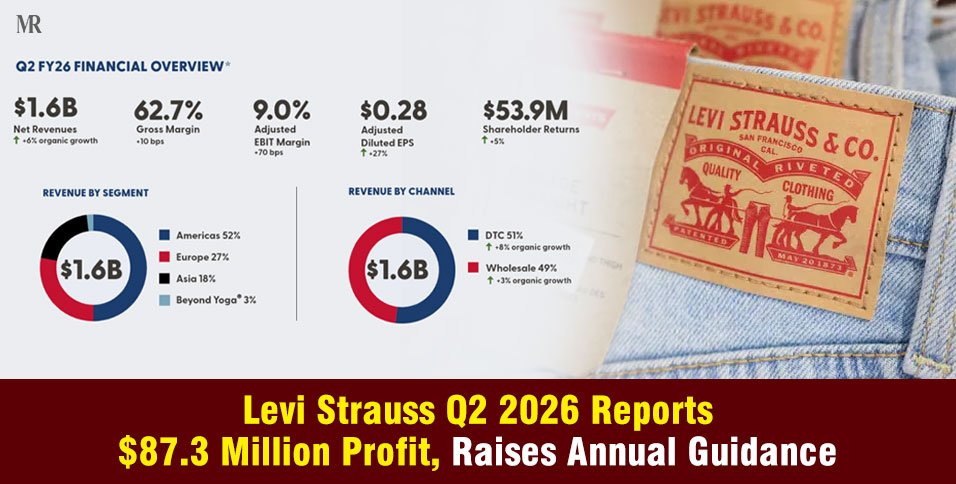
Levi Strauss & Co. delivered strong financial results for the second quarter ended May 31, 2026. Driven by solid global denim demand and a successful shift toward direct-to-consumer sales, the company beat Wall Street expectations on both revenue and earnings. Levi also reported a total net income of $87.3 million for the quarter, up from $67 million during the same period last year.
Following this successful Levi Strauss Q2 2026 earnings, management raised its full-year financial outlook and boosted its quarterly dividend.
Despite these positive figures, shares fell about 5% in extended trading on the day of the announcement. Analysts noted that while the overall results were strong, the midpoint of the updated full-year profit outlook fell slightly short of some aggressive market forecasts.
Global Regional Performance of Levi Strauss
The Levi Strauss Q2 FY26 financial results showed varied growth rates across major geographic segments. The Americas market remained the primary driver of growth, while Asian markets showed double-digit organic expansion.
The table below outlines the net revenues and reported growth across different regions for the three months ended May 31, 2026:
| Region / Brand | Net Revenue (in millions) | Reported Growth | Organic Growth |
| Americas | $815 | 9% | 7% |
| Europe | $420 | 4% | (1)% |
| Asia | $284 | 10% | 12% |
| Beyond Yoga® | $43 | 16% | 16% |
In the United States, net revenues grew 5% on a reported basis.
Growth in Europe slowed to 4% on a reported basis, which management attributed to a distribution center transition in the prior year that altered shipment timings. On an organic basis, European revenue decreased by 1%.
Meanwhile, the Asia-Pacific region demonstrated robust health with a 12% organic revenue increase.
Direct-to-Consumer Growth Shifts the Business Model
Direct-to-consumer (DTC) channels are transforming the operational footprint of Levi Strauss & Co.
In the second quarter, DTC net revenues rose 11% on a reported basis and 8% on an organic basis. This segment now accounts for 51% of total net revenues for the company.
E-commerce sales led the DTC category, growing 19% on a reported basis. This shift toward selling directly to consumers allows the brand to capture higher margins and maintain firmer control over pricing.
Wholesale net revenues also experienced a modest increase, growing 5% on a reported basis and 3% on an organic basis.
Michelle Gass, President and CEO of Levi Strauss & Co., emphasized this strategic transition during the Levi Strauss Q2 2026 earnings call.
“Our evolution into a DTC-first, denim lifestyle company with a much larger addressable market is translating to faster growth and higher profitability,” Gass stated. “While we are pleased with the progress, we are still in the early stages of our long-term growth journey.”
Premium Innovations and Brand Marketing Drive Consumer Interest
To capture higher-income shoppers, Levi Strauss is actively expanding its premium product portfolio. The newly introduced Blue Tab premium line is gaining traction in select stores, allowing the brand to enter the luxury denim market. Levi Strauss has also expanded its offerings beyond traditional jeans into categories like dresses, skirts, tops, and lightweight sweaters. Women’s clothing sales performed exceptionally well during the quarter.
In terms of marketing, the 173-year-old brand utilized creative campaigns to engage younger consumer demographics.
During preparations for the FIFA World Cup, branding at Levi’s Stadium was temporarily covered up. Management quickly turned this moment into a global social media campaign. The covered-up logo campaign generated millions of views and was brought directly into flagship retail stores to enhance cultural relevance.
Revised Full-Year 2026 Guidance
Backed by a profitable first half of the year, corporate leadership raised its financial expectations for the remainder of fiscal 2026.
Chief Financial and Growth Officer Harmit Singh confirmed that the company is passing through its full second-quarter financial beat into its updated guidance.
The company updated its full-year projections as follows:
- Reported Net Revenue Growth: Raised to a range of 7.0% to 7.5%, up from the previous forecast of 5.5% to 6.5%.
- Adjusted Diluted EPS: Raised to a range of $1.46 to $1.52, up from the prior estimate of $1.42 to $1.48.
About half of the projected revenue growth will stem from unit sales volume, while the other half will come from pricing actions.
The financial outlook assumes that macroeconomic pressures do not worsen significantly and that U.S. import tariffs remain steady at 30% for China and 20% for the rest of the world.
To support the supply chain, the company continues to diversify its sourcing away from China, Bangladesh, and Cambodia to mitigate tariff and currency pressures.
Enhanced Returns for Shareholders
The Levi Strauss board of directors declared a quarterly dividend of $0.16 per share. This represents a 14% increase over the previous year and totals approximately $62 million in payouts. The dividend is payable on August 5, 2026, to stockholders of record at the close of business on July 22, 2026.
Additionally, Levi expects to settle its $200 million accelerated share repurchase program in the third quarter of 2026. As of May 31, 2026, the company retains $240 million under its authorized share repurchase program. Harmit Singh noted that the increased dividend reflects deep confidence in cash flow generation and long-term shareholder value.
Macroeconomic Outlook and Consumer Resilience
While the core consumer base shows resilience, Levi Strauss management remains cautious about the broader economic climate.
Rising grocery bills and elevated fuel costs continue to pressure lower-income and middle-income households. Because a significant portion of the core retail customer base falls into these brackets, the company is watching discretionary spending patterns closely.
Other players in the apparel sector reported softer demand for women’s bottoms and dresses recently. However, Levi Strauss & Co. managed to counter this industry trend through brand loyalty, diverse product offerings, and a strong push into the premium denim segment.
End Note
The Levi Strauss Q2 2026 financial results demonstrate that the corporate shift toward a direct-to-consumer model is yielding positive returns. By expanding profit margins, increasing product diversity, and capturing market share in the premium denim segment, the company has navigated a challenging economic environment successfully. The upward revision of full-year guidance and the increase in shareholder dividends signal management’s optimism regarding stable denim demand and operational execution moving forward.
Maria Isabel Rodrigues