Mirror Review
July 7, 2026
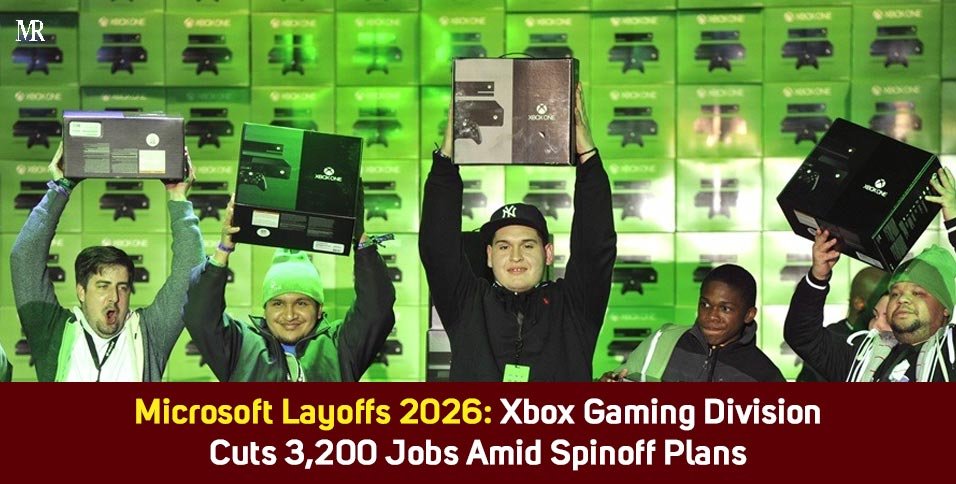
Microsoft is immediately eliminating 4,800 jobs, representing 2.1% of its global workforce, to control costs and adjust to shifting technology trends. As part of this corporate restructuring, the Microsoft Layoffs 2026 hit the Xbox gaming division especially hard, cutting 3,200 roles. This reduction accounts for one-fifth of the total gaming staff. Alongside the workforce reductions, Xbox plans to spin off four prominent independent video game studios to reset its business model.
The Scale of the Microsoft Layoffs 2026
Microsoft is cutting 4,800 total jobs across the company, marking one of the biggest layoffs in 2026.
The Microsoft Xbox layoffs, in particular, account for a massive portion of these cuts, with 3,200 total roles eliminated throughout fiscal year 2027.
Xbox CEO Asha Sharma confirmed that 1,600 employees are leaving immediately. The remaining 1,600 affected workers will phase out over the coming year.
In an official email sent to staff, Sharma noted the difficulty of the timeline:
“I recognize that a year-long restructuring creates additional challenges. Unfortunately, it is not possible to make all the necessary changes in a single day, and I wanted to be direct about the scale.”
Microsoft has faced financial pressure, with its stock price dropping 19% in 2026 due to investor anxieties over generative AI and slower adoption of its core software services.
The company also executed several rounds of layoffs in 2025, including a major action that eliminated 9,000 jobs.
To mitigate additional forced job losses, Microsoft introduced a one-time voluntary retirement program in April for eligible U.S. employees at the senior director level and below, which saw a one-third acceptance rate.
Why are Microsoft Xbox Layoffs Happening?
To understand why the Microsoft Xbox Layoffs 2026 are happening, it helps to examine the aggressive studio expansion that began years ago.
Microsoft spent billions acquiring massive publishers and independent creators to build up its Xbox Game Pass subscription service. This included buying ZeniMax Media for $8.1 billion in 2021 and finalizing a massive deal for Activision Blizzard.
However, the rapid expansion created a high cost structure just as the gaming industry entered a severe hardware crisis. Xbox executives noted that while Game Pass and multi-platform initiatives created value, they did not grow at the expected pace. The core business weakened as the market became crowded with an unprecedented number of monthly game releases competing for limited player attention.
Financially, the studio model proved unsustainable.
The internal gaming division operated at profit margins three to ten times lower than its platform and publishing competitors.
In a typical year, Xbox lost 64 cents for every dollar invested across certain segments, prompting leadership to reset the content portfolio.
Four Xbox Game Studios Transition to Independence
A central piece of the Xbox division restructuring involves spinning out four creative studios that Microsoft acquired over the last decade.
Instead of closing these developers, Xbox is allowing them to transition to new management or return to independent status.
- Double Fine Productions: Acquired in 2019, the studio returns to internal management ownership. Crucially, they will retain their intellectual property (IP), catalog, and financial runway for future games.
- Compulsion Games: The Canadian developer behind We Happy Few will also transition back to an independent studio while retaining its franchises.
- Ninja Theory: The developers of the Senua franchise have entered terms to join new ownership with dedicated funding to complete their active projects.
- Undead Labs: The creators of State of Decay 3 will similarly move to new ownership to continue game development.
Additionally, France-based Arkane Studios is currently reviewing potential options with its local works council.
Publicly announced first-party games are not canceled, and massive platforms like Mojang (Minecraft) and King (Candy Crush) will now report directly to the Xbox CEO to simplify the leadership pipeline.
Following the announcement, Double Fine Productions shared a public statement regarding the transition, stating, “We’re thankful to everyone at Xbox for seven great years together, and for working with us to reach an outcome which preserves our history and culture, and returns ownership of our games to us.”
Streamlining the Xbox Operating Model
Beyond content, the Microsoft sales layoffs and gaming cuts target deep internal operational complexity.
Over the years, the platform teams grew 40% larger even as overall player base and active playtime declined.
This expansion resulted in severe corporate fragmentation, with some parts of the company operating under as many as 14 distinct layers of management.
| Restructuring Area | Old Model | New Reset Model |
| Management Layers | Up to 14 layers of corporate management | Reduced to 5 layers maximum, target of 3 where possible |
| Organizational Focus | Fragmented, independent studio structures | Built around individual makers, player-coaches, and DRIs |
| Vendor Spending | High reliance on external contracts | 50% reduction in external vendor spend |
| Leadership Structure | Dispersed profit and loss accountability | Consolidated under a single Chief Operating Officer |
To fix these inefficiencies, Xbox promoted veteran executive Helen Chiang to the role of Chief Operating Officer. Chiang, who has spent nearly two decades at the company managing Xbox Live and the Minecraft franchise, will hold end-to-end profit and loss responsibility across all hardware, content, and services.
At the same time, long-time platform leader Dave McCarthy is retiring after 17 years with the division.
Industry and Market Reactions
Wall Street analysts have questioned Microsoft’s long-term reliance on consumer gaming businesses when enterprise software and cloud computing demand higher focus.
Following the news, DA Davidson analyst Gil Luria shared insights on CNBC:
“This is not a business Microsoft needs to be in, or should be in. It is very possible that they will spin it off at some point.”
While Microsoft’s commercial business is adjusting to automated tasks driven by artificial intelligence, Chief People Officer Amy Coleman clarified that AI is not directly replacing these laid-off workers. Instead, the cuts reflect a direct correction of over-hiring, shifting market demands, and lower console hardware cycles.
End Note
By reducing 3,200 gaming jobs and spinning off four prominent studios, Xbox is abandoning its previous strategy of aggressive studio accumulation in favor of a lean, sustainable operation.
While the ongoing Microsoft Layoffs 2026 are painful for employees, leadership believes a flatter organization with fewer management layers will help the business return to stable financial growth by 2027.
Maria Isabel Rodrigues