Mirror Review
July 6, 2026
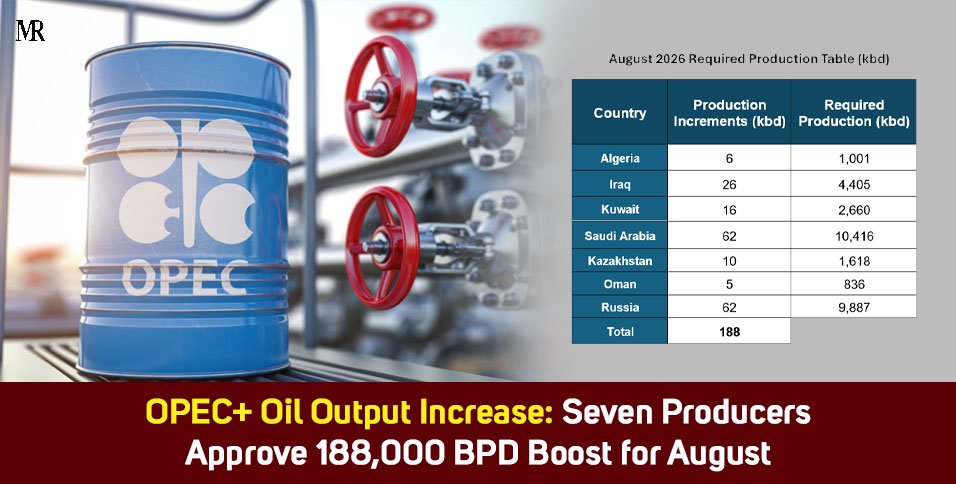
The upcoming OPEC+ oil output increase will bring an extra 188,000 barrels per day (bpd) to the global market this August. Seven major member countries, including Saudi Arabia and Russia, approved this production boost during a virtual meeting on July 5, 2026. This decision marks the fifth consecutive monthly increase by these producers as they gradually reverse voluntary supply cuts implemented in 2023.
Global energy markets are closely watching this development because it coincides with recovering export routes and changing geopolitical conditions in the Middle East, altering the supply landscape for the rest of the year.
Seven Nations Agree to OPEC+ August Production Boost
Seven key producers from the alliance met online to review the latest global energy trends and supply demands. The participating nations include Saudi Arabia, Russia, Iraq, Kuwait, Kazakhstan, Algeria, and Oman. Together, they decided to adjust their current supply baselines by implementing a combined production increase of 188,000 bpd for August 2026.
This move follows similar incremental supply steps taken in June and July.
According to the official statement from the OPEC+, these measures give participating countries a structured path to manage their output while accelerating compensation for any previous overproduction.
The group also reiterated its commitment to full conformity under the shared Declaration of Cooperation, which the Joint Ministerial Monitoring Committee (JMMC) will continue to oversee.
Why the OPEC+ Oil Output Increase Matters Now
To understand the August oil output increase, it helps to examine the events that forced the alliance to restrict supplies in the first place.
Back in April and November 2023, the organization introduced deep voluntary production cuts. Those cuts came in response to global banking instability and commodity sell-offs that threatened to collapse energy prices.
More recently, geopolitical tensions severely disrupted physical supply lines.
The U.S.-Israel war with Iran led to the effective closure of the Strait of Hormuz, a vital maritime chokepoint that handles roughly 20 percent of the world’s oil and liquefied natural gas. Because tanker traffic ground to a halt, regional storage facilities filled up quickly, forcing Gulf producers to drastically cut their actual output.
OPEC figures show that total alliance production plunged to 33.13 million bpd in May 2026, down from 42.77 million bpd in February. The current unwinding of these cuts shows that the alliance believes the market can handle more supply as shipping conditions improve.
Strait of Hormuz Reopens as Peace Talks Progress
The primary driver behind the changing market dynamics is the reopening of regional shipping routes.
Traffic through the Strait of Hormuz has been rising steadily since U.S. President Donald Trump and Iranian President Masoud Pezeshkian signed a memorandum of understanding on June 17, 2026, to end the conflict.
Data from the tracking platform MarineTraffic showed 38 confirmed transits through the strait on July 2. While this is lower than the 48 transits seen the previous day and well below the pre-war average of 130 daily crossings, it represents a substantial recovery from the height of the naval blockade.
As shipping constraints ease, blocked barrels are finally moving to global buyers. Saudi Arabia more than doubled its shipping volumes since the peace agreement compared to the preceding three months combined.
Concurrently, Iran has pushed nearly 50 million barrels of crude into the market since its ports were cleared.
Market Impacts and the Crude Price Response
Despite the announced OPEC oil output increase, international crude prices experienced minor losses.
On Monday morning, following the OPEC+ meeting, Brent crude futures fell 34 cents to $71.78 a barrel, while U.S. West Texas Intermediate (WTI) crude settled at $68.49 a barrel.
Prices have dropped back to pre-war levels, completely erasing the gains from April when Brent briefly topped $126 a barrel.
Analysts point out that the market is adjusting to the reality of a near-term oversupply.
The combination of returning Gulf exports, record-high crude shipments from Russia’s western ports due to domestic refinery disruptions, softer demand from China, and rising U.S. production has kept a lid on price growth.
Market experts view the official quota changes as secondary to the physical return of oil.
Fabien Yip, a market analyst at IG in Sydney, clarified the situation:
“Actual barrels have been constrained for months by the Strait of Hormuz blockade, falling well short of the quota. That constraint is now easing, driving prices down. Add OPEC+’s incremental barrels to that backlog clearing, alongside softer Chinese demand and higher US and Russian exports, and the setup is a near-term oversupply.”
Other analysts suggest the headline numbers may look more impactful than they are in practice.
Tony Sycamore, a market analyst at IG, commented on the broader changes within the alliance, noting that the United Arab Emirates officially left the organization on May 1, 2026.
Sycamore stated, “The number was largely in line with expectation. With UAE leaving and when quotas are probably still not being met due to production still ramping up after the conflict, I’m not sure they mean much at the moment.”
Production Volumes and National Targets
The physical recovery of Gulf oil production is already visible in recent data.
A Reuters survey revealed that OPEC oil output in June rose by 3.3 million bpd month-on-month, climbing to 19.43 million bpd. This marks a significant rebound from the multi-decade lows recorded during the peak of the shipping blockade.
Furthermore, Gulf exports jumped by more than 3 million bpd in June to surpass 10 million bpd, though this total remains about 40 percent below pre-war baselines.
The alliance plans to maintain a highly cautious approach during this recovery phase. The seven participating nations will continue to meet monthly to evaluate changing global demand, compliance, and compensation schedules.
The next formal review session is scheduled for August 2, 2026. Officials emphasized that they retain the flexibility to pause, accelerate, or completely reverse these supply changes if economic conditions shift suddenly.
End Note
The latest OPEC+ oil output increase represents a calculated effort by major producers to normalize global energy supplies after a period of intense geopolitical disruption.
By adding 188,000 bpd back to the market in August, Saudi Arabia, Russia, and their allies are guiding a transition away from emergency supply curbs.
While paper quotas are rising, the true test for global energy prices rests on how quickly the shipping lanes in the Strait of Hormuz recover and whether global demand can absorb the incoming wave of oil.
Maria Isabel Rodrigues