Mirror Review
May 20, 2026
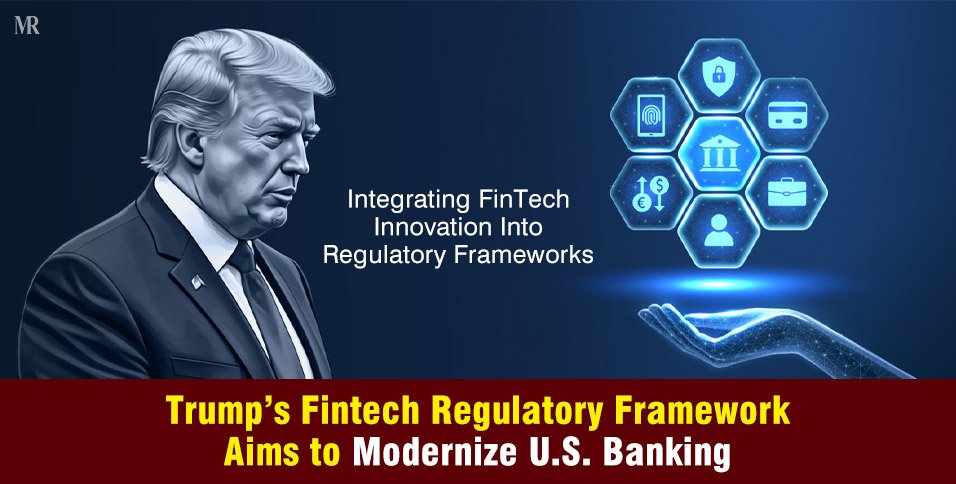
President Donald Trump signed a major executive order to review and overhaul how the federal government regulates financial technology firms.
The new Trump fintech regulatory framework instructs federal agencies and the Federal Reserve to evaluate rules that slow down financial innovation, with a specific focus on expanding how digital asset and payment companies access the central bank’s infrastructure.
This directive aims to clear out outdated banking policies to ensure the United States leads the global digital financial economy. By modernizing these rules, the administration intends to increase market competition and lower costs for consumers.
Historically, traditional banks held exclusive access to the core systems that move money across the country. This executive order directly targets those barriers, initiating a formal review of how fintech firms can integrate into the existing financial architecture.
Directives of the Trump Fintech Executive Order
The Trump fintech executive order sets explicit deadlines for federal financial regulators to review their current supervisory practices and application processes.
The main goal is to identify regulations that unnecessarily block fintech partnerships with traditional banks, credit unions, and broker-dealers.
- 90-Day Agency Review: Heads of federal agencies must audit existing rules within 90 days to find policies that limit competition or burden small and emerging tech firms.
- Action Within 180 Days: Regulators must take concrete steps to encourage innovation based on their findings within six months.
- Streamlining Licenses: The order instructs agencies to simplify the application processes for fintech firms seeking bank charters, federal licenses, or deposit insurance.
The order applies to a broad definition of fintech companies, covering businesses involved in payment processing, blockchain services, digital banking, and investment management.
Federal Reserve Fintech Access and Payment Infrastructure
A critical element of this US fintech regulatory framework involves the Federal Reserve System.
The White House requested the Federal Reserve Board of Governors to evaluate how uninsured depository institutions and non-bank financial companies can gain direct access to Reserve Bank payment accounts and services.
These accounts, often called master accounts, act as bank accounts for banks, allowing direct settlement through the central bank without an intermediary.
The Federal Reserve must submit a comprehensive report within 120 days detailing its legal authority to expand access. The report must cover:
- Legal options to grant direct Federal Reserve fintech access to covered non-bank firms.
- An analysis of current legal impediments that prevent direct access, along with legislative solutions to mitigate risk.
- A clear review of whether the 12 individual Federal Reserve Banks have the independent authority to grant or deny access to these accounts.
If the central bank finds that existing laws allow this access, it must create transparent application procedures and make decisions on complete applications within 90 days.
Contextual Background of the US Fintech Innovation Framework
The Trump fintech policy builds on several actions taken over the past year to reform the nation’s financial technology systems. The administration has consistently pushed to replace legacy frameworks with digital alternatives.
| Date | Executive Action | Primary Focus |
| Early 2025 | Executive Order | Securing the nation’s position in the digital asset economy. |
| March 2025 | Executive Order | Establishing a Strategic Bitcoin Reserve and a U.S. Digital Asset Stockpile. |
| March 2025 | Executive Order | Transitioning federal government operations from paper payments to electronic systems. |
| December 2025 | Presidential Memorandum | Ensuring U.S. dominance and competitiveness in 6G technology development. |
| May 2026 | Executive Order | Setting up the US fintech innovation framework to update banking access. |
These actions show a clear pattern of shifting away from brick-and-mortar financial standards toward electronic and blockchain-based systems.
Impact on Trump Crypto Regulation 2026
The crypto industry stands to gain heavily from the Trump crypto regulation 2026 initiatives. For years, digital asset firms struggled to secure direct access to national payment rails, leaving them reliant on intermediary banks.
This push also aligns with the administration’s broader effort to create clearer oversight standards for digital assets through recent SEC and CFTC guidance updates.
The executive order explicitly addresses this by reviewing account access for companies engaged in digital assets. This focus could directly benefit state-chartered institutions, such as Wyoming special purpose depository institutions (SPDIs), which are designed specifically to bridge crypto assets with traditional banking.
The industry has already seen early movement. The Federal Reserve Bank of Kansas City previously granted Kraken, a Wyoming SPDI, access to a limited master account.
The review also arrives as lawmakers debate stablecoin oversight and payment infrastructure modernization under proposals such as the GENIUS Act.
Additionally, the Federal Reserve proposed a framework last December to create restricted “skinny” master accounts to accommodate non-traditional financial firms. This new executive order pushes the central bank to formalize and accelerate those efforts.
Industry Response and Regulatory Concerns
While fintech and crypto advocates welcomed the policy, traditional banking groups expressed caution. The debate centers on maintaining a level playing field and protecting the broader financial system from systemic risks.
Rebecca Romero Rainey, CEO and president of the Independent Community Bankers of America (ICBA), emphasized the need for consistent rules across all financial providers.
She stated:
“Federal Reserve officials conducting their review of access to Reserve Bank payment accounts must recognize that the Reserve Banks retain discretion under federal law to deny or grant master account access to special-purpose depository institutions, stablecoin issuers and other crypto-related entities.”
The ICBA argued that policymakers should pause new guidelines regarding stablecoins, national trust charters, and master accounts until they thoroughly evaluate the combined economic impact on local communities.
Parallel Security Measures
The administration paired its fintech integration into banking initiatives with strict enforcement updates. On the same day Trump signed the fintech order, he issued a separate directive focused on financial security and identity verification.
This second order commands the Treasury Department and financial regulators to update the Bank Secrecy Act. The update aims to prevent undocumented immigrants from accessing bank accounts or payment networks. It specifically directs officials to monitor peer-to-peer platforms, unregistered money services businesses, and third-party processors to stop off-the-books wage transactions that evade tax obligations or federal reporting thresholds.
End Note
The Trump fintech regulatory framework represents a decisive effort to rewrite the rules of American banking for the digital age. By forcing federal regulators and the Federal Reserve to dismantle outdated protections that favor incumbent banks, the policy clears a path for wider fintech integration into banking infrastructure.
While traditional banking groups urge caution regarding safety and risk, the administration’s aggressive timelines ensure that the coming months will see a fundamental restructuring of how digital assets and fintech firms interact with the U.S. financial system.
Maria Isabel Rodrigues