Mirror Review
May 20, 2026
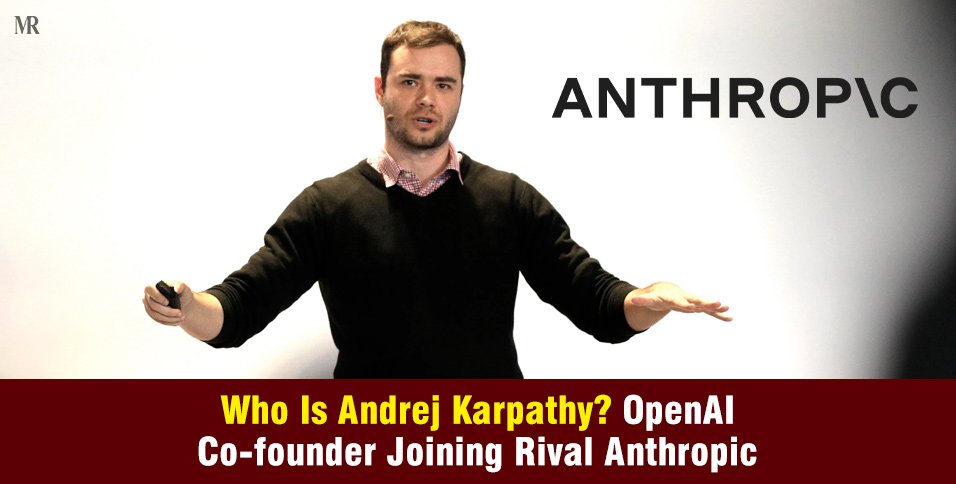
Andrej Karpathy joins Anthropic to work on the artificial intelligence startup’s pretraining research team. The OpenAI co-founder and former Tesla AI executive announced his new role on X, stating his excitement to return to research and development during a formative time for large language models. Karpathy previously helped launch OpenAI in 2015, directed the Autopilot computer vision team at Tesla, and founded the AI education platform Eureka Labs. His move to Anthropic strengthens the AI lab as it competes for elite technical talent to build next-generation frontier models.
Early Life and Education of Andrej Karpathy
Andrej Karpathy was born on October 23, 1986, in Bratislava, Czechoslovakia, which is now part of Slovakia. He spent his childhood there until his family immigrated to Toronto, Canada, when he was 15 years old.
He built his foundational knowledge in computer science and physics at the University of Toronto, graduating with a Bachelor of Science degree in 2009.
During his undergraduate years, he served as the treasurer for the Computer Science Student Union. He also attended classes and reading groups led by deep learning pioneer Geoff Hinton, which sparked his early interest in neural networks.
- Advanced Academic Studies
Karpathy continued his studies at the University of British Columbia, where he earned a Master of Science in Computer Science in 2011.
Working under adviser Michiel van de Panne, his research focused on learning controllers for physically simulated figures. This work applied machine learning to agile robotics within physical simulations, modeling movements for simulated runners or people in crowds.
In the fall of 2011, Karpathy entered Stanford University to pursue his doctorate. He received a PhD in Computer Science in 2015 under the primary supervision of Fei-Fei Li at the Stanford Vision Lab.
Andrew’s doctoral thesis focused on the design of convolutional and recurrent neural network architectures. He specifically researched deep learning models operating at the intersection of natural language processing and computer vision, developing systems capable of translating images into natural language descriptions, known as image captioning.
Andrej Karpathy Early Career and Elite Internships
During his five years as a doctoral student at Stanford, Andrej Karpathy completed three separate research internships at major tech labs, which allowed him to apply his academic insights to real-world datasets.
- Google Brain (Summer 2011): He spent five months as a research intern working on large-scale unsupervised deep learning and computer vision for videos.
- Google Research (Summer 2013): He returned to Google for four months to focus on large-scale supervised deep learning and computer vision architectures specifically for YouTube videos.
- Google DeepMind (Summer 2015): He spent four months in London working on the deep reinforcement learning team alongside Koray Kavukcuoglu and Vlad Mnih, focusing on model-based reinforcement learning systems.
Andrej Karpathy’s Academic Contributions at Stanford
While completing his PhD, Karpathy collaborated with Fei-Fei Li to design a new university course, CS 231n: Convolutional Neural Networks for Visual Recognition. He served as theprimary instructor for this class, which was the first dedicated deep learning course offered at Stanford University.
The course quickly became one of the most popular classes on campus, experiencing rapid enrollment growth over three consecutive years.
| Academic Year | Number of Enrolled Students |
| 2015 | 150 students |
| 2016 | 330 students |
| 2017 | 750 students |
Karpathy also created and maintained a personal side project called arxiv-sanity.com. The portal allowed researchers to search, filter, and sort through nearly 100,000 machine learning papers published on the Arxiv repository over a six-year period.
For fun, he built several deep learning libraries directly in JavaScript, including ConvNetJS, RecurrentJS, REINFORCEjs, and t-sneJS, because of his interest in web development. His rigorous evaluation work on image databases led to him being jokingly referred to as the reference human for ImageNet.
Founding OpenAI
In late 2015, Karpathy became a founding member of OpenAI, a newly established artificial intelligence research group in San Francisco.
Working as a research scientist from January 2016 to June 2017, he helped with much of the early structuring and recruiting for the lab.
His research focused on generative models, contributing to projects like PixelCNN++ for image generation, and deep reinforcement learning, where he trained neural networks to control keyboards and mice to fill out web forms.
Leading Autopilot Vision at Tesla
Elon Musk recruited Karpathy away from OpenAI in June 2017. Musk, who was a board member at both organizations at the time, described Karpathy in an email exchange as arguably the #2 person in the world in computer vision, right behind OpenAI chief scientist Ilya Sutskever.
Karpathy assumed the role of Senior Director of Artificial Intelligence and Autopilot Vision at Tesla, reporting directly to Musk. He led the computer vision and deep learning teams responsible for the neural networks that power Tesla Autopilot and briefly contributed to the Tesla Optimus humanoid robot project. His engineering team managed four core technical components for the vehicle fleet:
- Data Infrastructure: Handling all in-house data labeling and designing custom labeling interfaces.
- Neural Network Training: Developing models for semantic segmentation, object detection, and 3D depth estimation.
- Chip Deployment: Optimizing neural networks to run efficiently in production on Tesla’s custom in-house inference chip.
- Scale Engineering: Deploying software updates across a rapidly growing fleet of millions of cars to transition Autopilot into a scalable Full Self-Driving system.
His work at Tesla earned him a spot on the MIT Technology Review’s Innovators Under 35 list for 2020. After taking a multi-month sabbatical, Karpathy officially left Tesla in July 2022.
Andrej Karpathy’s Return to OpenAI
After his departure from Tesla, Karpathy returned to OpenAI in February 2023. During his second stint at the lab, he built and led a new technical team focused on mid-training optimization and synthetic data generation. He remained at OpenAI for exactly one year, leaving the company again in February 2024.
Following his second departure, Karpathy shifted his professional focus toward independent AI education. He expanded his Badmephisto YouTube channel, which he originally created in 2006 to host Rubik’s Cube tutorials that achieved over 9 million views, into a platform for technical machine learning lectures. He also produced the “Zero to Hero” video playlist, a comprehensive guide demonstrating how to build artificial neural networks from scratch.
Building Eureka Labs
On July 16, 2024, Karpathy officially launched Eureka Labs, an AI-integrated education platform. The startup aimed to build a new style of school that uses generative models to scale high-quality teaching. The company’s introductory product was an AI course titled LLM101n, designed to help students build their own storytellers.
The platform also pioneered the concept of generative AI teaching assistants to guide students through technical curricula. While the approach drew some public criticism regarding student data privacy and the potential loss of personal student-teacher relationships, it cemented Karpathy’s status as a top educator. Time Magazine named him one of the 100 Most Influential People in AI for 2024.
When Did Andrej Karpathy Coin The Term Vibe Coding?
Beyond his institutional work, Andrej Karpathy has frequently driven broader cultural and technical trends within the software industry through his social media commentary. He is widely recognized as the inventor of vibe coding, a term he coined in February 2025 to describe a shifting paradigm in software development.
“Vibe coding describes a process where engineering hobbyists and professionals construct fully functional applications and web platforms solely by typing natural language prompts, leaving the underlying source code generation entirely to an AI model.” – Andrej Karpathy
The concept quickly spread beyond technical circles into the mainstream business world, prompting organizations to build custom agents and altering public valuations of traditional software-as-a-service providers.
Collins Dictionary subsequently named the phrase its Word of the Year. Interestingly, the specific model Karpathy used in his original viral demonstration post was developed by Anthropic.
What Is The Karpathy Loop Method?
In March 2025, Karpathy published another viral technical experiment where he connected an AI coding agent to a small language model and allowed it to run unsupervised for 48 hours.
The autonomous agent ran 700 independent experiments, tweaking and optimizing its own training code to uncover 20 distinct self-found code optimizations.
When Karpathy applied those exact same code tweaks to a much larger model, it cut overall training time by 11%. He labeled this automated optimization process “autoresearch,” which the broader artificial intelligence community quickly adopted under the technical name “the Karpathy Loop”.
Why Andrej Karpathy Is Joining Anthropic?
The decision by Andrej Karpathy to join Anthropic on May 19, 2026, marks a major transition in the competitive rivalry between frontier AI labs.
Anthropic confirmed that Karpathy joined the company’s core pretraining team, which is managed by Nick Joseph, the head of pretraining.
At Anthropic, Karpathy is tasked with launching and building out a specialized research team dedicated to using Claude itself to automate and accelerate pretraining research.
Instead of relying strictly on acquiring more hardware and expanding raw compute capacity, his team will focus on algorithmic optimizations, applying the concepts established by the Karpathy Loop to maximize training efficiency.
1. The Industry Talent War
Karpathy’s hiring comes amid a significant shift in corporate valuations and talent distribution across Silicon Valley.
Anthropic recently agreed to a $30 billion funding round, driving its private market valuation toward a reported $900 billion, which places it ahead of OpenAI’s $852 billion valuation recorded in March 2026.
Karpathy is the latest in a series of high-profile departures from OpenAI to Anthropic. Other notable transitions include:
- John Schulman: The OpenAI co-founder left the ChatGPT maker to join Anthropic in 2024.
- Ross Nordeen: The xAI founding member and former Tesla colleague joined Anthropic earlier in May 2026.
- Chris Rohlf: The 20-year cybersecurity veteran from Meta joined Anthropic’s frontier red team concurrently with Karpathy to stress-test frontier models against severe threats.
These personnel shifts have occurred alongside high-profile departures from OpenAI’s executive ranks, including former chief scientist Ilya Sutskever and tech chief Mira Murati.
2. Broad Corporate Challenges
The Andrej Karpathy Anthropic news adds technical momentum to Anthropic during a complex regulatory period.
The hiring occurred the same week Anthropic appeared in a Washington federal appeals court to challenge a U.S. Department of Defense supply-chain risk designation.
The designation was issued after Anthropic refused to alter its core safety guidelines regarding mass surveillance and autonomous weaponry, which temporarily excluded the lab from a Pentagon cloud intelligence integration deal signed by Google, Microsoft, Amazon, and OpenAI.
End Note
The appointment of Andrej Karpathy to Anthropic’s pretraining division highlights the intense competition for the elite engineering talent required to advance frontier artificial intelligence models.
As the OpenAI co-founder and former Tesla AI executive shifts his focus from independent education at Eureka Labs back to large-scale research and development, his team’s focus on automated pretraining could fundamentally alter how frontier models acquire core capabilities.
While Karpathy remains passionate about his educational initiatives and intends to return to them in the future, his immediate engineering contributions will center on pushing the technical limits of Claude.
Maria Isabel Rodrigues