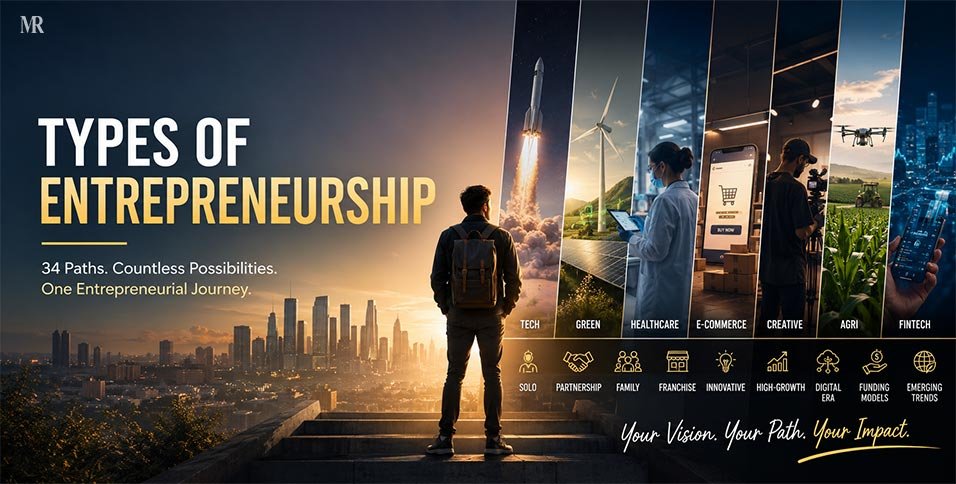
Not all entrepreneurs are the same — and neither are their businesses. Some build apps that scale to millions. Others run tight local operations that serve their neighborhood. A few are changing the world through clean energy or biotech.
Understanding the different types of entrepreneurship helps you figure out where you fit, how to grow, and what path to take.
Whether you’re just starting or exploring a new path, this guide breaks down all 34 types of entrepreneurship that matter in 2026, along with clear definitions, real examples, and what makes each one unique.
List of 34 Types of Entrepreneurship at a Glance
Here’s a snapshot of all the types of entrepreneurship covered in this guide, organized by category:
| Category | Types of Entrepreneurship |
| By Business Purpose | Small Business, Scalable Startup, Social, Corporate, Lifestyle |
| By Industry/Sector | Tech, Green, Healthcare, E-commerce, Creative, Agri, Fintech |
| By Ownership | Solo, Partnership, Family, Franchise |
| By Innovation Level | Innovative, Imitative, Research-Based |
| By Growth Strategy | High-Growth, Survival, Acquisition |
| Digital-Era Types | Creator, AI, No-Code, Community, Platform |
| By Funding Model | Bootstrapped, Venture-Backed, Crowdfunded |
| Emerging Trends 2026 | Climate, Space, Web3, Bio-Entrepreneurship |
Types of Entrepreneurship by Business Purpose
- What is Business Purpose Entrepreneurship?
This category classifies ventures based on their core mission, underlying goals, and intended destination. Instead of looking at what the business sells, it looks at why the business was built—whether that is to serve a local community, achieve hyper-growth, generate a flexible income, or solve a pressing global issue.
1. Small Business Entrepreneurship
Small business entrepreneurship involves starting and running independent companies with the primary goal of earning a stable income and supporting a local economy. These ventures are self-sustaining, rely on traditional revenue models, and are not built with the intention of scaling into massive global corporations or pursuing a public stock listing.
Examples: Local restaurants, salons, retail shops, and independent agencies.
Key trait: Focused on profitability and community, not hyper-growth. According to the U.S. Small Business Administration, small businesses make up 99.9% of all U.S. businesses and employ nearly 46% of the private workforce.
2. Scalable Startup Entrepreneurship
Scalable startup entrepreneurship focuses on building businesses designed to grow rapidly and generate exponential revenue, typically powered by technology, software, or unique intellectual property. These entrepreneurs enter massive markets, lean heavily on external equity funding, and build operational models where revenue can skyrocket while expenses stay relatively flat.
Examples: SaaS platforms, AI companies (Anthropic), fintech apps.
Key trait: Built for speed. Think OpenAI, Stripe, or Notion in their early days.
3. Social Entrepreneurship
Social entrepreneurship is the practice of launching ventures that explicitly aim to solve systemic social, cultural, or environmental problems while remaining financially self-sufficient. Here, profit is a tool, not the mission.
Examples: Clean energy startups like Sunfire, affordable healthcare platforms like Zipline.
Key trait: Impact-first. B Corp certification is common among social enterprises.
4. Corporate Entrepreneurship (Intrapreneurship)
Corporate entrepreneurship occurs when established corporations foster startup-like innovation from within their existing organizational structures. Employees use the company’s vast capital, distribution networks, and brand authority to research, develop, and launch entirely new products or spin-off entities.
Examples: Google’s X lab, Amazon’s internal startup teams, 3M’s innovation programs.
Key trait: Resources of a big company, mindset of a startup.
5. Lifestyle Entrepreneurship
Lifestyle entrepreneurship involves creating a business that is intentionally structured to fund, support, and complement a specific personal lifestyle and freedom goals. Growth and hiring are often capped on purpose to ensure the founder maintains full control over their schedule, location, and daily workload.
Examples: Travel bloggers, freelance consultants, solopreneurs, online coaches.
Key trait: Work-life integration over rapid growth.
Types of Entrepreneurship by Industry or Sector
- What is Industry-Based Entrepreneurship?
Industry-based entrepreneurship is defined by the sector or market an entrepreneur chooses to operate in. As technology, sustainability, healthcare, and digital commerce continue evolving, sector-focused entrepreneurship has become one of the biggest drivers of innovation in 2026.
Here are the most important industry-based entrepreneurship types shaping the modern economy today:
6. Tech Entrepreneurship
Tech entrepreneurship focuses on building businesses powered by software, artificial intelligence, cloud computing, cybersecurity, robotics, or digital infrastructure. These companies are usually designed to scale quickly and solve large problems through technology.
Examples: AI startups, SaaS platforms, cybersecurity firms, robotics companies.
Key trait: High scalability and rapid innovation. Tech entrepreneurship continues to dominate global startup funding in 2026, especially in generative AI and automation.
7. Green / Sustainable Entrepreneurship
Green entrepreneurship centers around sustainability, climate solutions, renewable energy, ESG innovation, and the circular economy. These entrepreneurs aim to build profitable businesses while reducing environmental impact.
Examples: Carbon capture startups, EV charging infrastructure companies, sustainable packaging brands.
Key trait: Mission-driven innovation focused on long-term environmental impact. Climate tech investment has surged globally as governments and corporations push toward net-zero goals.
8. Healthcare Entrepreneurship
Healthcare entrepreneurs build businesses in biotechnology, digital health, telemedicine, diagnostics, medical devices, and health AI. The rise of AI-powered healthcare and remote care has made this one of the fastest-growing sectors in recent years.
Examples: Remote patient monitoring platforms, AI diagnostics startups, biotech companies.
Key trait: Strong growth potential combined with high regulatory and research requirements.
9. E-commerce Entrepreneurship
E-commerce entrepreneurship involves selling products or services online through digital storefronts, marketplaces, or direct-to-consumer (DTC) brands. Social commerce and creator-led brands have significantly expanded this category in 2026.
Examples: Shopify-based DTC brands, niche online stores, dropshipping businesses.
Key trait: Low barriers to entry and global reach. Modern e-commerce brands rely heavily on content, influencers, and community-building.
10. Creative Entrepreneurship
Creative entrepreneurs monetize artistic or creative skills through businesses built around content, design, entertainment, music, media, or digital experiences. The creator economy has transformed creative work into scalable business models.
Examples: Independent production studios, content creators, designers, music brands, digital artists.
Key trait: Personal brand and audience are often the biggest assets.
11. Agri-Entrepreneurship
Agri-entrepreneurship focuses on agriculture, food innovation, agritech, and smart farming solutions. Technology is modernizing agriculture through automation, AI, drones, and sustainable farming methods.
Examples: Precision agriculture startups, vertical farming companies, food-tech ventures.
Key trait: Combines traditional agriculture with modern technology to improve efficiency and sustainability.
12. Fintech Entrepreneurship
Fintech entrepreneurship disrupts traditional financial services through digital payments, blockchain, lending platforms, neobanks, crypto infrastructure, and financial software.
Examples: Digital wallets, buy-now-pay-later platforms, crypto exchanges, neobanks.
Key trait: Fast-moving innovation in a highly regulated industry. Fintech remains one of the most competitive startup sectors globally in 2026.
Types of Entrepreneurship by Ownership Structure
- What is Ownership Structure Entrepreneurship?
This category defines businesses by how control, legal liability, and equity are distributed among the founders or operators. The structure dictating who owns the entity changes everything from daily decision-making speed and conflict resolution to funding options and legal obligations.
13. Solo Entrepreneurship
Solo entrepreneurship, or solopreneurship, is an operational model where a single individual owns, manages, and executes the entire business strategy without hiring full-time employees. While solopreneurs may use automated tools or hire project-based freelancers, the core success and operation of the business rest entirely on one person.
Example: A specialized conversion rate optimization consultant who operates under their own name, managing client acquisition, delivery, and invoicing independently.
Key trait: Full control, full responsibility. Popular among freelancers and consultants.
14. Partnership Entrepreneurship
Partnership entrepreneurship involves two or more individuals legally combining their capital, skills, and labor to co-own and operate a business. Ownership stakes, responsibilities, and profit-sharing models are explicitly outlined in a formal agreement to balance the workload and operational risk.
Examples: Apple (Jobs + Wozniak), Google (Brin + Page).
Key trait: Works best when partners bring complementary skills.
15. Family Entrepreneurship
Family entrepreneurship is a business structure where leadership, strategic decision-making, and majority ownership are held by members of the same family, often across multiple generations. Succession planning and long-term legacy Preservation usually take priority over short-term quarterly profits, resulting in the richest families.
Example: Walmart, which was founded by Sam Walton in 1962 and remains heavily controlled by the Walton family through their collective ownership stake and board representation.
Key stat: In 2024, Family businesses account for about 70% of global GDP, according to McKinsey and Company.
16. Franchise Entrepreneurship
Franchise entrepreneurship is a business model where an independent operator buys the rights to open and run a local branch of an established global brand. The entrepreneur pays an initial fee and ongoing royalties in exchange for immediate access to a proven operations manual, supply chain, and brand recognition.
Examples: McDonald’s, Subway, Anytime Fitness.
Key trait: Lower risk, less creative freedom.
Types of Entrepreneurship by Innovation Level
- What is Innovation Level Entrepreneurship?
This category measures how much new thinking a business introduces to the market. It separates the pathfinders who create entirely new industries from the operators who copy proven ideas into underserved markets or turn laboratory discoveries into commercial products.
17. Innovative Entrepreneurship
Innovative entrepreneurship occurs when founders introduce completely novel products, breakthrough technologies, or highly disruptive business models that establish entirely new market categories or completely replace old ones.
Examples: Tesla, which commercialized high-performance electric vehicles and built a proprietary global charging network when the automotive industry viewed EVs as unfeasible.
Key trait: These entrepreneurs create something that didn’t exist before.
18. Imitative Entrepreneurship
Imitative entrepreneurship involves taking an existing, proven business model from one market and replicating it in a different geographic region, demographic, or niche where competition is low or non-existent.
Examples: Regional delivery apps modeled after DoorDash, SaaS clones built for local markets.
Key trait: Lower R&D cost, faster to market.
19. Research-Based Entrepreneurship
Research-based entrepreneurship occurs when academic researchers, scientists, or engineers spin deep-tech or scientific discoveries out of institutional university labs and turn them into commercial, market-ready products. These include Biotech spinouts, deep tech ventures, and university-backed IP commercialization.
Examples: Moderna, which spent years conducting academic and laboratory research into mRNA technology before launching a commercial platform for vaccines and therapeutics.
Key trait: These startups are built on scientific breakthroughs or R&D output. They often come out of universities or government-funded labs.
Types of Entrepreneurship by Growth Strategy
- What is Growth Strategy Entrepreneurship?
This category classifies ventures by how fast they want to expand and how they use their capital to get there. It looks at whether a business is built to capture global market share as fast as possible, survive tough financial times, or grow by buying existing cash-flowing assets.
20. High-Growth Entrepreneurship
High-growth entrepreneurship focuses on rapid market share capture, immense scaling speeds, and reaching massive valuations. Profitability is often delayed in favor of reinvesting every dollar into customer acquisition, product development, and hiring top talent.
Example: Uber, which expanded into hundreds of global cities simultaneously, prioritizing rapid market expansion over short-term profitability.
Key trait: Common in tech. Think unicorn-track startups.
21. Survival Entrepreneurship
Survival entrepreneurship occurs when individuals start a business out of absolute financial necessity due to layoffs, unemployment, economic collapse, or a lack of formal job opportunities. The primary objective is to generate immediate cash flow to cover basic daily living expenses.
Example: An individual who loses their corporate job during an economic recession or is replaced by AI immediately begins offering independent home-repair services to their local neighborhood to cover rent.
Key trait: Most common in emerging economies and during economic downturns.
22. Acquisition Entrepreneurship
Also called “search fund” entrepreneurship, acquisition entrepreneurship involves raising capital to purchase an existing, profitable small-to-medium-sized business rather than launching a brand-new startup from scratch. The entrepreneur takes over as CEO to fix operational gaps and scale the existing cash flow.
Example: An MBA graduate who raises a search fund from private investors to buy a profitable, 15-year-old regional commercial HVAC company from a retiring owner.
Key trait: Lower startup risk, often funded by investor groups. Growing fast as a strategy in 2025–2026.
Digital-Era Entrepreneurship Types (Most Relevant in 2026)
- What is Digital-Era Entrepreneurship?
Digital-era entrepreneurship includes the modern business models created by high-speed internet, cloud computing, and advanced software tools. These businesses have ultra-low startup costs, operate globally from day one, and can scale up without needing physical brick-and-mortar storefronts.
23. Creator Entrepreneurship
Creator entrepreneurship is the process of building an engaged online audience through content production and then building a business around that community using digital products, merchandise, streaming, or subscriptions.
Platforms: YouTube, TikTok, Patreon, Substack.
Key stat: The creator economy is projected to exceed $500 billion by 2027, according to Goldman Sachs.
24. AI Entrepreneurship
AI entrepreneurship involves building applications, workflows, or automated platforms using generative artificial intelligence, large language models, and machine learning systems to solve specific customer pain points. AI startups are the fastest-growing entrepreneurship category in 2026.
Examples: AI writing tools, autonomous agents, AI-powered workflow products.
Key trait: Low marginal cost, high scalability.
25. No-Code Entrepreneurship
No-code entrepreneurship allows founders to build complex web applications, internal tools, and software solutions using visual drag-and-drop platforms and tools like Webflow, Bubble, Zapier, or Glide.
Example: A non-technical founder building a specialized job board using Webflow, Airtable, and Zapier that generates thousands of dollars in monthly subscription fees.
Key trait: Dramatically lowers the barrier to entry. A non-technical founder can ship a product in days.
26. Community Entrepreneurship
Community entrepreneurship focuses on building a business around a highly engaged group of people who share a common interest, career goal, or hobby, monetizing through recurring membership fees or private access.
Examples: Paid communities on Circle or Slack, niche Discord servers with monetization.
Key trait: These entrepreneurs build businesses around tight-knit communities, usually niche interest groups, professional networks, or membership platforms.
27. Platform Entrepreneurship
Platform entrepreneurship involves building digital marketplaces that connect independent buyers directly with independent sellers, taking a fee or commission from each transaction without ever owning the underlying inventory or physical assets. They don’t own the supply; they own the network.
Examples: Uber, Airbnb, Etsy, Fiverr.
Key trait: Network effects drive value. Harder to build, but highly scalable once traction hits.
Types of Entrepreneurship by Funding Model
- What is Funding Model Entrepreneurship?
This category organizes companies by how they secure capital to launch and grow. How a business is funded directly dictates how much equity the founder keeps, how fast the company needs to grow, and who ultimately calls the shots in the boardroom.
28. Bootstrapped Entrepreneurship
Bootstrapped entrepreneurship means building and growing a business using only personal savings and early customer revenue, without taking on venture capital or outside bank loans.
Examples: Basecamp, Mailchimp (pre-acquisition), Notion in its early phase.
Key trait: Full ownership, slower scale, no dilution.
29. Venture-Backed Entrepreneurship
Venture-backed entrepreneurship involves selling equity shares of the company to venture capital firms and institutional investors in exchange for large injections of growth capital.
Example: Stripe, which raised early capital from major Silicon Valley venture funds to rapidly expand its global payments infrastructure.
Key stat: Global VC investment hit $425 billion in 2025, according to Crunchbase data.
30. Crowdfunded Entrepreneurship
Crowdfunded entrepreneurship relies on raising small amounts of capital from a large group of individual customers who pre-order a product before it is manufactured.
Platforms: Kickstarter, Indiegogo, Republic.
Key trait: Proves market demand early. Pebble Watch raised $10M on Kickstarter before selling a single unit.
Emerging Types of Entrepreneurship in 2026
Emerging entrepreneurship represents the new frontiers of business innovation in 2026. These businesses tackle advanced technical problems and long-term global challenges, requiring massive research, deep technical skills, and a long-term outlook to succeed.
31. Climate Entrepreneurship
Climate entrepreneurship focuses on commercializing scalable technologies that reduce carbon emissions, remove carbon from the atmosphere, or build infrastructure that helps industries adapt to changing weather patterns.
Example: Heirloom Carbon, a company that uses natural limestone to capture and permanently store carbon dioxide directly from the atmosphere.
Key stat: Climate tech startups raised $51 billion globally in 2024, per BloombergNEF. This number is rising in 2026.
32. Space Entrepreneurship
Space entrepreneurship includes commercial ventures focused on low-Earth orbit logistics, satellite technology, private aerospace exploration, and orbital manufacturing.
Examples: SpaceX, Rocket Lab, Astroscale, Planet Labs.
Key stat: Morgan Stanley estimates the space economy will exceed $1 trillion by 2040.
33. Web3 Entrepreneurship
Web3 entrepreneurship involves building decentralized applications, open financial protocols, and digital asset systems on top of public blockchain networks.
Examples: DeFi protocols, NFT platforms, decentralized social networks.
Key trait: Ownership is baked into the product. Still volatile and evolving, but active in 2026.
34. Bio-Entrepreneurship
Bio-entrepreneurship combines molecular biology, gene editing, and advanced computing to create breakthroughs in personalized medicine, synthetic food sources, and life extension.
Examples: CRISPR-based startups, longevity biotech firms like Altos Labs, and synthetic biology ventures.
Key trait: Long development cycles, but massive potential. Longevity alone is projected to be a $610B+ market by 2025, per Bank of America.
Which Type of Entrepreneurship Is Right for You?
There’s no single right answer as to which type of entrepreneurship is right for you. The best type of entrepreneurship depends on your goals, resources, risk tolerance, and the problem you want to solve.
- If you want stability, small business or lifestyle entrepreneurship makes sense.
- If you’re chasing scale, look at scalable startups, AI, or platform entrepreneurship.
- If you care about impact, social or climate entrepreneurship may be your path.
- If you’re working inside a company, intrapreneurship lets you innovate without going out on your own.
The 34 types of entrepreneurship in this guide cover almost every path available to you in 2026. The real question isn’t which type is “best” — it’s which one fits the life and business you actually want to build.
Maria Isabel Rodrigues