Mirror Review
April 30, 2026
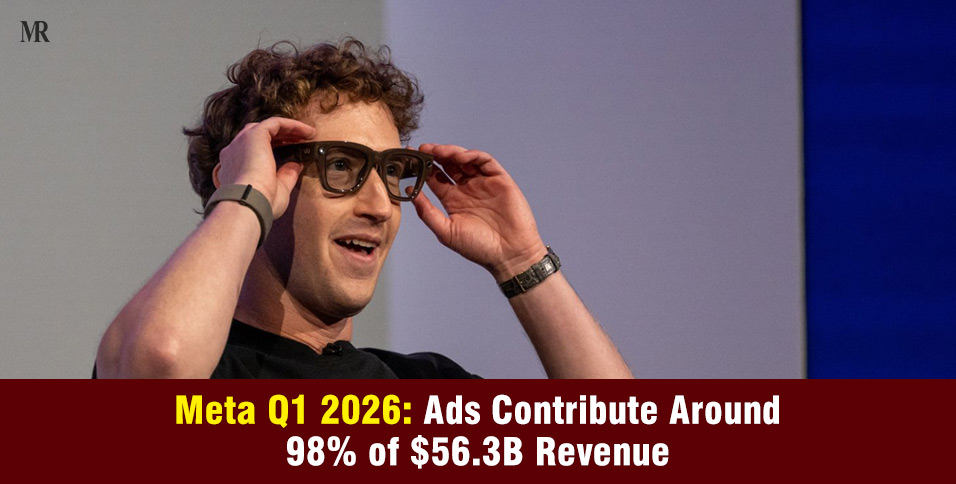
Meta Platforms reported total revenue of $56.31 billion for the first quarter of 2026, marking a 33% increase year-over-year. Advertising remains the company’s primary engine, generating $55.02 billion and accounting for approximately 98% of total revenue.
While Meta Q1 2026 beat analyst expectations for revenue and earnings, a hike in its planned capital expenditure (capex) forecast led to a 6% drop in Meta stock during extended trading.
This growth comes as CEO Mark Zuckerberg shifts the company’s core focus toward integrating artificial intelligence (AI) across its social ecosystem.
Despite the financial gains, the company faces new challenges, including a slight dip in user growth caused by international internet disruptions.
Meta Capex Increased Due to AI Infrastructure
A central theme of the Meta Q1 2026 Results is the aggressive pursuit of AI supremacy.
Meta raised its full-year capital expenditure forecast to a range of $125 billion to $145 billion, up from the previous range of $115 billion to $135 billion.
CFO Susan Li attributed this $10 billion increase to higher component pricing, specifically for memory, and the costs of building out data centers for future capacity.
During the Meta earnings call, Li noted that the company has “continued to underestimate our compute needs” as AI capabilities advance.
The company is investing heavily in:
- Custom Silicon: Developing over 1GW of custom chips with Broadcom.
- Hardware Diversity: Integrating significant amounts of AMD chips alongside new Nvidia systems.
- Data Centers: Expanding the global footprint to support the training and inference of advanced models.
Mark Zuckerberg, CEO of Meta, stated, “We are among the few companies positioned to shape the future, and we are on track to do that. I’m looking forward to delivering personal superintelligence to billions of people.”
Financial and Operational Performance
Meta delivered strong profitability figures, largely aided by a substantial one-time tax benefit. Net income rose to $26.8 billion, or $10.44 per diluted share.
However, excluding an $8.03 billion tax benefit related to the U.S. Corporate Alternative Minimum Tax, diluted EPS would have been $7.31.
Key Financial Highlights From Meta Q1 Earnings 2026
| Metric | Q1 2026 | Q1 2025 | Change |
| Total Revenue | $56.31B | $42.31B | 33% |
| Ad Revenue | $55.02B | $41.39B | 33% |
| Operating Margin | 41% | 41% | 0% |
| Net Income | $26.77B | $16.64B | 61% |
Ad performance improved significantly, with ad impressions increasing by 19% and the average price per ad rising by 12% year-over-year.
User Engagement Trends and International Disruptions
The Meta Q1 2026 Results revealed a rare quarter-over-quarter decline in Family Daily Active People (DAP). While DAP grew 4% year-over-year to 3.56 billion, it fell slightly from 3.58 billion in the previous quarter.
Meta blamed this decline on external factors rather than a loss of platform appeal:
- Internet disruptions in Iran.
- Restrictions on WhatsApp access in Russia.
Zuckerberg highlighted that video engagement remains at an all-time high on Facebook and Instagram, with Reels watch time increasing 10% in Q1 following ranking improvements.
Meta Layoffs and Workforce Optimization
To offset the massive Meta capex spending, the company continues to refine its workforce. Meta ended the quarter with 77,986 employees, a 1% decrease from the previous quarter.
CFO Susan Li confirmed that another round of Meta layoffs is scheduled for May 2026.
Mark Zuckerberg explained that AI is allowing smaller teams to do work that previously required dozens of people. He expressed a desire to “streamline teams so they aren’t bigger than they need to be” while rewarding “heavy hitters” who have outsized impacts.
The Road Ahead: Personal Superintelligence and Regulatory Risks
Meta’s plan centers on the release of its Muse family of models, including Muse Spark, from the newly formed Meta Superintelligence Labs. These models are designed to power “business agents” for entrepreneurs and “personal agents” for consumers.
However, Meta warned investors of potential “material losses” due to legal and regulatory scrutiny. The company faces thousands of lawsuits alleging that its platforms are addictive and harmful to children. High-stakes trials in California and New Mexico are scheduled for later this year. Also, China recently blocked the Meta Manus Deal, citing AI Tech transfer risks.
End Note
The Meta Q1 2026 Results paint a picture of a company in deep transition. While Meta continues to dominate the digital advertising space, it is betting its future on a massive, capital-intensive AI pivot.
The dual strategy of aggressive Meta capex spending and ongoing Meta layoffs reflects a drive for efficiency through automation.
Whether these investments will lead to a new era of “personal superintelligence” remains the central question for investors watching Meta’s trajectory in 2026.
Maria Isabel Rodrigues