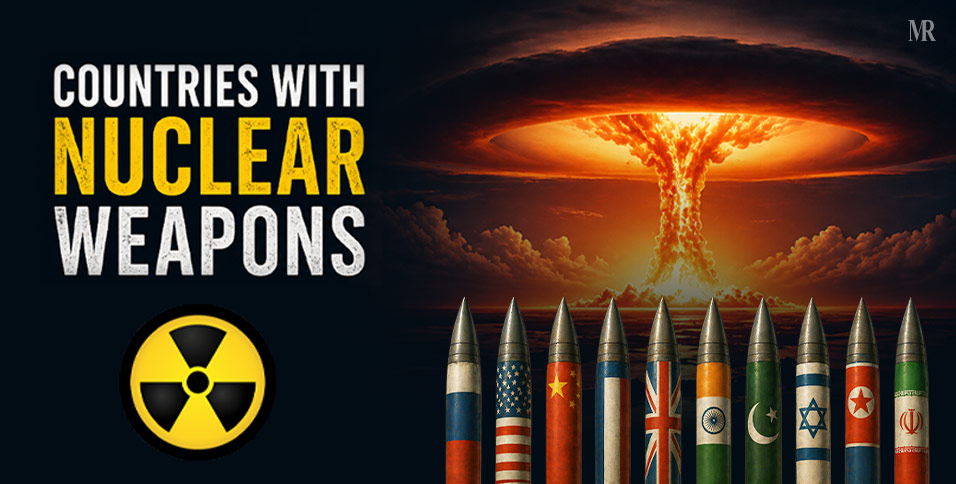
In 2026, the global distribution of nuclear weapons remains deeply concentrated, but the balance of power is shifting.
Russia and the United States still dominate the countries with most nuclear weapons, together holding roughly 86% of the world’s total inventory and over 80% of deployable warheads. Yet this long-standing duopoly is being challenged.
We are now firmly in what analysts call the “Third Nuclear Age”—a period defined by rapid nuclear power expansion in Asia, evolving deterrence strategies, and the integration of advanced technologies such as AI into nuclear command systems.
So, which countries have nuclear weapons in 2026, and who holds the most power? Let’s find out!
If you’re new to the topic, you can explore a deeper breakdown of what nuclear energy is and how it works here!
What Counts as a “Nuclear Power”?
In 2026, the global inventory of Countries With Nuclear Weapons consists of approximately 12,331 warheads. Under the Treaty on the Non-Proliferation of Nuclear Weapons (NPT), only five states are“recognized” nuclear-weapon states: the U.S., Russia, China, France, and the UK. However, four additional states, India, Pakistan,Israel, and North Korea, possess operational arsenals outside the NPT framework.
For clarity:
- Stockpile refers to warheads available for military use.
- Inventory includes both active warheads and retired ones awaiting dismantlement.
- Warheads are the explosive parts of a missile or bomb that carry the destructive payload, such as a nuclear charge.
- Deterrence is a strategy where a country prevents an attack by making the cost of that attack too high. This is why nuclear weapons are rarely used, but always influential.
Nuclear technology also has significant civilian applications across industries. Read the real-world applications of nuclear energy across key industries here!
List Of Countries With Nuclear Weapons (Top 10)
Here is a complete list of countries with nuclear weapons in 2026, ranked by capability and stockpile size, based on data from organizations such as the International Campaign to Abolish Nuclear Weapons, Arms Control Association, and Statista.
| Country | Estimated Warheads | Deployed Strategic Warheads | Global Share | Status |
| 1. Russia | ~5,800 | 1,718 | ~48% | Largest stockpile |
| 2. United States | ~5,200 | 1,670 | ~43% | Most advanced triad |
| 3. China | ~620 | 24 | ~5% | Fastest growing |
| 4. France | ~290 | 280 | <3% | NATO-aligned deterrent |
| 5. United Kingdom | ~225 | 120 | <2% | Submarine-based |
| 6. India | ~190 | 0 (Reserve) | <2% | Expanding triad |
| 7. Pakistan | ~170 | 0 (Reserve) | <2% | Tactical focus |
| 8. Israel | ~90 | 0 (Ambiguity) | — | Undeclared arsenal |
| 9. North Korea | ~60 | 0 (Reserve) | — | Rapid development |
| 10. Iran | 0 (threshold) | N/A | — | Near-breakout capability |
1. Russia
Russia maintains the world’s largest military stockpile at 4,400 warheads. Following the expiration of New START, Moscow has prioritized “novel” systems like the Avangard hypersonic vehicle and the Poseidon underwater drone to bypass U.S. defenses. Russia’s 2024 policy revision lowered the threshold for nuclear use, now allowing for responses to “massive” conventional attacks.
2. United States
The U.S. enters 2026 with 3,700 nuclear warheads in its active stockpile. Modernization is centered on the Sentinel ICBM and Columbia-class submarines. The U.S. now faces a “two-peer” deterrent environment, requiring force postures that can simultaneously address both Russia and a rapidly expanding China.
3. China
China represents the most significant shift among countries with nuclear weapons, with an arsenal now reaching 620 warheads. Beijing is undergoing the most rapid expansion in its history, constructing massive silo fields for solid-fueled ICBMs and projecting a stockpile of 1,000 warheads by 2030. Moreover, China’s rise is not limited to weapons; it is also expanding rapidly in nuclear energy infrastructure.
4. France
France holds 290 nuclear warheads, primarily delivered via submarine-launched ballistic missiles (SLBMs) and air-launched cruise missiles. As of early 2026, President Macron has promoted “forward deterrence,” suggesting the temporary deployment of nuclear-capable aircraft to allies during crises.
5. United Kingdom
The UK maintains a stable arsenal of 225 warheads, exclusively deployed on four Vanguard-class submarines. The UK’s deterrent is integrated into NATO planning, and London has recently deepened cooperation with Paris to address instability in Eastern Europe.
6. India
India has expanded its nuclear stockpile to 190 warheads, a 20% increase over five years. It has successfully operationalized a full nuclear triad, including the Arihant-class submarines, to ensure a credible second-strike capability.
7. Pakistan
Pakistan possesses an estimated 170 nuclear warheads, focusing its posture almost entirely on India. Its strategy of “Full-Spectrum Deterrence” involves the development of short-range tactical nuclear weapons intended to counter conventional military incursions.
8. Israel
Israel continues its policy of strategic opacity with an estimated 90 warheads. While it does not officially acknowledge possession, analysts believe Israel maintains a sea-based leg via Dolphin-class submarines equipped with nuclear-capable cruise missiles.
9. North Korea
North Korea has accelerated its program to roughly 60 warheads by 2026. Pyongyang’s latest advancements include solid-fueled ICBMs with a 15,000 km range and the development of multiple independently targetable reentry vehicles (MIRVs).
10. Iran
Iran occupies the final position as a “threshold” power. As of April 2026, Iran’s nuclear program is characterized by extreme tension following joint USA-Israel military strikes in June 2025 and March 2026. While the IAEA reports no evidence of a finalized weapon, Iran has enriched uranium to 60% levels, providing a breakout capability of a “very short time”.
Key Trends in 2026: AI and the Modernization Race
A defining feature of nuclear power in 2026 is the integration of Artificial Intelligence into Nuclear Command, Control, and Communications (NC3).
While AI offers faster data analysis, UN Resolution 80/23 (adopted in December 2025) warns that AI-enabled decision-making risks shortening response windows and introducing automation bias.
Furthermore, the lack of traditional arms control treaties means that stability now depends on the internal restraint and communication resilience of individual countries with nukes.
As nuclear technology evolves, debates around its long-term sustainability and environmental impact are becoming more relevant. For more context, learn whether nuclear energy is renewable or non-renewable here.
Mirror Review’s Assessment of the Top 10 Countries With Nuclear Weapons 2026
The global nuclear landscape in 2026 marks a decisive break from the structured stability of the past.
With the expiration of the New START in February 2026, the world’s two largest nuclear powers, the United States and Russia, now operate without a legally binding arms control framework for the first time in over five decades. This signals the transition from regulated deterrence to unconstrained strategic competition.
At the same time, the rise of China as a near-peer nuclear force, combined with persistent regional tensions involving India, Pakistan, and North Korea, has transformed nuclear weapons from static stockpiles into active geopolitical tools.
Meanwhile, Iran’s threshold status introduces a new layer of uncertainty where capability, rather than possession, becomes the defining factor of power.
In this evolving environment, nuclear weapons are no longer just about how many warheads a country holds, but:
- How quickly can they be deployed
- How advanced their delivery systems are
- How resilient their command-and-control infrastructure remains under pressure
The result is a world where deterrence is more complex, decision-making windows are shorter, and the margin for error is increasingly thin.
End Note
The top countries with nuclear weapons in 2026 are less about sheer numbers and more about strategy, speed, and intent.
The dominance of Russia and the United States still defines the global order, but the rapid rise of China and the growing importance of regional powers are reshaping how deterrence works in practice.
At the same time, weakening arms control frameworks and emerging technologies are making nuclear stability more fragile, not because weapons are increasing dramatically, but because decision-making is becoming faster and more complex.
The real question is no longer about which countries have nuclear weapons, but how those atomic weapons countries influence global security in an increasingly unpredictable world.
To understand how these same nations use nuclear technology beyond weapons, explore our breakdown of the top 10 global nuclear power leaders.
Maria Isabel Rodrigues
FAQs
- Who are the top 5 nuclear superpowers?
The top five nuclear superpowers are Russia, United States, China, France, and United Kingdom, as they are officially recognized nuclear-weapon states under the Treaty on the Non-Proliferation of Nuclear Weapons and possess the most advanced arsenals.
- What are the top 10 countries with nuclear weapons?
The top 10 countries with nuclear weapons or nuclear capability in 2026 are Russia, United States, China, France, United Kingdom, India, Pakistan, Israel, North Korea, and Iran, with Iran considered a threshold state rather than a confirmed nuclear-armed country.
- Does Iran have nuclear weapons?
No, Iran does not currently possess nuclear weapons, but it is classified as a threshold state due to its advanced uranium enrichment and potential capability to develop a weapon in a short timeframe.