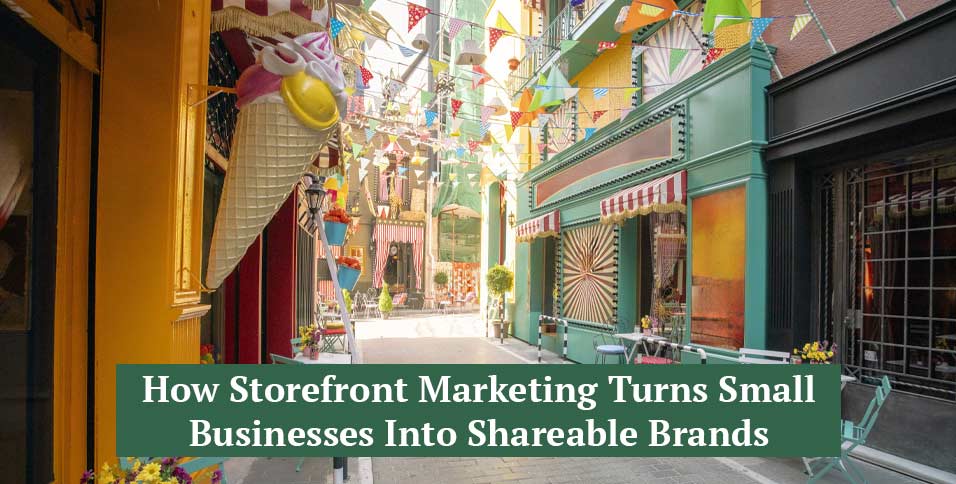
A small business can spend $3,000 a month on paid ads and still walk past its most underused marketing channel every morning on the way in. The storefront. The window. The sign above the door. These attract attention at no cost per impression, and they compound quietly every time a passerby snaps a photo or drops a pin on Google Maps.
That is the thesis behind storefront marketing in 2026, and it is one reason more founders are commissioning custom neon signs for businesses as part of their brand rollout rather than filing signage under facilities expenses. When a storefront gets designed with intent, it produces a steady trickle of user-generated content, location tags, and walk-in curiosity. No media plan required.
What follows is a practical look at how this actually works for small businesses now, and what the term means, what it costs. What to measure. And where owners quietly waste money trying to do it themselves.
What Storefront Marketing Means for Small Businesses in 2026
Storefront marketing is the intentional design of a physical storefront as a brand media channel. Mouthful. Shorter version: treat your storefront like a billboard, a photo opportunity, and a search result all at once.
The difference from traditional signage comes down to intent.
An “Open” sign tells people you are open. A storefront designed for marketing tells people who the brand is, gives them a reason to stop, and hands them something to share afterward. That third part is where the compounding happens. A customer who photographs your window on a Saturday afternoon is delivering free advertising to her network by Monday morning.
Most growth-stage brands figure this out around year two or three. Usually, it clicks after they notice a weird pattern in their Instagram tags: a disproportionate share comes from people who have never bought anything. I just passed by and took a picture. That is the signal.
It means the storefront is already working as a marketing surface, just without a strategy behind it. Storefront marketing is what happens when the owner stops ignoring that pattern and starts designing for it on purpose.
The ceiling here is higher than most owners assume. Cafés, boutique fitness studios, and independent retailers regularly report that their storefronts drive more discovery than their paid social, especially for customers living within a ten-minute radius of the door.
Why Foot Traffic Alone No Longer Measures Storefront Marketing Success
Foot traffic used to be the cleanest number in the room. Count the people who walked in, divide by the people who walked past, and there is your conversion rate. That model was never complete, and in 2026, it undercounts the storefront’s actual job.
Here is the problem. A person walks past your storefront, takes a photo, posts it on Instagram with your location tag, then brings two friends back three weeks later. That first visit registers as zero on a foot-traffic report. The return counts as a single customer. The storefront actually earned three visits, but only one got credited.
Modern storefront performance sits across four quieter metrics:
- Google Business Profile photo insights (how many customer-uploaded photos your location collects per month)
- Branded or location-tagged social posts (how often people tag your venue on Instagram, TikTok, or Google Maps)
- Direct search volume for your business name (a lagging indicator that visibility is compounding)
- Dwell time at the window or entry (easy to track informally, harder to automate)
None of this requires enterprise software. A founder with a phone and fifteen minutes a week can track all four. What they show you is whether the storefront is earning attention, not just converting the attention that has already arrived at the door.
4 Storefront Elements That Attract Organic Attention and Customers
Four design elements consistently drive the photos, tags, and share behavior that storefront marketing depends on. Not every business needs all four, but a storefront with none of them is effectively invisible to anyone who wasn’t already planning to visit.
1. A signature sign or light feature. The single most photographed element on almost any storefront. It could be a hand-painted mural, a custom neon piece, dimensional lettering, or a clever awning. The thing that actually matters is specificity. Stock signage from a chain supplier is not shared because it looks like every other storefront that bought the same template.
2. A window treatment with a point of view. Seasonal displays. A rotating product story. A single well-lit object in an otherwise empty window. Boring windows get ignored. Over-busy windows confuse passersby. Editorial-style windows (one clear idea, executed well) get photographed.
3. A distinct entryway. Floor mats, door decals, potted plants, and a branded rug. The entry zone is where a customer silently decides whether the inside is worth their time. Small business owners often over-invest in the interior and under-invest in the five feet in front of the door.
4. Lighting that reads at night. A storefront that disappears after 6 p.m. is leaving hours of free impressions on the table. This is where LED signage and custom neon outperform painted signs by a wide margin. They attract attention during commute hours, when most paid ads struggle to catch anyone’s eye.
Each element is low-cost relative to its compounding effect. None of them require renovation.
Why Custom Storefront Signs Outperform Generic Branding for Local Businesses
Off-the-shelf signage is cheap, and it shows. A generic logo printed on a standard backing behaves the same way a stock photo behaves on a website: technically fine, but forgettable. Customers are not forgettable. They photograph specifically.
Custom signage earns its price tag through a few practical advantages that generic vendors cannot replicate.
The first is recognition. A custom sign carries proprietary design elements (typography, shape, lighting behavior) that cannot be copied by the shop next door. That uniqueness is what makes a storefront findable in a photo stream or a location tag weeks after someone visited.
Brand voice comes next. A generic printed sign communicates “we exist.” A custom sign communicates what kind of place you are. A bakery with warm handwritten neon reads completely differently from a bakery with sharp modern LED strips. Both are bakeries. Only one reflects a clear identity choice.
And then there’s durability that actually matches the price tag. Modern LED neon flex signs (the style that has largely replaced glass tube neon for indoor and semi-outdoor business use) are rated for 50,000+ hours of operation. Translated into practical terms, that sign will outlast most lease terms, which turns it from a decor spend into a capex item with a real useful life.
The trade-off is real. Custom signage costs three to eight times as much as stock signage upfront. For a small business on thin margins, that premium only makes sense if the storefront sits on a route where people actually walk, drive, or photograph.
In a strip mall with 40 mph traffic and no pedestrians, a generic sign is fine. On a walkable high street or in a café district, custom pays for itself inside a year.
Storefront Marketing Mistakes Small Businesses Should Avoid
Most storefront marketing failures fall into a predictable set of patterns. The ones below show up often enough that any owner planning an upgrade should pressure-test their plan against them before spending a dollar.
Designing for the owner, not the customer. What looks great to the person who paid for it is not always what a stranger finds interesting. A storefront is a customer-facing asset. The real test is whether a person with no prior knowledge of the business would stop, look, or photograph.
Over-indexing on the logo. A giant logo slapped on the window tells passersby almost nothing beyond the business name. Strong storefronts lead with a mood, a product, or a message. The logo belongs somewhere in the composition, but it usually does not belong at the beginning.
Ignoring the after-dark hours. Businesses that rely solely on daylight visibility are leaving between 30 and 50% of foot-traffic hours unlit, depending on the season. A storefront that reads at night extends the brand’s presence without extending staff hours.
Treating signage as a one-time spend. Storefronts age. Vinyl fades. LED drivers fail eventually. A storefront that was sharp in 2023 and never touched in 2026 is actively communicating neglect to the people walking past. Refresh cycles matter, even the small ones.
Skipping the measurement step. Without a simple tracking habit (photo counts, tag mentions, search volume), the owner has no way to tell whether the storefront investment is paying off. Guessing is the most expensive way to run this channel.
How to Brief a Designer for a Storefront That Markets Your Business
A well-briefed designer produces better work in less time, with fewer rounds of revision. Most storefront projects run over budget because the owner cannot actually articulate what the storefront is supposed to do. Solve that part first.
A working brief should cover five points, in plain language:
1. The one-sentence brand statement. Not a tagline. Something closer to “we’re the neighborhood bakery that makes French pastry feel unpretentious.” A designer cannot design identity without understanding it first.
2. The photograph test. Describe what you want a customer to photograph, and why. If you cannot picture the photo in your head, the storefront will not produce one in reality.
3. The traffic context. Pedestrian, drive-by, or both? Daytime, nighttime, or both? Designers need this to calibrate scale, lighting, and legibility distance.
4. The budget envelope with a ceiling. Not a target. A ceiling. Designers respect ceilings and build within them. Vague budgets invite scope creep.
5. The measurable outcome. What changes 90 days after install will count as success? More photo tags, more walk-ins, more window dwell time, or specific foot traffic at certain hours.
For businesses working with a signage vendor or a neon fabricator, the brief should also cover mounting constraints (lease restrictions often dictate this), power access, and whether the piece needs to function both indoors and outdoors. These logistics quietly kill more storefront projects than design disagreements ever do.
Simple Ways to Measure Storefront Marketing ROI for Your Small Business
Measuring storefront ROI does not require enterprise analytics or a dedicated tool stack. It requires one spreadsheet, a 15-minute weekly habit, and the patience to track the same four indicators for at least 90 days before drawing any conclusion.
The metrics that matter, and how to track them without spending money:
Google Business Profile photo uploads. Log in once a week and note how many customer-uploaded photos were added. A storefront that is actually working will see this number grow, particularly after a design refresh.
Branded and location-tagged social mentions. Search your business name and location on Instagram and TikTok weekly. Count the posts where someone tagged the venue organically. A steady trickle is normal. A visible jump after a signage change is a signal.
Direct brand search volume. Check Google Trends or Search Console monthly for searches of your exact business name. Rising direct search means visibility is compounding. People who saw the storefront later Google the brand.
Walk-in conversion from ambient traffic. Ask every new customer (casually, not on a form) how they heard about you. Track the percentage who say “I walked by” or “I saw the sign.” That percentage is the crudest, but most honest, measure of storefront pull.
A small business that treats these four inputs seriously will know within a quarter whether a storefront upgrade paid off. Most owners never actually run that check, which is why storefront investment has a reputation as a vanity spend. Measured properly, it is one of the higher-ROI marketing lines on the books.
Key Storefront Marketing Takeaways for Small Businesses
Storefront marketing is not a new idea. What is new is the framework for treating a physical storefront as a measurable, managed channel, with design inputs, performance metrics, and a refresh cycle that matches how quickly customer attention moves in 2026.
For small business owners on a tight budget, a few things matter more than the rest. A signature visual element that earns photos. A measurement habit that survives the first 90 days.
A design brief that prioritizes customer behavior over owner preference. Get those right, and the storefront starts earning its keep as a marketing surface instead of sitting there as overhead.
The businesses winning at this are not spending more money. They are being more specific.
A local café working with a neon sign company on a single signature piece often sees a better return than a competitor dropping the same budget on paid social. The difference comes down to this: the storefront keeps earning attention long after the invoice is paid.
Every commute. Every weekend, walk. Every tagged photo. That is what turns a small business into a shareable brand, and not just a place that happens to sell things.