Mirror Review
March 26, 2026
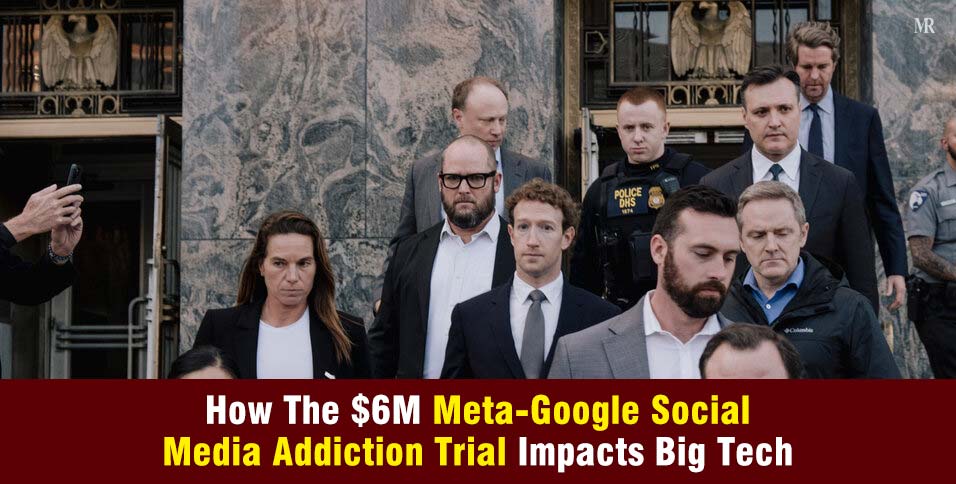
On March 25, 2026, a Los Angeles jury delivered a historic verdict against Meta and Google, finding them liable for the mental health crisis of a 20-year-old woman, awarding her $6 million in total damages.
This social media addiction trial is a turning point in how the legal system views the responsibility of tech companies toward their youngest users.
The Verdict Against Meta and Google
The LA jury reached its decision to declare that Meta and Google are liable after nine days of intense deliberation.
They concluded that Meta (the parent of Instagram) and Google (the owner of YouTube) were negligent in how they designed their apps.
Of the $6 million total, Meta must pay $4.2 million (70% liability), while Google is responsible for $1.8 million (30% liability).
The plaintiff, identified as Kaley G.M., started using YouTube at age six and Instagram at nine.
She argued that these platforms used addictive features to keep her hooked, leading to severe depression, anxiety, and body dysmorphia.
While the financial penalty is small for companies worth trillions, the legal precedent is massive, since it’s a test for over 2,000 similar lawsuits currently waiting.
Why the Jury Finds Meta and YouTube Negligent
The core of the Youtube and Meta social media addiction trial focused on product design rather than the content itself.
This was a smart move by the legal team to bypass Section 230, a law that usuallyprotects tech firms from being sued over what users post.
The jury agreed that specific features were “defective” and intentionally addictive, such as:
- Infinite Scroll: The endless feed that prevents users from finding a natural stopping point.
- Autoplay: Videos that start automatically, removing the choice to stop watching.
- Push Notifications: Constant alerts that pull users back into the app at all hours.
- Beauty Filters: Tools that the plaintiff claimed warped her self-image and fueled her body dysmorphia.
“Today’s verdict is a referendum — from a jury, to an entire industry — that accountability has arrived,” stated the plaintiff’s lead counsel following the decision.
Industry Reactions To the Meta and Google Lawsuit
Despite the ruling, both companies stand by their platforms.
They argue that mental health is a complex issue with many causes, including home life and genetics.
During this YouTube social media addiction trial, Google’s lawyers argued that YouTube is a “responsibly built streaming platform” rather than a traditional social media site.
Moreover, Meta spokesperson Ashly Nikkole Davis said, “Teen mental health is profoundly complex and cannot be linked to a single app.”
Both companies have already confirmed they plan to appeal the verdict.
However, the pressure is mounting. Just one day before this ruling, a New Mexico jury ordered Meta to pay $375 million in a separate case involving child safety and deceptive practices.
What Happens Next for Big Tech?
This successful social media lawsuit sends a clear signal that the “era of the unchecked scroll” may be ending.
Because the jury finds Meta and YouTube negligent, other plaintiffs now have a roadmap for victory.
We can expect three major shifts in the near future:
- Redesigning Features: To avoid further liability, platforms may be forced to limit infinite scrolling or default autoplay for minors.
- Increased Settlement Probabilities: With a loss on their record, Meta and Google might choose to settle the thousands of pending cases rather than risk more public trials.
- New Legislation: Lawmakers are already using this verdict to push for bills like COPPA 2.0, which would create stricter online safety rules.
Takeaway
The end of the social media addiction trial is a warning moment for Big Tech companies.
For the first time, a jury has looked at the internal mechanics of Instagram and YouTube and labeled them as “defective products.”
Now, while the $6 million payout is a small amount for these giants, the legal shield they once enjoyed is cracking.
As more cases go to court, the pressure on Meta and Google to prioritize safety over profit will only grow.
Maria Isabel Rodrigues