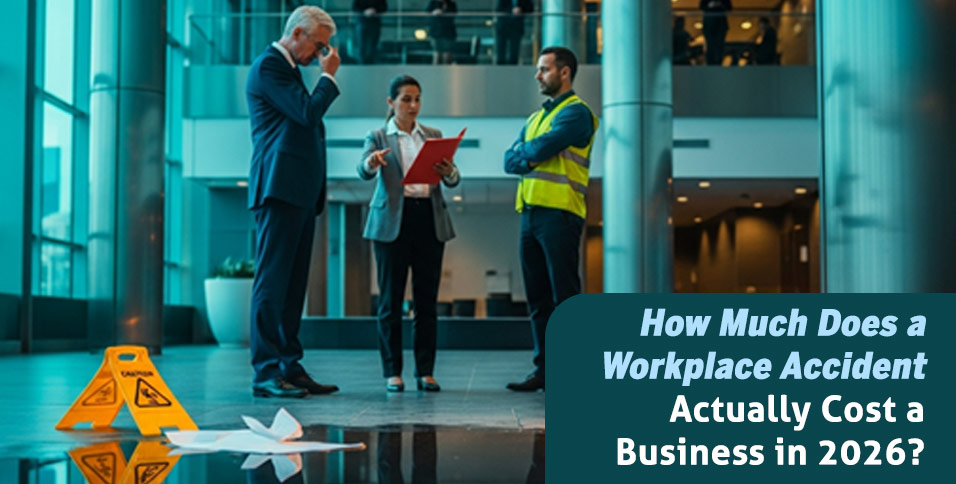
Revenue growth and profit margins dominate every executive’s agenda. Leaders spend countless hours optimizing sales funnels, streamlining operations, and slashing overhead. But here’s the uncomfortable truth: one unattended maintenance ticket can erase an entire year’s profit margin.
Too many companies treat safety protocols as a regulatory box to check rather than a core business strategy. That miscalculation destroys reputations and leads to devastating lawsuits. So what does a workplace accident actually cost in 2026?
This article breaks down the true financial, legal, and reputational costs of commercial property accidents and shows how minor oversights quickly balloon into serious corporate liabilities.
Direct Financial Costs of a Workplace Accident
The most obvious costs include medical bills, workers’ compensation payments, and immediate operational shutdowns. Most executives severely underestimate these figures when drafting annual budgets. Private industry employers reported 2.5 million nonfatal injuries in 2024, a recordable rate of 2.3 cases per 100 full-time workers.
Overall claim volumes are dipping across most major sectors. But the cost per claim is climbing fast. Georgia alone paid $1.72 billion in workers’ compensation benefits in a single year.
Simple mistakes carry the highest price tags. Same-level falls cost employers $9.99 billion each year in medical expenses and lost wages. These direct costs drain your cash flow now. They also drive up insurance premiums for years.
To better understand how these costs affect your business, consider the differences between direct and indirect financial burdens outlined in the table below.
| Cost Category | Description | Real-World Examples | Estimated Financial Impact |
| Direct costs | Immediate expenses tied to the accident | Medical bills, workers’ comp, emergency transport | $9.99B annually for same-level falls alone |
| Indirect costs | Hidden operational and legal expenses that follow | Legal fees, lost productivity, replacement staffing | Typically 4x to 10x higher than direct costs |
| Reputational costs | Long-term damage to brand and company valuation | Lost contracts, negative PR, stock dips | Can reach hundreds of millions (e.g., $650M in fire damages) |
How Hidden Liabilities and Legal Fees Hit Your Bottom Line
Direct costs are just the starting point. Hidden liabilities, legal fees, and operational shutdowns can threaten a company’s entire financial foundation. Unplanned downtime halts production lines, ruins inventory, and delays deliveries to your most valuable clients. Globally, unplanned downtime costs $1.4 trillion, which is nearly equal to Spain’s gross domestic product.
Brand damage creates losses that are even harder to quantify. One industrial warehouse fire caused $650 million in damage because the fire suppression systems had been compromised. Failing to maintain facilities doesn’t just cause property damage; it triggers full-blown public relations disasters. Stock prices and investor confidence tank after high-profile events like these.
When an accident stems from negligence, the legal and financial exposure gets serious fast. Defective products or unsafe commercial properties invite massive premises liability lawsuits. The true cost of failing to prioritize safety and avoiding a slip and fall becomes painfully clear in the courtroom.
Sound extreme? Consider some recent legal outcomes. Courts have approved settlements of $22.1 million for catastrophic brain injuries caused by defective products, $6.5 million in federal personal injury cases, and $3.0 million verdicts in defective tire lawsuits. These figures reflect the true cost of neglected maintenance and unsafe environments when a case goes to trial.
Why Slips, Trips, and Falls Devastate Businesses
Heavy machinery accidents grab headlines. But slips and falls quietly drain businesses across every sector. These preventable incidents cause major physical and financial harm. Trips, slips, and falls account for 15% of all accidental deaths. Only motor vehicle accidents cause more.
The human toll is staggering. In 2024, 48,308 deaths in the U.S. resulted from these incidents. Even non-fatal cases cripple productivity and tank team morale. Roughly 22% of slip-and-fall injuries keep employees out of work for more than a month.
So why do these incidents keep happening? Here are the three biggest culprits:
- Uneven or wet surfaces: The single leading cause across all property types, accounting for 55% of all slip and fall incidents.
- Lack of fall protection: OSHA issued over 7,000 citations in 2023 for fall protection violations, making it the most frequently cited standard in the country.
- Falls from height: These caused over a quarter of all worker deaths in Britain in a single year, costing the economy £687 million.
Proper lighting, high-traction flooring, routine walkway inspections, and immediate spill cleanup all help. These steps dramatically cut premises liability claims.
During investigations, safety records are your best defense. Government agencies audit companies after major incidents. If they find a pattern of negligence, fines increase fast. Document each safety repair. It could shield you from heavy penalties.
Emerging Workplace Safety Trends for 2026
Looking ahead, physical accidents are only one liability. C-suite leaders must view workplace safety more broadly. Assaults are rising across the country. Safety programs now have to adapt.
According to the NCCI, the rate of assaults jumped 62% over the past decade. Certain sectors face even higher risks from client or customer violence. In healthcare alone, workplace violence has become an $18.27 billion crisis. Women account for roughly two-thirds of all assault victims.
Technology is a valuable resource in addressing this issue. Advanced monitoring software and immediate alert systems enable companies to deter violence before escalation. Upgrading security infrastructure can help reduce the likelihood of costly incidents.
Don’t overlook psychological risks. Untreated mental health conditions and workplace trauma cost $193.2 billion in lost earnings each year. Burnout and toxic environments drain resources as fast as physical accidents.
Courts hold employers to higher standards than ever. Recent lawsuits enforce a clear legal “duty of care” for staff protection. If you ignore bullying or harassment, you invite fines and litigation.
The Bottom Line
The cost of a workplace accident in 2026 is more than a medical bill. Incidents start a chain of lost productivity, fines, and legal settlements. Investing in safety is much cheaper than paying for negligence. Take action now: prioritize regular training, equipment updates, and hazard checks to safeguard your team and your bottom line. Safety is your responsibility—lead by example.
See also: Is Temu Legit?