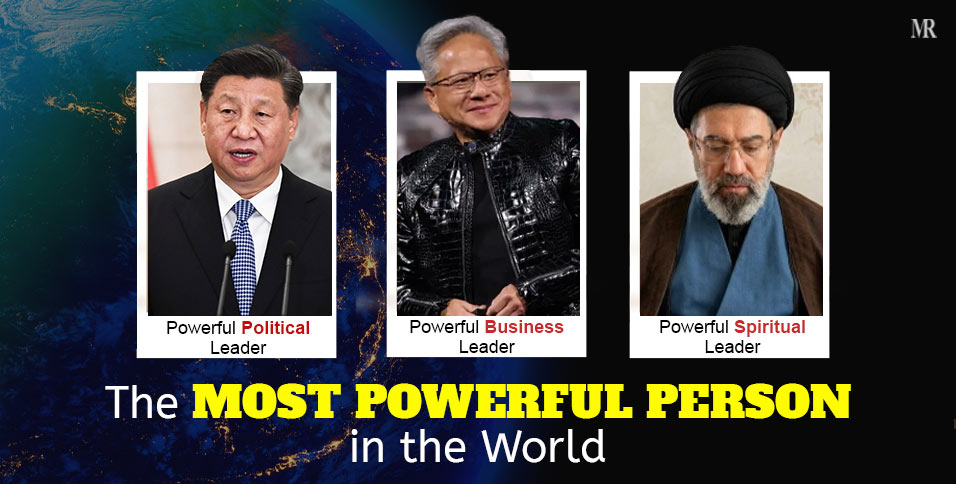
Power shapes our lives in countless ways, from the policies that govern us to the technologies we use. It is the power to influence, make decisions that affect millions, and encourage others to follow the same.
Power comes in many forms:
- Political leaders hold the reins of nations, shaping global affairs.
- Business leaders drive innovation and steer the economy.
- Spiritual leaders guide beliefs and values, offering solace and direction.
This list explores these three distinct categories. It’s a snapshot of the influential figures who are shaping our world right now, in 2026.
Remember, there is no single most powerful person in the world.
Since power is constantly shifting, new leaders emerge all the time. But this glimpse offers a fascinating look at the individuals who hold immense sway over our world.
List of 30 Most Powerful People in the World 2026
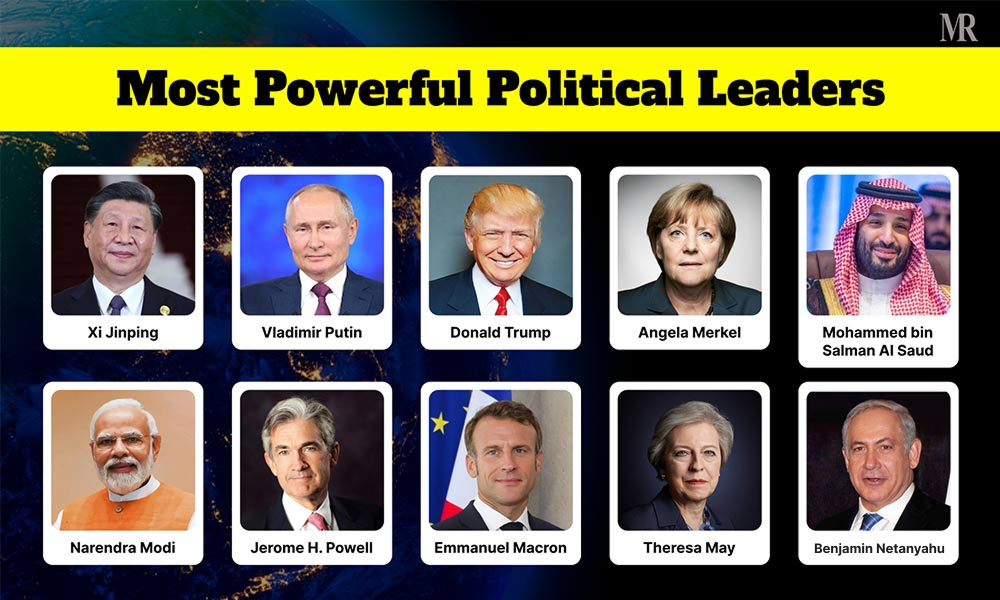
| Political Leaders | Business Leaders | Spiritual Leaders |
| 1. Xi Jinping | 1. Jensen Huang | 1. Mojtaba Khamenei |
| 2. Vladimir Putin | 2. Satya Nadella | 2. Ahmed el-Tayeb |
| 3. Donald Trump | 3. Elon Musk | 3. Mohammad bin Abdulkarim Al-Issa |
| 4. Angela Merkel | 4. Mark Zuckerberg | 4. Pope Leo XIV |
| 5. Mohammed bin Salman Al Saud | 5. Sam Altman | 5. Sadhguru Jaggi Vasudev |
| 6. Narendra Modi | 6. Sundar Pichai | 6. The Dalai Lama (Tenzin Gyatso) |
| 7. Jerome H. Powell | 7. Jamie Dimon | 7. Acharya Prashant |
| 8. Emmanuel Macron | 8. Wang Chuanfu | 8. Patriarch Kirill of Moscow |
| 9. Theresa May | 9. Jeff Bezos | 9. Gauranga Das |
| 10. Benjamin Netanyahu | 10. Mukesh Ambani | 10. Gurudev Sri Sri Ravi Shankar |
The Top 10 Most Powerful Political Leaders in the World Are As Follows:
1. Xi Jinping
- Country – China
- Title – President of the People’s Republic of China, General Secretary of the Communist Party
- Birth Year – 1953
Xi Jinping, the President of China, is the most powerful person in the world 2026. As the leader of the world’s second-largest economy and a nuclear superpower, Xi holds unmatched influence over global politics, trade, and security. Since taking office in 2013, he has consolidated power through sweeping reforms, anti-corruption drives, and assertive foreign policy.
Under Xi’s leadership, China has strengthened its technological, military, and geopolitical reach through initiatives like the Belt and Road Initiative (BRI). His vision of a “Chinese Dream” aims to restore national strength and global prominence, positioning China as a central player in shaping the 21st-century world order.
2. Vladimir Putin
- Country – Russia
- Title – President of the Russian Federation
- Birth Year – 1952
As President of Russia, Vladimir Putin has redefined Russia’s position through strong nationalist policies and assertive foreign strategies. His leadership combines a focus on military strength, economic resilience, and political control.
Despite international sanctions and criticism, Putin’s influence remains across Eurasia, the Middle East, and energy markets. His ability to maintain power domestically while shaping international security and diplomacy makes him one of the most powerful man in the world.
3. Donald Trump
- Country – United States
- Title – President of the United States
- Birth Year – 1946
Donald Trump’s return to the White House in 2025 has reaffirmed his position as one of the most influential figures in global politics. His leadership style continues to challenge conventional diplomacy and redefine America’s global strategy.
Trump’s policies focus on economic nationalism, border control, and an “America First” doctrine. While controversial, his ability to command public attention and shape global scenarios on trade, tariffs, security, and technology ensures his dominance internationally.
On 3rd January 2026, Trump announced that U.S. forces had captured Venezuelan President Nicolás Maduro in a major military operation, showing his willingness to use military power directly and assert U.S. dominance far beyond its borders.
4. Angela Merkel
- Country – Germany
- Title – Former Chancellor of Germany
- Birth Year – 1954
Angela Merkel, who served as Chancellor of Germany from 2005 to 2021, is one of the 50 most popular women in the world. She is known for her straightforward leadership and calm diplomacy and has guided Europe through major crises, including the Eurozone debt crisis, migration challenges, and global pandemics.
Even in retirement, her legacy continues to influence European Union policies and global economic strategies. Merkel’s scientific background and steady decision-making made her a symbol of stability and rational governance.
5. Mohammed bin Salman Al Saud
- Country – Saudi Arabia
- Title – Crown Prince & Prime Minister
- Birth Year – 1985
Mohammed bin Salman (MBS) is the de facto ruler of Saudi Arabia and a transformative force in the Middle East. As the architect of Vision 2030, he has launched bold reforms to diversify the Saudi economy away from oil dependence and modernize its social structure.
Under his leadership, Saudi Arabia has pursued ambitious projects in technology, tourism, and renewable energy while expanding its geopolitical influence. Though controversial, MBS’s assertive diplomacy and modernization efforts have redefined the Saudi’s role in global economics and regional politics.
6. Narendra Modi
- Country – India
- Title – Prime Minister
- Birth Year – 1950
Narendra Modi is one of the most influential leaders in Asia, shaping India’s rise as a global power. Since becoming Prime Minister in 2014, Modi has focused on economic growth, cultural identity, infrastructure expansion, and digital transformation under initiatives like Make in India and Digital India.
His leadership style, characterized by strong nationalism and smart diplomacy, has elevated India’s presence in international forums such as the G20 and BRICS.
Most recently, the landmark India–EU Free Trade Agreement in 2026 reinforced Modi’s position as one of the world’s most powerful political leaders, highlighting his influence over major global trade decisions.
7. Jerome H. Powell
- Country – United States
- Title – Chair of the Federal Reserve
- Birth Year – 1953
Jerome H. Powell holds one of the most powerful financial positions in the world as the Chair of the U.S. Federal Reserve. His policies influence global interest rates, inflation, and economic stability. Powell’s steady leadership through economic problems, including the post-pandemic period, has earned him respect among global markets and policymakers alike.
By maintaining U.S. monetary policy during inflationary pressures and uncertainty, Powell plays the main role in maintaining confidence in the world’s largest economy. His decisions affect every major financial system worldwide, giving him immense political and economic importance.
8. Emmanuel Macron
- Country – France
- Title – President of France
- Birth Year – 1977
Emmanuel Macron is the youngest President in French history and Europe’s most prominent political voice. His centrist policies focus on European unity, climate leadership, and technological innovation.
Macron continues to play a crucial role in shaping the European Union’s foreign and defense policies. His efforts to balance diplomacy between Western powers and emerging nations prove his influence in redefining Europe’s global role.
9. Theresa May
- Country – United Kingdom
- Title – Former Prime Minister
- Birth Year – 1956
Theresa May, who served as the UK’s Prime Minister from 2016 to 2019, remains a respected stateswoman and influential voice in British and international politics. She led the country through the initial phases of Brexit, demonstrating resilience amid intense political division.
Since leaving office, May has continued her engagement in global policy discussions, advocating for women’s rights, democracy, and cybersecurity. Her steady leadership during one of Britain’s most challenging political transitions continues to define her global reputation.
10. Benjamin Netanyahu
- Country – Israel
- Title – Prime Minister
- Birth Year – 1949
Benjamin Netanyahu is Israel’s longest-serving Prime Minister and a defining figure in Middle Eastern politics. His leadership has been marked by security-focused policies, economic growth, and assertive diplomacy in regional and international affairs.
Netanyahu continues to influence Israel’s position on defense, technology, and smart alliances, while maintaining democracy, governance, and regional stability. His ability to overcome complex domestic and international challenges secures his role as one of the most powerful political leaders in 2026.
The Top 10 Most Powerful Business Leaders in the World Are As Follows:
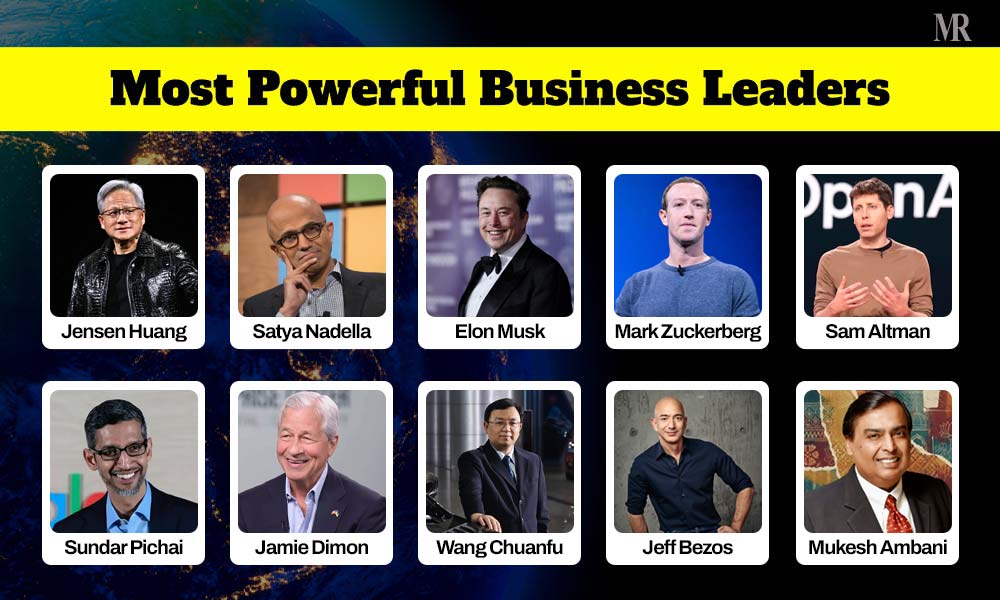
1. Jensen Huang
- Designation – Founder, President & CEO
- Company – NVIDIA Corporation
- Country – United States
- Industry – Semiconductors, Artificial Intelligence
Jensen Huang founded NVIDIA in 1993 and has led the company for over 30 years. He transformed NVIDIA from a graphics chip producer into the global leader in accelerated computing, creating the hardware and software foundations for AI applications ranging from autonomous vehicles to generative models.
In 2025, NVIDIA became the first company to surpass a $5 trillion market capitalization. In 2026, Huang received the IEEE Medal of Honor for his contributions to computing, and continues to expand NVIDIA’s CUDA ecosystem, which powers the world’s most advanced AI systems.
2. Satya Nadella
- Designation – Chairman & CEO
- Company – Microsoft Corporation
- Country – United States
- Industry – Technology, Cloud Computing, AI
Satya Nadella has led Microsoft for 13 years, transforming it from a primarily software-focused company into a cloud and AI powerhouse. He secured a key partnership with OpenAI, embedding generative AI into Microsoft’s enterprise software and Azure cloud platform.
Under his leadership, Microsoft’s market capitalization consistently competes with Apple and NVIDIA. In 2026, Azure maintains a dominant position in cloud computing, and Microsoft continues expanding AI capabilities across productivity and enterprise platforms.
3. Elon Musk
- Designation – Founder & CEO
- Company – Tesla, SpaceX, xAI
- Country – United States
- Industry – Automotive, Aerospace, AI, Social Media
Elon Musk has spent more than two decades building companies that shape multiple industries simultaneously. Tesla redefined electric vehicles, SpaceX revolutionized commercial spaceflight, and xAI now powers next-generation AI research. In 2026, xAI merged with SpaceX, creating a vertically integrated innovation engine from AI to orbital satellite internet.
Musk’s net worth exceeds $850 billion, enabling him to fund Mars colonization, humanoid robotics, lunar cities, and global telecommunications. His influence spans both physical infrastructure and digital technology, making him one of the most powerful business figures globally.
4. Mark Zuckerberg
- Designation – Co-founder, Chairman & CEO
- Company – Meta Platforms
- Country – United States
- Industry – Social Media, AI, Virtual Reality
Mark Zuckerberg has spent nearly two decades transforming Meta from a social media network into an AI and spatial computing leader. By releasing the Llama AI series, he established Meta as a primary alternative to Google and OpenAI, influencing the global developer ecosystem.
Meta still dominates digital communication through WhatsApp, Instagram, and Threads, reaching nearly 4 billion people. In 2026, Zuckerberg focuses on “Superintelligence” initiatives, aiming to redefine human-computer interaction and extend Meta’s technological influence.
5. Sam Altman
- Designation – CEO
- Company – OpenAI
- Country – United States
- Industry – Artificial Intelligence
Sam Altman has led OpenAI for over a decade, taking AI from specialized research to widespread commercial and policy impact. He oversaw key collaborations, including a Pentagon partnership, and built infrastructure capable of supporting AI at global scale.
In 2026, OpenAI is valued at nearly $500 billion and is expanding physical data center capacity with gigawatt-scale power. Altman participates in global AI governance discussions and is a central advisor on the development of Artificial General Intelligence.
6. Sundar Pichai
- Designation – CEO
- Company – Alphabet Inc. & Google
- Country – United States
- Industry – Technology, Internet Services, AI
Sundar Pichai leads Alphabet’s mission to reorganize the world’s information for the AI era. In 2026, he oversaw the launch of a $15 billion full-stack AI hub in India, signaling Google’s aggressive expansion into emerging markets. Under his leadership, Google has successfully defended its search dominance by integrating Gemini AI into its core products.
Pichai’s power stems from Alphabet’s unparalleled data ecosystem, which includes Search, YouTube, and Android. By managing the transition to “AI-first” search while maintaining massive advertising revenues, Pichai ensures that Google remains an indispensable utility for the global digital economy.
Sundar Pichai has spent nearly two decades at Google, transforming it from a search engine into a comprehensive AI and cloud technology company. He integrated Gemini AI across core services while maintaining Google’s leadership in Search, YouTube, and Android.
In 2026, Pichai oversaw a $15 billion AI hub in India, expanding Google’s footprint in emerging markets. Alphabet continues to leverage its data ecosystem to maintain its central role in global digital infrastructure.
7. Jamie Dimon
- Designation – Chairman & CEO
- Company – JPMorgan Chase & Co.
- Country – United States
- Industry – Banking, Finance
Jamie Dimon continues his reign as the world’s most influential banker. As the head of JPMorgan Chase, the largest bank by market capitalization, his decisions affect the flow of trillions of dollars across global markets. In 2026, Dimon remains a critical bridge between Wall Street and the highest levels of government, often acting as a stabilizing voice during periods of economic volatility.
His leadership is characterized by a “Fortress Balance Sheet” philosophy that has allowed JPMorgan to absorb smaller competitors and expand its technological lead in digital banking and AI-driven wealth management.
8. Wang Chuanfu
- Designation – Founder, Chairman & President
- Company – BYD Co., Ltd.
- Country – China
- Industry – Automotive, Battery Technology, Electronics
Wang Chuanfu has built BYD into the world’s largest electric vehicle (EV) manufacturer, surpassing Tesla in total global sales in 2025. A brilliant engineer turned billionaire, Wang’s power lies in his company’s vertical integration; BYD manufactures its own batteries and semiconductors, insulating it from the supply chain shocks that have crippled rivals.
By 2026, Wang has expanded BYD’s footprint into over 70 countries, leading the global push for affordable, mass-market sustainable transport. His influence is a cornerstone of China’s “Green Tech” dominance and a primary driver of the global transition away from internal combustion engines.
9. Jeff Bezos
- Designation – Founder & Executive Chairman
- Company – Amazon
- Country – United States
- Industry – E-commerce, Technology, Space
Though no longer the daily CEO, Jeff Bezos remains the ultimate architect of the Amazon empire. Through his role as Executive Chairman, he guides the strategic direction of Amazon Web Services (AWS), which provides the cloud backbone for a vast portion of the internet. In 2026, his focus has shifted heavily toward TeraWave (satellite connectivity) and Blue Origin.
Bezos’s influence is sustained by Amazon’s status as the world’s largest online marketplace and a leader in logistics AI. His long-term vision for space-based industry and terrestrial sustainability continues to shape the investment priorities of the global business elite.
10. Mukesh Ambani
- Designation – Chairman & Managing Director
- Company – Reliance Industries Limited
- Country – India
- Industry – Conglomerate (Energy, Retail, Telecom, AI)
Mukesh Ambani is the most powerful business leader in Asia and the primary architect of India’s modern digital economy. As of 2026, Reliance Industries is the largest public company in India, with Ambani leading a massive pivot toward Green Hydrogen and homegrown AI infrastructure through the Jio platform.
Ambani’s power is multifaceted: he controls India’s largest retail network, its dominant telecommunications provider, and its most significant energy assets. By partnering with global giants like Google and NVIDIA to build India-specific AI models, Ambani has ensured that Reliance remains the gatekeeper to the world’s fastest-growing consumer market.
The Top 10 Most Powerful Spiritual Leaders in the World Are As Follows:
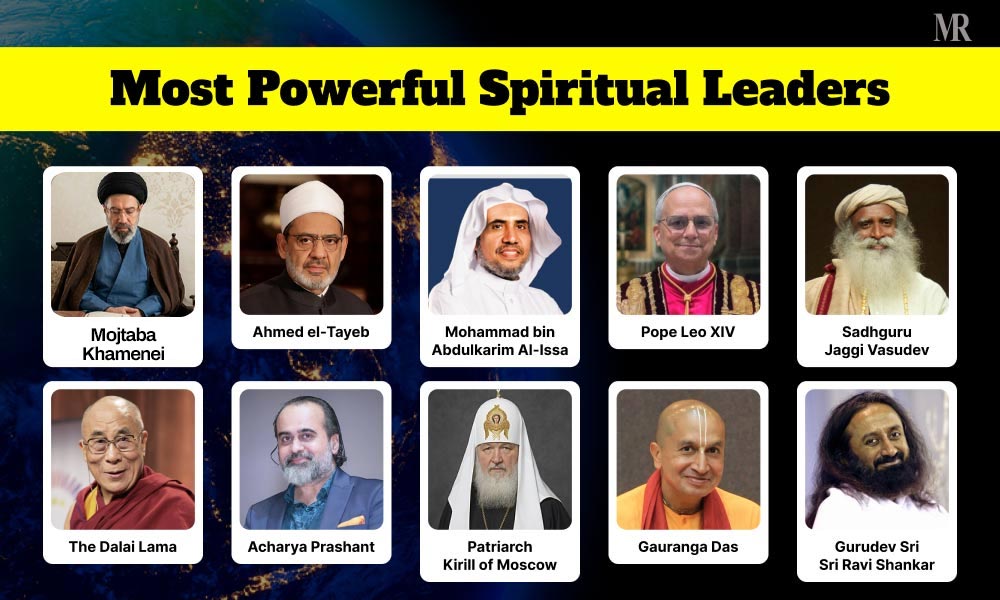
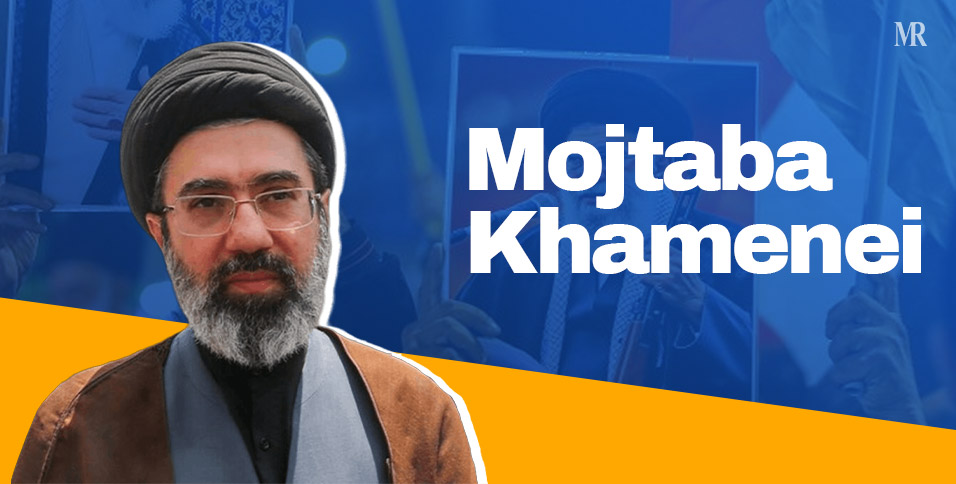
1. Mojtaba Khamenei
- Nation – Iran
- Religion – Islam (Shia)
Mojtaba Khamenei has emerged as the most powerful spiritual and political leader in the world following his formal elevation to Supreme Leader of Iran on March 8, 2026. This transition occurred under extraordinary circumstances after the death of his father, Ayatollah Ali Khamenei, during the opening strikes of the 2026 conflict with the United States and Israel.
By securing the “decisive vote” of the Assembly of Experts during an active war, Mojtaba has consolidated absolute authority over the Islamic Republic’s military, judiciary, and religious institutions.
His power is uniquely absolute; unlike many global leaders who face legislative or democratic checks, he serves as the Vali-e Faqih (Guardian Jurist), a role that grants him the final word on all state and spiritual matters for a nation at the center of global geopolitical tension.
Beyond his constitutional titles, Mojtaba’s influence is rooted in his deep, decades-long integration with the Islamic Revolutionary Guard Corps (IRGC) and the country’s intelligence.
2. Ahmed el-Tayeb
- Nation – Egypt
- Religion – Islam (Sunni)
Ahmed el-Tayeb serves as the Grand Imam of Al-Azhar Mosque and University in Cairo, one of the most respected institutions in the Islamic world. As the spiritual leader of millions of Sunni Muslims, he is a strong advocate of moderation, interfaith harmony, and modern Islamic scholarship. His teachings focus on rational interpretation of Islam in a rapidly changing world and the need for religious leaders to counter extremism through education.
El-Tayeb’s leadership within Al-Azhar University, which trains countless clerics and theologians, ensures his vision shapes Islamic thought across generations. El-Tayeb remains one of the most trusted voices of mainstream Sunni Islam today.
3. Mohammad bin Abdulkarim Al-Issa
- Nation – Saudi Arabia
- Religion – Islam (Sunni)
Dr. Mohammad bin Abdulkarim Al-Issa is the Secretary-General of the Muslim World League, a global Islamic organization headquartered in Makkah. He is a reform-minded cleric and one of the most prominent advocates of religious tolerance and cross-cultural dialogue within the Islamic world. He promotes a moderate understanding of Islam and counters extremist ideologies by building bridges between Muslim and non-Muslim societies.
Al-Issa has become a global diplomat for Islam, addressing international forums, universities, and interfaith councils. Under his leadership, the Muslim World League has taken a forward-looking approach to global humanitarianism and peacebuilding.
4. Pope Leo XIV
- Nation – Vatican City
- Religion – Christianity (Roman Catholic)
Pope Leo XIV, elected in 2025, leads the world’s largest Christian denomination. As the head of the Roman Catholic Church, he is one of the most powerful person in the world. Building upon his predecessor Pope Francis’ legacy, Pope Leo XIV is viewed as a reformer. He has a pragmatic approach to modern challenges facing the Church, such as secularism, social justice, and global inequality.
His papacy emphasizes compassion, inclusivity, and ethical responsibility. Through his global advocacy on climate action, poverty eradication, and human rights, Pope Leo XIV continues the Vatican’s moral diplomacy on the world stage.
- Sadhguru Jaggi Vasudev
- Nation – India
- Religion – Hinduism / Spiritual Humanism
Sadhguru Jaggi Vasudev is a globally recognized spiritual teacher, mystic, and founder of the Isha Foundation — a non-profit organization that promotes yoga, meditation, and social service. His initiatives like “Rally for Rivers” and “Save Soil” combine spirituality with environmental activism, positioning him as both a sage and a global thought leader.
Through public talks, books, and online engagement, he addresses human well-being, leadership, and consciousness. His practical, science-aligned approach to spirituality resonates and helps him bridge Eastern mysticism and Western logic.
6. The Dalai Lama (Tenzin Gyatso)
- Nation – India (Tibetan exile)
- Religion – Buddhism (Tibetan)
The 14th Dalai Lama, Tenzin Gyatso, remains the world’s most revered Buddhist leader and a symbol of peace and compassion. He has been living in exile since 1959 and has become the face of Tibetan Buddhism with a moral voice for non-violence, freedom, and mindfulness.
Despite his advanced age, the Dalai Lama continues to inspire millions through his lectures, writings, and digital outreach. A Nobel Peace Prize laureate, he has consistently advocated for peaceful coexistence, interfaith dialogue, and mental well-being. His life’s message that “compassion is a universal religion” continues to guide global talks on ethics and humanity.
7. Acharya Prashant
- Nation – India
- Religion – Hindu / Vedantic Philosophy
Acharya Prashant is a modern spiritual teacher known for bringing deep Vedantic wisdom to the modern intellect. A former civil servant turned philosopher, he founded the PrashantAdvait Foundation, which focuses on awareness-based living, self-inquiry, and freedom from psychological suffering.
Unlike many traditional gurus, Acharya Prashant emphasizes understanding over rituals by blending rationality and spirituality,. His digital presence through YouTube lectures, books, and online courses has made his message accessible to millions worldwide.
8. Patriarch Kirill of Moscow
- Nation – Russia
- Religion – Christianity (Russian Orthodox)
Patriarch Kirill I serves as the head of the Russian Orthodox Church and is one of the most influential figures in Eastern Christianity. Since his enthronement in 2009, he has strengthened the Church’s role in Russian society and maintained a close relationship with the Russian government.
His leadership blends theological conservatism with national identity, positioning the Church as a central force in Russian cultural and moral life. While his political alignment has drawn international debate, his impact on preserving Christian heritage and expanding the Church’s outreach in post-Soviet regions is undeniable.
9. Gauranga Das
- Nation – India
- Religion – Hinduism (Vaishnavism / ISKCON)
Gauranga Das is a monk, leader, and environmental advocate within the International Society for Krishna Consciousness (ISKCON). Based in Mumbai’s Govardhan School, he has become a prominent voice promoting sustainable living inspired by Vedic principles.
Gauranga Das has worked in environmental projects like Govardhan Ecovillage (a model for eco-friendly spiritual communities) and has earned global recognition, including awards from the United Nations and UNESCO.
Gauranga Das also focuses on emotional intelligence, mindful leadership, and holistic education. He represents a new generation of monks who merge devotion with environmental and social responsibility.
10. Gurudev Sri Sri Ravi Shankar
- Nation – India
- Religion – Hinduism / Interfaith Spirituality
Gurudev Sri Sri Ravi Shankar is the founder of the Art of Living Foundation, one of the world’s largest volunteer-based organizations. His movement spans over 150 countries, promoting meditation, stress relief, and humanitarian service. Gurudev has inspired millions to integrate spirituality into daily life through simple yet profound breathing and meditation techniques.
His peacebuilding initiatives have brought opposing sides together in conflict zones and influenced global conversations on happiness and human values. From mental health awareness to prison reform, his projects highlight a universal message that inner peace is the foundation of outer harmony.
End Note on The Most Powerful Person in the World
Power takes many forms, from guiding nations to shaping economies and inspiring millions.
The most powerful person in the world in 2026 is defined not just by wealth or authority, but by the ability to influence lives, decisions, and global trends.
Across politics, business, and spirituality, these leaders exemplify how vision, strategy, and values converge to leave a lasting impact on humanity.
Their actions today will shape the world of tomorrow, reminding us that true power lies in the capacity to inspire, lead, and transform.
As we reflect on the dynamics of power and influence, we invite you to consider: Who do you consider the most powerful person in the world, and why?
Also Read: The 50 Most Popular Women on the Internet throughout the Decade