Mirror Review
May 04, 2026
Who is Jerome Powell, and why does he matter so much to global markets?
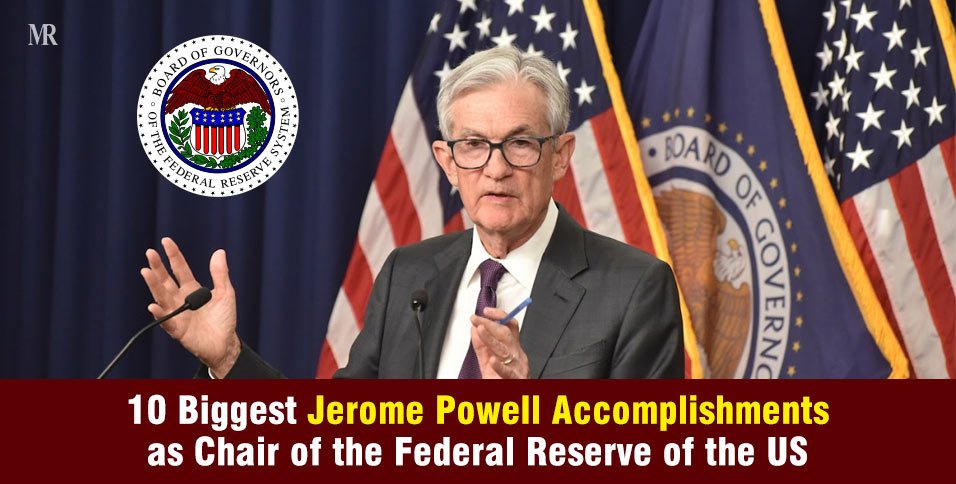
Jerome Powell, Chair of the Federal Reserve of the USA, has one of the most powerful financial roles of controlling interest rates, managing inflation, and steering economic stability not just in the U.S., but worldwide.
Over the past year, he has remained in the spotlight amid rate decisions, political scrutiny, and shifting economic risks.
At his latest Federal Open Market Committee meeting in April 2026, Jerome’s latest statement, “I won’t see you next time,” has effectively signaled that his tenure as Chair is ending.
As his era as chair of the Federal Reserve ends, here are 10 key Jerome Powell accomplishments that define his leadership at the Federal Reserve.
List of Top 10 Jerome Powell Accomplishments as Federal Reserve Chair
Note: Powell was first confirmed as the 16th Fed Chair by the U.S. Senate on January 23, 2018 (84–13), and reconfirmed on May 12, 2022 (80–19). His chairmanship officially ends May 15, 2026, making him one of only a handful of Fed chairs to serve two full consecutive terms.
1. Emergency COVID-19 Response: The Fastest Fed Mobilization in History
When COVID-19 triggered a global financial freeze in March 2020, Powell deployed the Federal Reserve’s full toolkit at a speed and scale never seen in peacetime.
- Rate Cuts to Near-Zero:
On March 3 and March 15, 2020, the Fed cut its target federal funds rate by a combined 1.5 percentage points, bringing it to a range of 0%–0.25%.
- Unlimited QE:
On March 23, 2020, the Fed announced unlimited quantitative easing. In the subsequent two years, it purchased $5 trillion in bonds, expanding the balance sheet from $4 trillion to $9 trillion.
- $750 Billion Corporate Backstop:
On April 9, 2020, the Fed announced its corporate credit facilities would be scaled up to backstop a combined $750 billion in corporate debt, invoking Section 13(3) of the Federal Reserve Act, emergency lending powers not used since the 2008–09 financial crisis.
- Dollar Swap Lines:
Currency swap lines with foreign central banks peaked at nearly $450 billion in May 2020, preventing a global dollar shortage from amplifying the crisis internationally.
The S&P 500 bottomed on March 23, 2020, the same day the Fed announced unlimited QE, and had fully recovered all its losses by August 2020.
2. Engineering the Fastest Rate Hike Cycle in 40 Years to Kill Inflation
When post-pandemic supply shocks and stimulus spending drove prices to a generational high, Powell responded with the most aggressive tightening cycle since Fed Chair Paul Volcker in the early 1980s.
- The Inflation Peak:
In June 2022, U.S. CPI inflation peaked at 9.1% (the highest level since 1981).
- 11 Rate Hikes in 16 Months:
The Fed hiked interest rates 11 times between March 2022 and July 2023, taking the federal funds rate from near-zero to a peak of 5.25%–5.50% (a 23-year high). Four of those hikes were 0.75 percentage points each, a magnitude not deployed since 1994.
- Disinflation Without Recession:
Before Trump’s tariff policies complicated the picture, inflation was on a path to hit the Fed’s 2% target in 2025, something few economists thought possible, while the unemployment rate stayed below 4.5% throughout the entire tightening cycle, a remarkably rare soft landing.
3. The “Soft Landing”: Defeating Inflation While Keeping Unemployment Near Record Lows
Separate from the mechanics of the rate hike cycle, the outcome itself deserves its own entry. Historically, aggressive Fed tightening has ended in recession. This time it did not.
- The Numbers:
The Consumer Price Index fell from its June 2022 peak of 9.1% to 2.9% by December 2024, a drop of over 6 percentage points, while the U.S. economy added jobs every single month of 2023. GDP grew 3.3% in Q4 2023 alone.
- Rare Historical Achievement:
Powell brought inflation back down almost to the Fed’s 2% target with only a very limited rise in unemployment, something few economists thought possible. The Fed’s own models, and most Wall Street forecasters, had assigned high odds of recession in 2023. It did not come.
4. Sustaining a Record-Breaking, Inclusive Labor Market
Powell placed full employment, and specifically the employment of the most marginalized workers, at the center of the Fed’s policy posture in a way that was deliberate and measurable.
- Pre-Pandemic Record Lows:
In 2019, Powell cut rates three times despite an unemployment rate already at 3.6% below nearly all economists’ estimates of the non-accelerating inflation rate (NAIRU). The unemployment rate for Black workers fell to 5.3%, the lowest on record at the time.
- Post-Pandemic Speed:
The U.S. labor market recovered all 22 million jobs lost in the COVID-19 recession by mid-2022, one of the fastest recoveries from mass unemployment in modern U.S. economic history.
- Eight-Year Track Record:
Low unemployment disproportionately benefits the most disadvantaged groups in the labor market, those with less education, Black and Hispanic workers, and people with criminal records. For six of Powell’s eight years as chair, the unemployment rate remained in the 3%–4.5% range.
5. The 2020 Jackson Hole Framework: Rewriting the Fed’s Policy Constitution
After an 18-month internal review, the first of its kind in the Fed’s history, Powell unveiled a major update to the Fed’s operating blueprint. This is one of the biggest Jerome Powell accomplishments.
- Announced at Jackson Hole:
Speaking at the Federal Reserve Bank of Kansas City’s annual Economic Policy Symposium in Jackson Hole, Wyoming, on August 27, 2020, Powell unveiled the revised “Statement on Longer-Run Goals and Monetary Policy Strategy.”
- Flexible Average Inflation Targeting (FAIT):
The Fed adopted “average inflation targeting,” formally committing to allow inflation to run “moderately” above its 2% goal “for some time” following periods when it had run below that objective. This was a direct response to PCE inflation averaging just 1.4% from 2012 to 2020 despite near-zero interest rates.
- Inclusive Employment Standard:
The framework formally declared maximum employment a “broad-based and inclusive goal,” shifting language away from purely aggregate numbers toward outcomes for specific demographic groups. This was a meaningful institutional change for a central bank that had historically treated all unemployment as equal.
6. Navigating the 2023 Regional Banking Crisis Without Contagion
As the Fed’s rate hike campaign drove down the market value of long-duration bonds, cracks appeared in the regional banking sector. Powell responded swiftly enough to prevent contagion.
- The Failures:
Silicon Valley Bank (SVB), headquartered in Santa Clara, California, failed on March 10, 2023, the second-largest bank failure in U.S. history at the time. Signature Bank followed two days later, on March 12.
- The Bank Term Funding Program (BTFP):
The Fed created the Bank Term Funding Program in March 2023 to lend to banks that had large unrealized losses on government bonds and were at risk of large-scale deposit withdrawals. It allowed banks to exchange assets such as U.S. Treasuries for cash at their full face amount, regardless of current market value.
- All Depositors Protected:
Acting in concert with the Federal Deposit Insurance Corporation (FDIC) and Treasury, the Fed enabled the resolution of the two failed banks in a manner that protected all depositors. The broader banking system held, and no further major bank failures followed.
- Self-Critical Transparency:
In April 2023, the Fed published a 115-page self-review led by Vice Chair for Supervision Michael Barr, acknowledging that SVB had 31 unaddressed supervisory warnings at the time of its failure, triple the average for peer banks. Powell publicly endorsed the findings and its recommended reforms.
7. The Quantitative Tightening (QT) Campaign: Shrinking a $9 Trillion Balance Sheet
Running in parallel to the rate hike campaign, Powell executed the largest deliberate reduction of a central bank balance sheet in history.
- The Peak:
The Fed’s balance sheet reached a historic peak of $8.96 trillion in April 2022, representing 36% of U.S. GDP, after $5 trillion in pandemic-era bond purchases.
- The Drawdown:
Beginning in June 2022, the Fed allowed its securities holdings to decline by more than $2.2 trillion, with roughly $1.6 trillion in Treasury securities and $600 billion in agency mortgage-backed securities.
- Conclusion:
QT ended in December 2025, having reduced the balance sheet from $8.9 trillion in 2022 to $6.5 trillion, a $2.4 trillion reduction, without triggering the kind of repo market stress that derailed the Fed’s previous QT attempt in September 2019.
8. The 2025 Jackson Hole Framework Revision: Course Correction in Real Time
Five years after announcing FAIT, Powell returned to Jackson Hole to acknowledge what had gone wrong and revise the framework again, a rare act of public institutional self-correction.
- Scrapping FAIT:
The Fed decided to scrap its controversial Flexible Average Inflation Targeting (FAIT) regime in favor of a Flexible Inflation Targeting (FIT) regime at the August 2025 Jackson Hole symposium.
- Powell’s Own Admission:
Powell said at Jackson Hole 2025 that “the idea of an intentional, moderate inflation overshoot had proved irrelevant, there was nothing intentional or moderate about the inflation that arrived a few months after we announced our 2020 changes.”
- Rebalancing the Dual Mandate:
The revised framework removed the asymmetric “shortfalls” language from the employment goal and restored a more balanced two-sided approach, making the Fed equally willing to respond to overheating as to underemployment. It was an unusually candid admission from a sitting Fed chair that a signature policy had not worked as designed.
9. Defending Federal Reserve Independence Against Unprecedented Political and Legal Attack
No accomplishment required more personal endurance than Powell’s refusal across two Trump administrations to bend monetary policy to political will.
- First Term:
During Trump’s first term (2018–2021), Trump publicly and repeatedly attacked Powell, at one point calling Fed officials “boneheads” for not cutting rates to zero or below. Powell refused and continued raising rates in 2018 before pausing on data grounds in early 2019.
- Second Term — Criminal Investigation:
In July 2025, Office of Management and Budget Director Russell Vought opened an investigation into a $2.5 billion renovation of the Marriner S. Eccles Building in Washington, D.C., widely seen as a pretext for Powell’s “for cause” removal.
- The Courts Intervene:
In March 2026, U.S. District Judge James Boasberg quashed the grand jury subpoenas, writing that “there is abundant evidence that the subpoenas’ dominant purpose is to harass and pressure Powell either to yield to the president or to resign,” and that “the government has offered no evidence whatsoever that Powell committed any crime other than displeasing the president.” The Department of Justice formally dropped the investigation in April 2026.
- Public Support:
A Gallup poll in December 2025 found Powell was the most popular American political official among 13 surveyed, and a September 2025 poll found 70% of Americans believed Trump should not replace Federal Reserve members who disagreed with him.
10. The Final Act: Rate Easing Cycle, a Historic Dissent Vote, and Staying On as Governor
Powell’s closing chapter combined deft policy sequencing with a dramatic final meeting and a historic post-chair decision that set a new institutional precedent.
- The Easing Cycle:
In September 2024, the Fed made its first 0.50% rate cut, then cut rates five more times over the following year, bringing the federal funds rate from 5.25%–5.50% down to 3.50%–3.75% by December 2025, a total reduction of 1.75 percentage points.
- New Inflation Shock:
The U.S. inflation rate jumped to 3.3% in March 2026, driven by a 12.5% surge in energy costs and an 18.9% spike in gasoline prices linked to the war with Iran, forcing the Fed to hold rates at three consecutive meetings in January, March, and April 2026.
- A Historic Final Vote — April 29, 2026:
Powell’s final FOMC meeting as chair ended in an 8–4 split vote, the most dissenting ballots at any single FOMC meeting since October 1992. Cleveland Fed President Beth Hammack, Minneapolis Fed President Neel Kashkari, and Dallas Fed President Lorie Logan opposed the statement’s easing bias, while Governor Stephen Miran voted for an immediate cut.
- Staying On as Governor:
On April 29, 2026, Powell announced he would remain on the Fed’s Board of Governors, where his term runs to January 31, 2028, citing a “series of legal attacks” against the central bank. His immediate predecessors, Janet Yellen, Ben Bernanke, and Paul Volcker, all resigned the same day their chairmanships ended.
The decision to remain as a Governor was met with public disappointment from NEC Director Kevin Hassett, who argued it was time for the Fed to move on. Moreover, Powell’s decision to stay denies Trump an immediate vacancy and preserves his vote on monetary policy through a period of institutional uncertainty.
End Note
Jerome Powell led the U.S. economy through some of its most chaotic years. From the COVID-19 crisis to the fight against high prices, Jerome Powell accomplishments have shaped the financial world we live in today.
While his time as Chair ends on May 15, 2026, he isn’t leaving the Federal Reserve entirely. By staying on the Board of Governors until 2028, Powell ensures his experience remains part of the team.
Maria Isabel Rodrigues