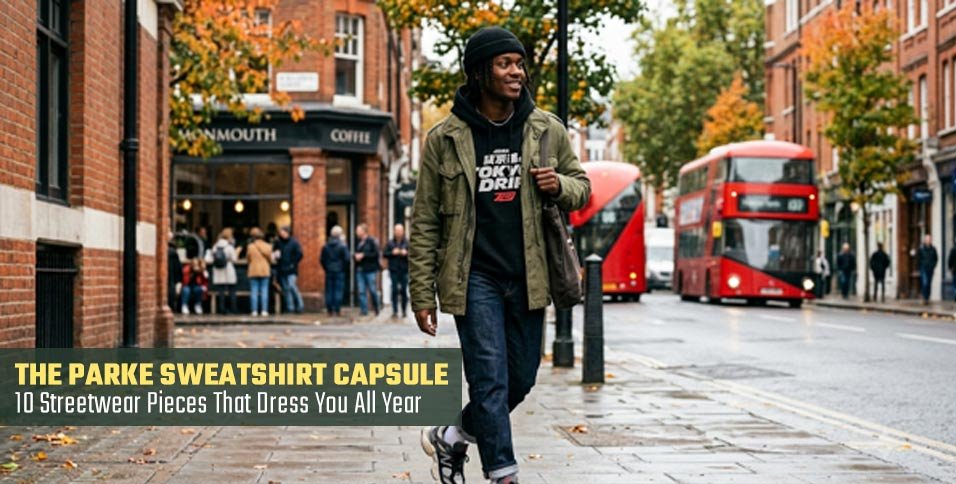
Why Ten Good Pieces Beat a Full Closet
Open your closet right now and count how many things you actually wore this month. For most people, the honest answer is somewhere between eight and twelve pieces, while the other forty hang there absorbing dust and guilt. That gap is the whole argument for a capsule wardrobe, and streetwear suits the idea better than almost any other style. Because streetwear runs on repetition and recognizable staples, nobody blinks when you wear the same crewneck twice in one week, and a piece like a parke sweatshirt is built for exactly that kind of heavy rotation, with fleece thick enough to survive constant wear and a look plain enough to never feel repeated. The math works in your favor too. Ten pieces that each cost a bit more still total less than the fifty cheap ones they replace, and every single one earns its keep instead of waiting for a mood that never comes. Beyond money, a small wardrobe removes the worst part of getting dressed, which is deciding. When everything matches everything, any combination you grab in the dark works, so mornings get faster and outfits get more consistent at the same time. There’s a confidence effect as well, though people rarely name it. Wearing pieces you trust completely reads differently than wearing whatever survived the laundry cycle, and others notice the difference even if they can’t explain it. Now, this system isn’t magic, and I’ll flag its limits honestly as we go, since capsules have real weak spots around weather extremes and formal events. Still, for the ninety percent of life that happens in casual clothes, ten smart pieces cover you better than a stuffed closet ever did. Here’s how to pick them, in order, without wasting a dollar.
The Parke Sweatshirt Test: What Every Capsule Piece Must Pass
Every piece that enters a ten-item wardrobe has to justify itself harder than pieces in a big closet ever do, so it helps to have a standard, and the best standard I know is what I call the anchor test. Ask three questions of any candidate. Does it pair with at least seven of your other nine pieces? Will it physically survive fifty wears a year? And does it look intentional worn completely on its own, with nothing interesting around it? A quality crewneck is the clearest example of a piece that passes all three, which is why something like a parke sweatshirt makes such a natural capsule anchor, since heavyweight fleece handles the wear count, the clean minimal face pairs with everything, and the ribbed cuffs and subtle embroidery give it enough presence to carry an outfit solo. Compare that against the pieces that fail the test, and you’ll notice they fail predictably. Loud items fail question one because they only pair with neutrals. Thin fast-fashion items fail question two by pilling before month three. And overly basic items sometimes fail question three, looking unfinished rather than minimal when worn alone, usually because the fabric lacks weight and the fit lacks shape. Fabric weight, honestly, is the quiet hero of the whole test. Heavy fleece drapes with structure, hides minor wrinkles, and softens with age, while light fleece clings, creases, and ages backwards. My personal rule, and it has never once betrayed me: when torn between two similar pieces, buy the heavier one. Weight is the one quality you can feel in three seconds that predicts everything else about how a garment will live in your rotation for years.
The Ten Pieces, In Exact Buying Order
Order matters more than people think, because each purchase should expand what your existing pieces can do, and buying a statement piece before your basics exist is how closets fill with orphans. Consequently, build in this sequence, pausing between purchases to actually wear what you have. Here’s the full list:
- A heavyweight crewneck sweatshirt in cream or grey your anchor, worn solo or layered, the hardest working piece you’ll own
- Straight-leg jeans in a medium wash the pant that pairs with every top on this list without a single exception
- Clean white leather sneakers they finish casual outfits and quietly upgrade plain ones
- A plain heavyweight black tee the summer base and the winter underlayer, doing two jobs for one price
- A black or charcoal hoodie your cold-morning default and your travel comfort piece
- A second pair of pants, black or olive, slightly tapered suddenly every top has two complete outfits
- A plain white or cream tee the light counterweight that keeps summer rotations from going all-dark
- One graphic statement piece, hoodie or tee now it has a calm wardrobe to land in, so it pops instead of clashing
- A simple overshirt or light jacket in a neutral the layer that turns five outfits into fifteen
- A beanie or cap small money, big finishing power, and it ties repeated outfits together
Notice the statement piece sits at number eight, not number one. That single ordering decision separates capsules that work from piles that don’t. Follow the sequence and every new item multiplies your combinations instead of just adding one more thing to ignore.
Color Rules That Make Everything Match
A ten-piece wardrobe only works if the pieces cooperate, and cooperation is almost entirely a color problem, so the rules here are strict but mercifully simple. Build the whole capsule from a base of four neutrals: black, cream, grey, and one earth tone like olive or washed brown. Those four shades combine in any direction without a single clash, which is the entire trick behind people who seem effortlessly well dressed. They’re not matching outfits each morning; they made matching impossible to fail months ago at the checkout page. Denim counts as a neutral too, thankfully, so a medium wash slots in anywhere without using up one of your four slots. Within the neutrals, aim for a spread of light and dark rather than clustering, because an all-dark capsule looks heavy in summer and an all-light one disappears in winter. Roughly half your tops dark, half light, and you’ll always have a combination that suits the season and the weather. Then comes the one allowed exception, and it matters: a single accent color, living in exactly one piece, ideally your statement graphic or your beanie. One accent reads as personality. Two accents read as noise in a wardrobe this small, since every piece appears constantly and clashes repeat themselves weekly instead of hiding in a big rotation. Texture is how you keep four colors from feeling boring, and it costs nothing extra. Fleece against denim, leather against knit, brushed cotton against canvas — the surfaces create variety even when the palette stays quiet. If you take one sentence from this whole section, take this: boring colors, interesting textures, one loud exception. That formula has dressed half the best-dressed people you’ve ever passed on the street.
Where Loud Graphics Fit in a Quiet System
A capsule built entirely from plain neutrals risks sliding from minimal into forgettable, and that’s precisely the job of piece number eight, the statement. Streetwear’s whole heartbeat is the bold graphic, so the goal was never to remove personality, just to give it a stage where it performs instead of competing. One loud piece inside nine quiet ones gets photographed; five loud pieces fighting each other get pitied. The statement slot rewards genuine boldness, too, because everything around it is calm enough to absorb it. Go for the big back print, the heavy front graphic, the piece you’d hesitate to buy in a chaotic wardrobe. Here it works. When choosing your statement, a few guidelines keep the piece useful rather than ornamental:
- Pick a graphic whose base garment color is still one of your four neutrals, so the piece layers into existing outfits even when the print is loud
- Favor prints with two or three colors over rainbow chaos, since simpler graphics age better and match your accent-color rule
- Check the print quality with a thumbnail along its edge, because a statement piece worn weekly needs screen-print durability, not a peeling transfer
- Choose a design you liked two years ago and still like now, as your own history is the best predictor of what survives trends
- Make sure it passes the solo test, looking complete over plain jeans with nothing else helping it
Worn with intention, the statement piece becomes the exclamation mark of the whole system. Everything else builds the sentence; this one ends it loudly. And because it’s singular, it stays special, which is something no closet with fifteen graphics can claim about any of them.
Layering the Capsule Through Four Seasons
Ten pieces covering twelve months sounds impossible until you realize layering multiplies clothing the way combinations multiply outfits, and the capsule was quietly designed for it from piece one. Summer runs on the two tees, jeans or shorts if you swap a pant seasonally, and the sneakers, with the crewneck riding along for cold evenings. Spring and autumn are the capsule’s home turf, where the crewneck and hoodie trade lead roles and the overshirt turns every top into a two-layer outfit. Winter is where the heavier pieces earn their price, and it’s where a serious graphic hoodie becomes structural rather than decorative, since a heavyweight hood layered under an open jacket adds real warmth at the neck that a crewneck can’t match. That’s also the season your statement piece works hardest, and it’s why graphic-heavy labels like hellstar cut their hoodies from dense, warm cotton in the first place, because a statement you can only wear in mild weather is a part-time statement. Layer order follows one mechanical rule: each layer outward must be genuinely roomier than the one beneath, so the tee sits closest, the fleece breathes over it, and the jacket closes over everything without bunching at the shoulders. Now for the honest limitation I promised earlier, because capsules do have one. Ten pieces cannot handle weather extremes, and pretending otherwise ruins the system. Real winter demands a proper coat, and real heat may demand shorts, so treat those as seasonal guests outside the ten rather than forcing the capsule to fail at jobs it was never built for. The ten cover your year’s middle eighty percent. Guests cover the edges. Together, they cover everything.
Fit and Proportion: Making Ten Pieces Look Like Thirty
Two people can own identical clothes and look completely different in them, and the gap is almost always proportion, which costs nothing and multiplies a small wardrobe better than any purchase could. The core principle is balance: volume in one zone, structure in the other. A relaxed crewneck over slimmer pants creates a clean triangle. Wider pants under a neater, tucked, or shorter top flips the triangle and still works. Both volumes at once, however, and the silhouette turns into a shapeless column, which is where most casual outfits quietly die. Within each garment, three checkpoints decide whether a piece reads intentional. The shoulder seam should sit at your shoulder’s edge or drop deliberately past it, never hovering awkwardly in between. The hem should land between your waistband and mid-hip for tops worn out, since longer starts swallowing your legs. And the pant-to-shoe intersection, that little junction at your ankle, should end in either a clean break or a deliberate stack of folds, not an accidental crumple. Here’s the hands-on trick that changed my own outfits more than any purchase ever did: the ten-second mirror check at the door, but from the side, not the front. Front views lie, because you instinctively stand straighter and everything drapes its best. The side view shows what the world actually sees all day, including hem length, pant break, and how layers sit at your back. Ten seconds, sideways, before leaving. Small adjustments follow naturally — a half-tuck here, one cuff roll there, sleeves pushed to the forearm — and each one changes an outfit’s whole energy for free. Ten pieces, worn with proportion awareness, genuinely outdress thirty pieces worn on autopilot. The mirror is the multiplier.
Maintenance and Rotation: Keeping the Capsule Alive
A small wardrobe concentrates wear, so every piece works five times harder than it would in a big closet, and care habits decide whether the system lasts three years or barely one. Washing is the main battlefield. Cold water, always, and graphic pieces turned inside out, because heat fades color, shrinks cotton unevenly, and cracks prints along their fold lines. The dryer deserves special suspicion, since its heat is what destroys the ribbed cuffs, hems, and collars that give sweatshirts and hoodies their structure. Hang the mid-weight pieces and lay the heaviest ones flat, as a soaked heavyweight top on a thin hanger will stretch its own shoulders under water weight. Wash frequency matters just as much as method. Fleece worn over a tee touches very little skin, so airing it overnight after wear handles most freshness, and a full wash every four to six wears is plenty. Every skipped cycle is genuine life added. Rotation is the quieter half of maintenance, and it’s the part people forget. Even within ten pieces, alternate rather than repeating, because fleece fibers need a day to decompress and recover their loft after wear, and back-to-back days flatten a favorite piece noticeably faster. Give each top a rest day and the whole capsule ages evenly instead of one hero dying young. Twice a year, run an honest audit. Check seams, cuffs, print edges, and knee wear, then replace the weakest piece with a better version rather than adding an eleventh item. The capsule stays ten forever; only the quality climbs. Treated this way, a small wardrobe becomes something a big closet never manages to be, which is finished. Nothing missing, nothing wasted, everything worn.
Final Words
A ten-piece streetwear capsule isn’t about owning less for its own sake; it’s about every single piece pulling real weight, every day, in any combination. Build in order, keep the palette to four neutrals plus one accent, let one loud graphic carry the personality, and protect it all with cold washes and honest rotation. Do the side-mirror check before you leave. Replace, don’t accumulate. Follow that system and getting dressed stops being a decision and starts being a result, one that looks deliberate every morning because, months ago at checkout, it was.
FAQ BLOCK
Q: Can I really manage with only ten pieces of clothing?
A: For casual daily life, yes, comfortably. The ten cover roughly eighty percent of your year. Weather extremes and formal events sit outside the system, so keep a proper coat and one formal outfit as seasonal guests rather than forcing the capsule to do their jobs.
Q: Which piece should I buy first for a streetwear capsule?
A: A heavyweight crewneck sweatshirt in cream or grey. It works solo, layers under jackets, pairs with every pant, and survives constant wear. It’s the single most versatile piece in the entire system, which is why it holds the number one slot.
Q: How do I stop a small wardrobe from looking repetitive?
A: Three tools: texture mixing, layering, and small finishers like beanies or caps. Fleece over denim reads differently than fleece over canvas, and a half-tuck or rolled cuff changes an outfit’s energy for free. People notice combinations, not individual pieces.
Q: How many graphic pieces belong in a capsule wardrobe?
A: One. A single statement inside nine quiet pieces stands out and stays special, while multiple graphics compete and clash on repeat in a rotation this small. Make that one piece genuinely bold, and keep its base color within your neutral palette.
Q: How often should capsule pieces be replaced?
A: Audit twice a year. Check seams, cuffs, print edges, and knee wear, then upgrade the single weakest piece instead of adding new ones. Quality heavyweight pieces typically last two to four years of heavy rotation when washed cold and air dried.