Mirror Review
September 1, 2026
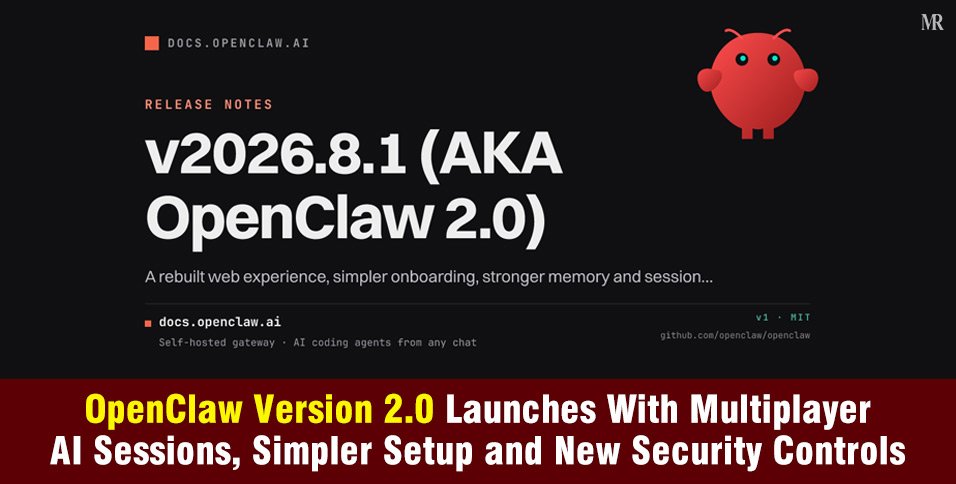
OpenClaw version 2.0 has launched with simpler setup, a rebuilt browser experience, persistent sessions, multiplayer collaboration, and new security controls. OpenClaw says the release is the largest update in its history. It was built by 933 contributors, including 569 first-time contributors, through more than 16,000 pull requests.
The release expands the open-source AI agent created by Peter Steinberger. It updates how users install OpenClaw, choose models, manage sessions, use browser tools, and work with other people. It also adds new ways to manage credentials and permissions as agents work with more tools and services.
OpenClaw Version 2.0 Makes Setup Easier
OpenClaw version 2.0 makes it easier for users to get an AI agent running. The update includes simpler onboarding and a rebuilt web experience that puts more of the setup and daily workflow in one place.
The improved model setup helps users connect OpenClaw with supported AI models and authentication options. Users can also return to their existing work instead of treating every interaction as a new session.
The browser experience is another major part of the update. OpenClaw’s Control UI provides a browser-based way to interact with the Gateway, view activity, and manage agent work.
The release makes that experience a more important part of how users work with OpenClaw. For developers using AI developer tools, the changes reduce some of the work needed to move from installation to actual use.
Multiplayer Sessions Change How Users Work With Agents
OpenClaw 2.0 introduces shared sessions that let users continue agent work across different environments. Sessions can run through the Gateway, paired devices, or cloud workers, while the work remains connected to the same session.
This creates a new model for multiplayer AI coding. Instead of keeping an agent session tied to one person’s computer, users can continue work from another supported environment and keep the existing context.
The update also improves session continuity. Developers can return to ongoing work and continue from the previous state instead of starting again. This is useful for tasks that take more than one interaction or require work to continue over time.
OpenClaw also supports session hosting on trusted paired devices. The system allows users to choose a device for session work while keeping authorization with the Gateway.
OpenClaw Version 2.0 Adds New Security Controls
OpenClaw 2.0 adds new controls for handling credentials and permissions. One change allows private credential requests, so an agent can request a secret through a protected prompt without exposing the credential value in the conversation or model context.
The release also adds session permission modes and team-level controls. These features give users more ways to decide what an agent or session can access.
These changes matter for agentic security because OpenClaw agents can interact with AI tools, files, services, and connected systems. Managing access becomes important when an agent can do more than simply generate text.
OpenClaw also continues to use trust boundaries between different users and workloads. Its security guidance recommends keeping workloads with different trust levels in separate environments rather than treating one shared Gateway as a complete security boundary.
The release therefore adds more controls without suggesting that users can ignore permissions or access management.
Why OpenClaw Version 2.0 Matters for Developers
OpenClaw version 2.0 brings several parts of the platform together in one major release. The changes cover setup, models, browser tools, sessions, automation, collaboration, and security.
For developers, the biggest practical change is the move toward persistent agent work. An AI agent can now remain part of an ongoing session instead of being used only for short, separate tasks.
That also changes how teams can use an open-source AI agent. Work can continue across supported devices and cloud environments, while users can keep track of the same session and its progress.
The scale of the release is also notable. OpenClaw says more than half of the 933 contributors were first-time contributors. The 16,000-plus pull requests show how much development went into the update.
OpenClaw Version 2.0 Expands the Agent Workflow
OpenClaw version 2.0 brings simpler setup, persistent sessions, multiplayer collaboration, and new security controls into one major release. The update gives developers more ways to configure, share, and manage AI agent work while maintaining control over credentials, permissions, and trust boundaries.
OpenClaw 2.0 connects setup, ongoing sessions, collaboration, and access management into a broader workflow. That makes the release an important step in how the open-source AI agent is being developed for longer and more collaborative tasks.
Gurushanth S Jatti