Mirror Review
June 29, 2026
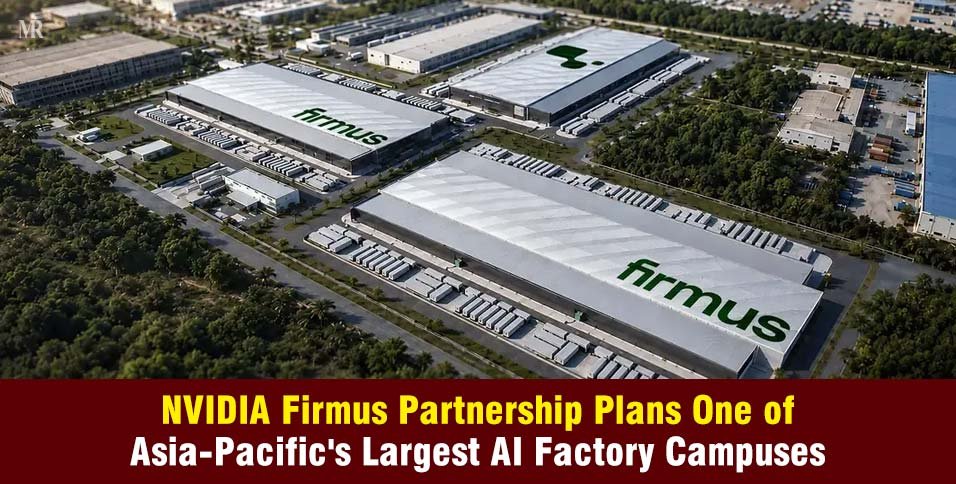
NVIDIA and Firmus Technologies have launched an AI infrastructure deal to build a massive 360-megawatt NVIDIA DSX AI Factory campus in Batam, Indonesia.
Running through 2034, the NVIDIA Firmus Partnership will deploy up to 170,000 advanced AI accelerators, including the Grace-Blackwell, Vera-Rubin, and Vera platforms, by 2028.
The project establishes one of the largest AI infrastructure developments in the Asia-Pacific region.
The NVIDIA Firmus Partnership utilizes an innovative revenue-sharing and credit-support model, allowing Firmus to sell NVIDIA-powered cloud services while NVIDIA earns standard product revenue alongside a share of usage-linked cloud earnings.
This commercial structure lowers capital barriers for high-growth AI-native companies, enterprise clients, and independent software vendors (ISVs) needing rapid, dependable access to scalable computing power.
The Evolution of the NVIDIA and Firmus Partnership
Historically, traditional data centers focused heavily on general-purpose central processing units (CPUs) designed to handle sequential storage and basic enterprise workloads. However, the rise of large language models, generative AI, and autonomous systems triggered an industrial-scale demand for parallel processing. This shift turned data centers into modern “AI factories” that treat data as a raw material and output intelligence as tokens.
To meet this transition, Australia’s AI Startup Firmus originally focused on optimizing energy efficiency and liquid-cooling designs through its proprietary HyperCube architecture. By engineering modular systems, the company aimed to tackle the immense heat and electrical loads generated by modern dense computing hardware.
The Firmus NVIDIA deal scales these regional innovations to a global level. Under this multi-year agreement, Firmus integrates its Australian-engineered HyperCube hardware directly with the NVIDIA DSX full-stack AI factory platform. This combination creates a unified architecture where software and hardware are co-designed, maximizing processing throughput while driving down operational overhead.
Technical Milestones of the NVIDIA Firmus Partnership
| Feature / Metric | Details and Specifications |
| Total Power Capacity | 360 Megawatts (MW) |
| GPU Deployment Volume | Up to 170,000 AI Accelerators |
| Hardware Generations | NVIDIA Grace-Blackwell, Vera-Rubin, and Vera platforms |
| Projected Offtake Revenue | US$25 billion to US$30 billion (First 6 Years) |
| Core Architecture | NVIDIA DSX integrated with Firmus HyperCube |
| Project Location | Batam, Indonesia (Partnered with DayOne) |
Lowering Cost Per Token via the Firmus GPU AI Factory Campus
As artificial intelligence matures from initial model training to continuous real-time inference and reasoning, the primary economic metric for infrastructure success has shifted to the cost per token. Token efficiency directly measures the total cost of ownership against hardware performance, software optimization, and real-world grid utilization.
The Firmus GPU AI Factory Campus addresses these economic demands by combining full-stack software with physical engineering.
NVIDIA DSX software provides automated blueprints to simulate, test, and manage the campus as a single cohesive machine. Concurrently, the liquid-cooled HyperCube architecture removes heat more effectively than legacy air-cooled facilities, significantly boosting tokens per watt.
Tim Rosenfield, Co-CEO of Firmus Technologies, explained the regional demand for this infrastructure:
“AI agents are creating a new class of industrial-scale demand for tokens, and Asia-Pacific needs AI factories that can be built faster, liquid-cooled more efficiently and operated at gigawatt scale. Together with NVIDIA, Firmus is building liquid-cooled, AI infrastructure designed to deliver AI tokens as efficiently and rapidly as possible for the region’s most important customers.”
Furthermore, the integration of NVIDIA DSX helps the facility manage power fluctuations dynamically. Features like DSX MaxLPS allow the campus to optimize power limits, enabling up to 40% more GPUs to operate within a constrained electrical budget. This prevents wasted energy and ensures stable, high-volume token generation for developers.
Expanding the NVIDIA Firmus Collaboration Across Asia-Pacific
The selection of Batam, Indonesia, for this massive campus proves the rise of sovereign AI and localized data processing.
Building infrastructure closer to regional users lowers latency, reduces data transit friction, and allows enterprises to comply easily with local regulatory frameworks. For this project, Firmus is collaborating with DayOne, a digital infrastructure platform based in Singapore, to manage the regional logistics and physical buildout.
Beyond Indonesia, Firmus Technologies is expanding its AI factory footprint deeper into Australia and Southeast Asia. Through an initiative called Project Southgate, the company is deploying modular AI factories in Tasmania, Melbourne, South Australia, and New South Wales. These sites prioritize renewable energy and advanced cooling to bring new capacity online rapidly. Firmus has also deployed AI systems in Singapore through a partnership with ST Telemedia Global Data Centres.
This expansion aligns with a broader global buildout of the NVIDIA AI Cloud ecosystem. Tech companies, telecommunications providers, and vertically integrated infrastructure firms worldwide are constructing similar factories.
Commenting on this global trend, Jensen Huang, founder and CEO of NVIDIA, stated:
“Every company and every country needs AI factory infrastructure to turn data into intelligence. NVIDIA AI Clouds bring full-stack AI factories closer to the regions, industries and developers building the next generation of AI, from model training to real-time inference and AI agents that will transform how people and organizations work.”
Market Implications for Global AI-Natives
The economic structure of the Firmus Technologies AI infrastructure deal with Nvidia sets a new precedent for how technology infrastructure is funded and accessed.
Historically, smaller AI startups and independent software vendors faced major financial bottlenecks. Procuring thousands of advanced GPUs requires massive upfront capital, which often outpaces what traditional capital markets or venture capital rounds can quickly provide.
The NVIDIA Firmus Partnership eliminates this barrier through its credit-support and revenue-sharing framework. By allowing AI-natives to scale their computing consumption flexibly without heavy capital investments, the partnership speeds up the deployment of practical applications.
Because NVIDIA shares in the ongoing cloud revenue, both companies are financially incentivized to maximize hardware utilization, maintain high uptime, and keep operational costs low.
End Note
The NVIDIA Firmus Partnership represents how computing power is delivered, managed, and funded across the globe today. By combining advanced accelerators with innovative Australian liquid-cooling architecture, the Batam campus addresses the intense physical and economic challenges of the modern computational era. With billions of dollars in committed offtake agreements and a footprint expanding across Southeast Asia, this collabor
Maria Isabel Rodrigues