Mirror Review
February 10, 2026
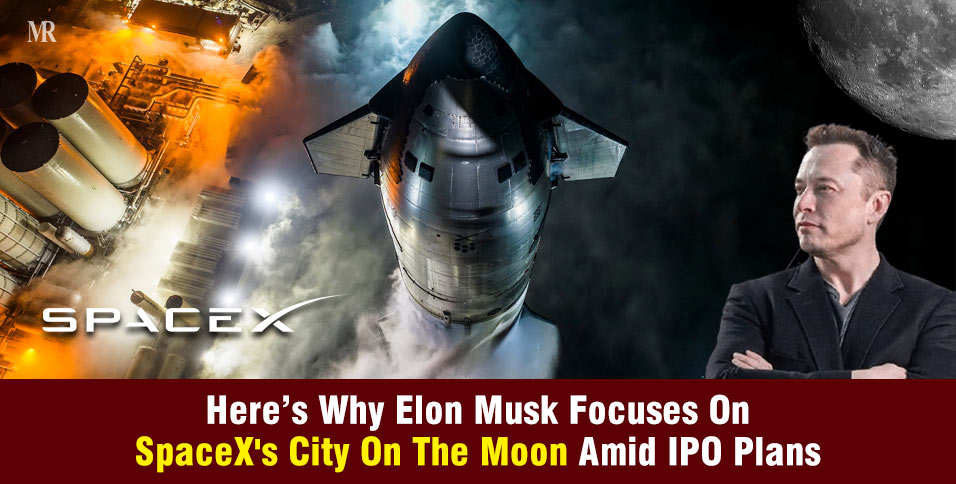
SpaceX is shifting its near-term focus to the Moon, positioning it as the company’s next long-term operating base rather than just a mission destination. The change is tied to SpaceX’s Starship program and NASA’s Artemis missions, which aim to support sustained human activity on the lunar surface.
Elon Musk confirmed the shift in a recent post on X, saying SpaceX is now working toward a “self-growing city on the Moon” that could be built in less than 10 years. He said a similar city on Mars would take more than 20 years due to longer travel times and limited launch windows.
Musk also said, “The mission of SpaceX remains the same: extend consciousness and life as we know it to the stars.”
The renewed focus on SpaceX City on the Moon comes as discussions around a future SpaceX IPO resurface, tying the lunar strategy to how Musk wants investors to view the company’s long-term scale and purpose.
Why the Moon Has Become Central to SpaceX’s Plan
SpaceX City On The Moon does not mean a fully built city tomorrow.
It refers to a long-term plan where SpaceX provides:
- Regular cargo and crew transport to the Moon
- Permanent lunar infrastructure support
- Launch and logistics services for governments and private firms
For years, Mars dominated Elon Musk’s public vision. But recently, the Moon has taken center stage.
That change is practical since the Moon is closer, cheaper to reach, and already backed by government funding.
Furthermore, NASA’s Artemis program aims to establish a long-term human presence on the lunar surface in the 2030s. And SpaceX’s Starship has been selected as the human landing system, placing the company at the core of these missions.
Thus, SpaceX’s “City On The Moon” reflects this shift from exploration to operations.
Starship Is the Real Reason Behind the Moon Focus
Starship is the largest and most expensive project SpaceX has ever built. It only works as a business if it flies often.
A lunar base creates that demand.
Cargo deliveries, habitat modules, fuel transport, and crew rotations all require frequent launches. This turns Starship into a workhorse instead of a one-off vehicle.
How a Lunar City Narrative Supports IPO Valuation
An IPO changes how a company tells its story.
Investors do not value SpaceX IPO only on rockets. They value future cash flows.
By talking about a City On The Moon, Elon Musk expands SpaceX’s addressable market from launch services to space infrastructure.
That shift helps justify private valuations reportedly above $180 billion and supports even higher expectations in public markets.
Government Strategy and Global Competition Matter
The Moon is no longer neutral territory.
As countries like China, Russia, India, Japan, and members of the European Space Agency accelerate plans for sustained lunar activity, the Moon is fast becoming the next arena for long-term space operations rather than short-term exploration.
The United States, meanwhile, is pursuing a different model.
Through NASA’s Artemis program, the US is funding sustained lunar missions while relying on private companies to build and operate critical systems. SpaceX, Blue Origin, Lockheed Martin, and Northrop Grumman are all part of this ecosystem, but SpaceX plays the most central role through Starship and launch dominance.
This growing wave of public investment makes the SpaceX City On The Moon idea feel less like speculation and more like alignment with global strategy.
Risks That Could Slow the SpaceX City On The Moon Plan
The plan to build SpaceX’s City On The Moon carries significant execution risk.
Starship, which is the core of the entire strategy, is still in active testing and must prove it can fly reliably, land safely, and operate at high launch frequency. Any delays or failures in reaching full reusability would directly slow lunar timelines.
Beyond engineering, regulatory approvals remain an issue.
Launch licensing, environmental reviews, and coordination with international space agencies can stretch schedules.
At the same time, government funding priorities can change with elections, affecting programs like Artemis that SpaceX depends on.
End Note
If Elon Musk can turn lunar missions into a repeatable system, it would set a new standard for how space activity is organized, funded, and scaled.
That outcome would reshape expectations not just for SpaceX, but for governments and private players planning to operate beyond low Earth orbit.
Whether the full vision arrives on schedule or not, the Moon is becoming the testing ground for humanity’s next phase in space.
SpaceX builds there will influence how the future of off-world development is structured long after launch milestones fade from memory.
Maria Isabel Rodrigues