Mirror Review
October 8, 2026
Google DeepMind, Isomorphic Labs, and Meta have joined Biohub’s Virtual Biology Initiative with a combined $300 million investment. The October 7 announcement also brought the U.S. Department of Energy (DOE) and the National Institutes of Health (NIH) into the effort, taking the combined commitment to $1.8 billion in funding, data, computation, and measurement technology for AI-ready biological data.
The $300 million investment from Google DeepMind, Isomorphic Labs, and Meta will support technologies and multimodal datasets for predictive models of biology. Biohub’s expansion raises a broader question: what exactly is the organization building, and how will biological data support predictive AI models?
What Is Chan Zuckerberg’s Virtual Biology Initiative?
Chan Zuckerberg’s Virtual Biology Initiative is a Biohub-led effort to create the biological data and technologies needed for predictive AI models of life. Biohub announced the Virtual Biology Initiative in April 2026 to coordinate data generation across institutions and disciplines.
Biohub plans to expand measurements of how cells respond to interventions across more cell types and conditions. Researchers can use the resulting datasets to develop AI systems that help predict biological responses and explore questions digitally through virtual experiments.
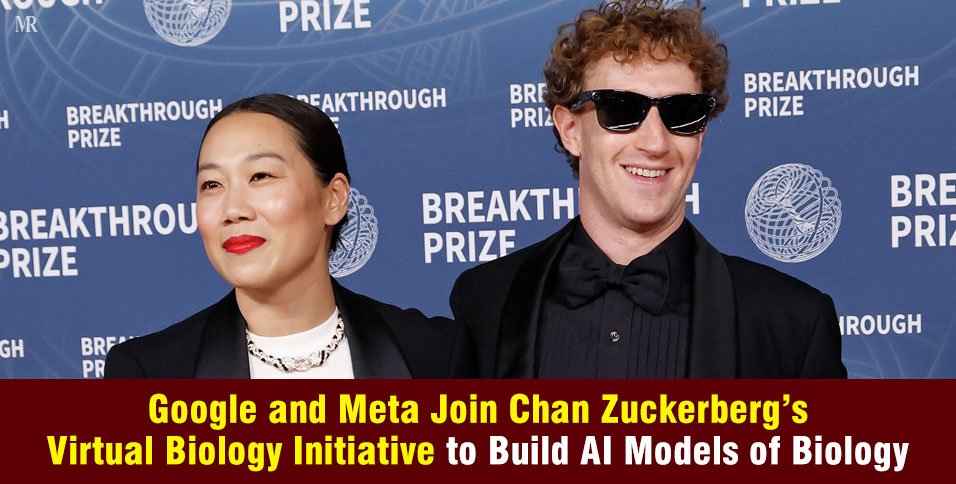
Mark Zuckerberg and Priscilla Chan founded the Chan Zuckerberg Initiative (CZI). CZI announced a $600 million commitment in 2016 to create the Chan Zuckerberg Biohub, establishing the research organization that now leads the current effort.
What Is the Chan Zuckerberg Biohub?
The Chan Zuckerberg Biohub is a nonprofit research institute that combines frontier AI and biology to advance biomedical research. Biohub was created through CZI’s 2016 commitment and has developed technologies, datasets, and research infrastructure for studying biology at cellular and larger scales.
Biohub’s existing resources include Tabula Sapiens, OpenCell, Zebrahub, CELLxGENE, and the CryoET Data Portal. Those resources provide biological measurements and data infrastructure that can support the broader AI biology effort.
What Is the Biohub Virtual Cell?
The Biohub virtual cell refers to the goal of developing predictive models that can represent biological systems and estimate how cells respond to interventions. Biohub describes creating a virtual cell as a major scientific challenge because researchers need large amounts of experimental data showing how living cells behave and respond to changes.
Predictive cell models could allow researchers to examine biological questions computationally before selecting experiments for laboratory testing. NIH says such models could help researchers identify potential drug targets and interventions and prioritize ideas for laboratory and clinical testing.
How Will Biohub Build AI-Ready Biological Data?
Biohub will build AI-ready biological data by expanding biological measurements across cell types, conditions, and interventions. The Virtual Biology Initiative will also develop technologies for studying cells and cellular interactions at greater scale, speed, and accuracy.
Biohub’s $500 million commitment anchors the initiative. Biohub will direct $400 million toward technologies including cryo-electron tomography, microscopy capable of imaging millions to billions of cells in living tissue, and tools for building and perturbing biology at molecular, cellular, tissue, and whole-organism levels. Another $100 million will fund research outside Biohub.
Biohub’s existing work with large biological datasets and measurement technologies provides the infrastructure for the expanded initiative.
What Are Google, Meta, DOE, and NIH Contributing to Virtual Biology Initiative?
Google DeepMind, Isomorphic Labs, and Meta are collectively investing $300 million in the Virtual Biology Initiative. The three organizations will contribute to technologies and multimodal datasets for predictive models of life.
DOE is contributing more than $500 million over five years through its Genesis Mission. DOE will bring capabilities including exascale computing, X-ray and neutron scattering, cryo-electron microscopy and tomography, and autonomous laboratories.
NIH will coordinate existing biomedical datasets, national data infrastructure, and research programs. NIH will work with Biohub to standardize appropriate datasets for AI model training, including resources developed through more than $500 million in prior federal investment.
Why Does AI Biology Need More Biological Data?
AI biology needs experimental data that connects biological conditions with measurable cellular responses. Predictive models require measurements across many more cell types and conditions than researchers have studied so far.
NIH and Biohub will standardize appropriate datasets for model training, while existing single-cell datasets can provide information about different cellular states. Better-connected datasets can give computational biology systems more information for modeling biological responses.
What Could the Virtual Biology Initiative Enable?
The Virtual Biology Initiative could allow researchers to explore biological questions computationally and prioritize laboratory experiments. NIH identifies potential applications including finding promising drug targets and interventions and selecting ideas for laboratory and clinical testing.
Virtual experiments could complement physical experiments by giving researchers another way to examine biological responses before testing selected hypotheses in the laboratory. Biohub’s goal is to create the foundational measurements and open resources needed for those predictive systems.
What Happens Next for Chan Zuckerberg’s Virtual Biology Initiative?
Chan Zuckerberg’s Virtual Biology Initiative will focus on generating, standardizing, and connecting the biological datasets required for predictive models. Biohub is bringing together scientific organizations including the Allen Institute, Broad Institute, Gladstone Institutes, Human Cell Atlas, Human Protein Atlas, and Wellcome Sanger Institute. NVIDIA will provide accelerated computing infrastructure, software and technical expertise.
Biohub will also develop technologies for collecting biological measurements at greater scale and speed while making appropriate data openly accessible. The approach builds on Biohub’s existing infrastructure and its work with large biological datasets.
The Virtual Biology Initiative now combines $1.8 billion in funding, data, computation, and new measurement technology from industry, government, and research organizations to build the foundation for predictive models of biology.
Gurushanth S Jatti