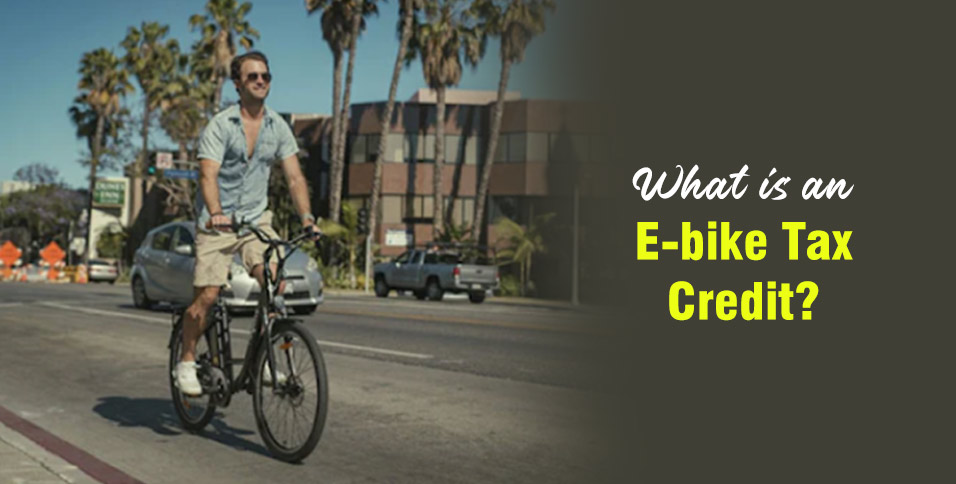
An electric bike is a bike that provides power assistance to the rider pedaling the bicycle. It combines the simplicity of a traditional bike with the power of technology. It is eco-friendly, less tiring, and also provides the health benefits of riding an ordinary bicycle. And yes, it is not cheating.
Experts have proven that riding an e-bike gives you physical benefits just as a conventional bike does. However, due to high prices, many individuals do not purchase these. They either chose to ride conventional bikes or, in most cases, opted for a motorbike. This poses a threat to the environment, as these motor vehicles can cause air and noise pollution.
What is An E-bike Tax Credit?
The proposed federal e-bike act suggests that electric bikes are made more affordable to individuals by offering an e-bike tax credit of up to 30% of the cost, capped at $1500. This act has not yet been passed into law; however, many states are currently offering it with their own distinct incentives.
Major Features
- a 30% federal tax credit is given on the cost of buying an eligible e-bike.
- The credit is limited to $1,500 per e-bike.
- Only e-bikes that cost $8,000 or less are eligible.
- For individuals, the credit is allowed once every three years (twice for a pair filing jointly).
E-bikes Eligible for an E-Bike Tax Credit:
- Class 1 or 3 e-bikes (pedal-assist types with pedals that can be operated; no motorcycle-like throttle-only models) are required.
- It must meet the necessary safety certifications (such as UL 2849) and have a motor that is less than 750 watts.
- The cost of the acquisition must not exceed $8,000.
- To demonstrate their eligibility, taxpayers must preserve their receipts and manufacturer paperwork.
- The bike must be new; it must not be a second-hand purchase.
Limitations
- Usually, you are only eligible to receive the credit once every three years.
- In order to concentrate advantages on regular riders rather than high-end purchases, several ideas contain income constraints (e.g., phase-outs for high earners).
Why the E-bike Tax Credit Matters:
- Environmental Impacts
E-bikes are an environmentally friendly mode of transportation since they do not emit harmful emissions, including carbon dioxide, nitrogen oxides, and hydrocarbons. While they still retain the benefits of a conventional bicycle. The e-bike tax credit encourages more people to purchase electric bikes for everyday travel. According to studies, carbon emissions might decrease by almost 10% if e-bikes took the place of just 15% of car trips.
- Health and Fitness
People who might not normally ride because of hills, age, or fitness level can now do so thanks to e-bikes, which also encourage physical exercise. E-bikes can be more affordable for people with lower and moderate incomes thanks to tax credits.
- Transportation Efficiency
Commuters can avoid traffic jams and make quick excursions in crowded cities more conveniently with e-bikes.
Rebate for Ebikes in Your State
Even in the absence of a federal credit, numerous state, regional, and local schemes already provide significant savings on e-bike purchases. Below are ebike credits in some of the significant states:
- California
One of the biggest government-sponsored e-bike incentive programs in the US is in California. California places a strong emphasis on environmental objectives and encourages people to switch from cars to e-bikes. In California, up to $1,200 is the incentive amount for regular e-bikes. For cargo or adapted e-bikes, the e-bike tax credit is up to $2,000. An additional $250 bonus for underprivileged areas is provided.
Eligibility
The eligibility depends primarily on income (poor to moderate income). Applications must be submitted during the lottery system’s limited application windows.
How It Operates
You apply online, get a voucher, and use it at authorized stores. Additionally, some programs provide extra cash for car trades.
- Colorado
One of the few states with a genuine statewide e-bike tax credit program is Colorado. Because it functions as a direct price reduction, Colorado is regarded as one of the simplest systems.
Instant discount of $450 (point-of-sale credit) is provided, which is an incentive amount and is anticipated to decline to $225 in 2026.
Eligibility
All residents have access to one annual credit
Additional Advantages
Residents with low incomes can receive:
- Up to an extra $1,100 in reimbursement
- For cargo e-bikes, add $300.
How It Operates
No difficult claim procedure is required. At checkout, you instantly receive the discount.
- Connecticut
Connecticut provides a well-organized voucher program that is very supportive of low-income consumers. The goal of this program is to make e-bikes affordable for middle-class and lower-class individuals. A normal rebate of $500 is the incentive amount. For residents with low incomes, up to $1,500 in total
Eligibility
You must spend less than a specific amount (about $3,000) for an e-bike. Extra advantages for households with a qualifying incomeareis provided.
How It Operates
First, apply for a coupon. Make sure that when purchasing an e-bike, you use it.
- Washington, D.C.
Washington, D.C., boasts one of the best programs, despite not being a state. This scheme is particularly supportive of delivery riders and urban commuters. The Incentive Amount is for regular e-bikes up to $1,500, while Cargo e-bikes cost up to $2,000.
Eligibility
Residents with low incomes predominate
How It Operates
Apply, get a voucher, then use it at participating stores.
- Minnesota
A special method based on cost percentage is available in Minnesota. Because it scales according to your income and bike price, this program is beneficial.
The Incentive Amount covers 50% to 75% of the cost of an e-bike. No more than $1,500 is covered.
Eligibility and Operation
Your income is determined by income-based levels. Apply when funds are available.
- Hawaii
Hawaii provides a more limited but uncomplicated program. This initiative encourages islanders to live without cars. The Incentive Amount Is 20% of the total cost (up to $500)
Eligibility
You must fulfill requirements like being a learner, a participant with a low income, and you must not owning a car.
Local City Programs
In addition to states, numerous cities provide extra incentives:
- Denver, Colorado: refunds ranging from $300 to $1,700
- Californian cities of San Diego and Santa Cruz: $400–$800 in local rebates
- California’s Alameda County: Up to $1,500
Conclusion
Many states encourage the use of e-bikes due to their endless advantages. In order to do so, they provide an e-bike tax credit to help you afford it. So you wish to buy an e-bike for everyday or occasional travel, and obtain the benefits of the e-bike tax credit.