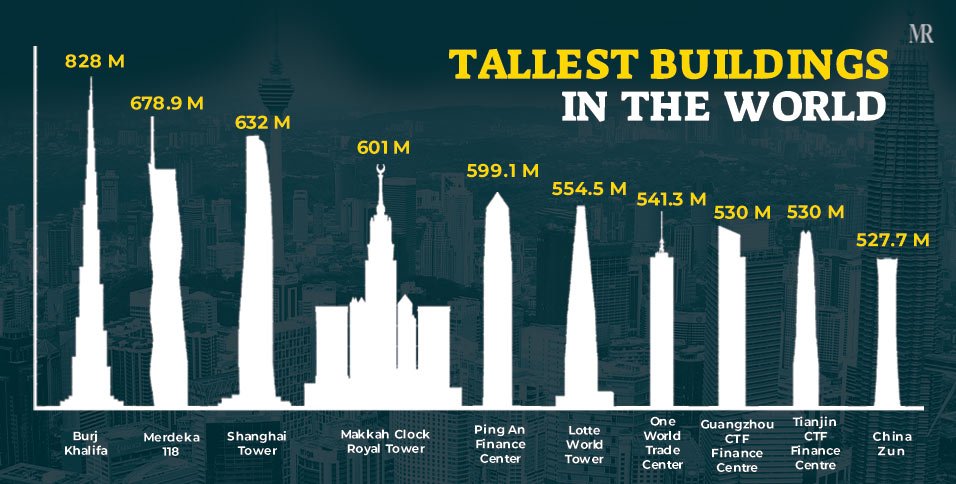
Have you ever wondered which are the tallest buildings in the world as of today? If yes, then this blog is for you! These aren’t just landmarks; they’re city-shapers, cultural icons, and testaments to human potential. So join us to explore how these buildings have redefined skylines, spurred economic growth, and become symbols of progress.
Note: This list focuses on ‘complexes’ and ‘buildings’ with a significant proportion of usable floor space for residential and commercial use, rather than merely towers designed for broadcasting or observation. Building heights are presented using architectural height, including permanent architectural spires but excluding antennas and other functional equipment, following the ranking methodology used by the Council on Tall Buildings and Urban Habitat (CTBUH).
List Of The Top 10 Tallest Buildings In The World
| Tallest Building In The World | Location | Height | Floors |
| Burj Khalifa | Dubai, UAE | 828 m | 163 |
| Merdeka 118 | Kuala Lumpur, Malaysia | 678.9 m | 118 |
| Shanghai Tower | Shanghai, China | 632 m | 128 |
| Makkah Clock Royal Tower | Mecca, Saudi Arabia | 601 m | 120 |
| Ping An Finance Center | Shenzhen, China | 599.1 m | 115 |
| Lotte World Tower | Seoul, South Korea | 554.5 m | 123 |
| One World Trade Center | New York, USA | 541.3 m | 94 |
| Guangzhou CTF Finance Centre | Guangzhou, China | 530 m | 111 |
| Tianjin CTF Finance Centre | Tianjin, China | 530 m | 97 |
| China Zun (CITIC Tower) | Beijing, China | 527.7 m | 108 |
1. Burj Khalifa

● Built By: Adrian Smith, Marshall Strabala, and George J. Efstathiou
● Country: Dubai, UAE
● Completed In: 2010
The Burj Khalifa, inaugurated in 2010, stands tall as a marvel of Islamic-inspired architecture. Named after UAE then-president Sheikh Khalifa bin Zayed Al Nahyan, this towering structure boasts 163 floors and a distinctive three-lobed design reminiscent of a flower. It holds numerous world records, including being the tallest building and featuring one of the world’s highest observation decks.
Its construction faced various challenges, such as Dubai’s sandy soil and strong winds. However, engineers addressed these obstacles with innovative solutions like friction piles and a twisting design. A large workforce ensured efficient construction, utilizing high-speed elevators and cranes.
Despite economic challenges and criticism during the global financial crisis, the Burj Khalifa emerged as a global tourist attraction, enhancing the surrounding real estate value.
However, concerns about its environmental impact and worker conditions were raised. Engineers responded by implementing sustainable solutions like special concrete mixes and cooling systems, underscoring a commitment to environmental responsibility.
2. Merdeka 118
- Built by: Fender Katsalidis in association with RSP KL
- Country: Malaysia
- Completed In: 2023
Merdeka 118, standing at 678.9 meters in Kuala Lumpur, Malaysia, ranks 2nd in the list of the tallest buildings in the world. Inspired by Tunku Abdul Rahman’s hand gesture during Malaysia’s independence in 1957, its diamond-shaped design is a striking symbol near the historic Merdeka Stadium.
The tower hosts various amenities like shopping, a hotel, and an observation deck, while also housing the headquarters of PNB, Malaysia’s largest fund management company.
Overcoming engineering challenges, including structural stability and wind resistance, it prioritizes sustainability through green building design and energy-efficient features.
Despite its economic potential in job creation and tourism, criticisms over its RM5 billion cost persist, questioning allocation priorities. Addressing environmental concerns, the tower integrates energy-efficient systems, but challenges like carbon emissions remain. Merdeka 118 embodies Malaysia’s progress yet prompts ongoing discussions on resource allocation and environmental impact mitigation.
3. Shanghai Tower

- Built By: Marshall Strabala, Jun Xia, and Arthur Gensler
- Country: China
- Completed In: 2015
The Shanghai Tower, among the top 3 tallest buildings in the world, rises 632 meters high with 128 floors. Designed by Gensler and built by Shanghai Construction Group, it began trial operations in January 2017.
Its distinctive twisted shape and double-skin facade, inspired by Shanghai’s history, signify the city’s past, present, and future. Situated in the Lujiazui Finance and Trade Zone, it complements neighboring landmarks like the Jin Mao Tower and the Shanghai World Financial Center.
The tower’s innovative “Core-Outrigger-Mega Frame” system ensures structural stability and seismic resilience, while its twisted design reduces wind loads. Functioning as a vertical city, it houses numerous companies, enhancing Shanghai’s global financial hub status. Notably, its design saved $58 million in steel and concrete, adding to its economic significance.
4. Makkah Clock Royal Tower
- Built By: SL Rasch GmbH and Dar Al-Handasah
- Country: Saudi Arabia
- Completed In: 2012
The Abraj Al Bait Tower in Mecca, Saudi Arabia, is a government-owned complex of seven skyscraper hotels standing tall at 601 m. Its central feature, the Makkah Clock Royal Tower, ranks as the fourth tallest building worldwide. Developed by the Saudi Binladin Group, it serves pilgrims visiting the Great Mosque of Mecca, located just 300 meters away.
The complex includes a five-star hotel, a shopping mall, and a parking garage. Its most prominent feature is the world’s largest clock face, measuring 43 meters in diameter and visible from 25 kilometers. The clock includes 98 million glass mosaic pieces and Arabic script.
Built as part of the Abraj Al Bait complex, with an estimated cost of US$16 billion, it boosts tourism and provides essential services for millions of pilgrims. The tower also houses a museum and a scientific center. The minaret broadcasts prayer calls, reaching 7 kilometers.
5. Ping An Finance Center

- Built By: Kohn Pedersen Fox Associates, J. Roger Preston Ltd., Thornton Tomasetti
- Country: China
- Completed In: 2017
The Ping An Finance Center is a 115-storey, 599.1-meter skyscraper in Shenzhen, China. Designed by Kohn Pedersen Fox Associates, it serves as the headquarters for Ping An Insurance. It holds the title of Shenzhen’s tallest building, the 2nd tallest in China, and the 5th tallest globally.
The building features office, hotel, and retail spaces, along with a high-end shopping mall and a conference center. Its “Free Sky” observation deck, located at approximately 562 meters above ground, offers panoramic views of Shenzhen. The building’s stainless-steel facade and “Core-Outrigger-Mega Frame” system provide structural integrity.
With a gross floor area of 459,187 square meters, Ping An Finance Center is one of the world’s largest skyscrapers by floor area. The complex includes a second, 47-storey tower and a planned retail bridge. Equipped with 33 double-deck elevators, it facilitates rapid transit. Construction faced engineering and regulatory challenges, and a planned antenna was omitted to avoid flight path obstructions.
6. Lotte World Tower
- Built By: Kohn Pedersen Fox, Syska Hennessy Group, Leslie E. Robertson Associates
- Country: South Korea
- Completed In: 2017
The Lotte World Tower is a 123-storey, 554.5-meter skyscraper in Seoul, South Korea. Designed by Kohn Pedersen Fox, it is the sixth tallest building globally and the tallest in OECD countries.
The tower features a “Sky Bridge Tour” on its roof, offering panoramic views. Its “Seoul Sky” observatory, spanning the top seven floors, includes a glass floor and a premium lounge bar. The exterior design, inspired by Korean ceramics, incorporates pale glass and metal filigree.
Construction, which began in 2012, faced engineering challenges, particularly with the Diagrid lantern-shaped roof structure, designed to withstand earthquakes and high winds. The tower opened with a fireworks display, marking its significance as South Korea’s first 100-plus-storey building.
7. One World Trade Center

- Built By: David Childs, Jaros, Baum & Bolles
- Country: USA
- Completed In: 2014
One World Trade Center is the main building of the World Trade Center complex that was rebuilt in Lower Manhattan, New York City. Designed by David Childs of Skidmore, Owings & Merrill, it stands at an architectural height of 541.3 meters (1,776 feet), making it the tallest building in the United States and the Western Hemisphere, and the 7th tallest in the world.
Built on the site of the original 6 World Trade Center, it honors the North Tower destroyed in the 9/11 attacks. The building features 94 stories, with office, retail, and observation spaces. The “One World Observatory” on floors 100-102 offers panoramic city views.
The tower’s design incorporates a concrete base for security, a tapering form, and a spire containing a broadcasting antenna. Its facade features glass and steel panels.
It includes sustainable features like recycled materials, rainwater collection, fuel cells, and energy-efficient lighting, earning LEED Gold certification. The building is a symbol of resilience and renewal, memorializing the past while looking toward the future.
8. Guangzhou CTF Finance Centre
- Built By: Kohn Pedersen Fox, Arup Group
- Country: China
- Completed In: 2016
The Guangzhou CTF Finance Centre is a 530-meter (1,739 ft), 111-storey supertall skyscraper in Guangzhou, China. Designed by Kohn Pedersen Fox Associates, it stands as one of the tallest buildings in the world.
This mixed-use building houses a hotel, serviced apartments, offices, and a shopping mall. Notably, it contains one of the world’s fastest elevators. Its sleek, modern design features a gently curving facade with recessed corners.
The building is a prominent landmark in Guangzhou’s central business district, contributing to the city’s skyline and economic development. It showcases advanced engineering and architectural design, incorporating sustainable features and high-speed vertical transportation.
9. Tianjin CTF Finance Centre

- Built By: Skidmore, Owings & Merrill LLP, Ronald Lu & Partners
- Country: China
- Completed In: 2019
The Tianjin CTF Finance Center is a 530-meter (1,739 ft), 97-storey supertall skyscraper designed by Skidmore, Owings & Merrill LLP and Ronald Lu & Partners. It’s the ninth-tallest building in the world and the second-tallest in Tianjin.
Featuring a gently curving glass facade with eight sloping mega-columns, the design enhances seismic resilience and structural integrity. The building’s aerodynamic shape, with tapered floor plates and rounded corners, minimizes wind resistance.
The tower houses offices, serviced apartments, and a hotel. Its design, incorporating a “crystalline-like curtain wall” and a “mega-column-looped crown,” creates a distinctive presence on the Tianjin skyline. Construction began in 2013, with the building receiving the Tall/Slender Structure award from the Institution of Structural Engineers in 2021.
10. CITIC Tower
- Built By: Kohn Pedersen Fox, TFP Farrells, Arup Group
- Country: China
- Completed In: 2018
CITIC Tower, also known as China Zun, is a 527.7-meter (1,732 ft), 108-storey supertall skyscraper in Beijing’s Central Business District. Designed by Kohn Pedersen Fox, it’s Beijing’s tallest building, one of the tallest in China, and the tenth tallest in the world.
Inspired by the “zun” wine vessel, its vase-like form features a wide base, a narrower center, and a wider top. The building primarily houses office spaces and features an observation area near its upper floors. It is also the tallest building in the world with a rooftop helipad.
The tower is designed to withstand China’s seismic activity. Its curved lobby and unique facade create a dramatic architectural presence.
Controversy arose regarding the top floors’ potential expropriation for national security due to their view of Zhongnanhai. Future building heights in the CBD are now capped.
Now that we’ve reached the end, let’s consider the expert analysis that provides a valuable perspective on the similarities of these architectural achievements.
Detailed Insights On The Top 10 Tallest Buildings in the World
| Category | Analysis |
| Common Materials & Techniques | Steel and Concrete: Fundamental materials for structural integrity and stability. Glass Facades: Curtain wall systems for natural light and modern aesthetics. Advanced Foundation Systems: Deep foundations, friction piles, and reinforced concrete mats. Wind Resistance Design: Aerodynamic shapes, tapered profiles, and sophisticated structural systems. Seismic Design: Advanced seismic measures in earthquake-prone regions. |
| Height Differences | Burj Khalifa has a significant lead over the other buildings, standing 149.1 meters taller than Merdeka 118. The remaining nine buildings range from 527.7 meters to 678.9 meters, a height difference of 151.2 meters. |
| Construction Time | Projects are complex and lengthy, often spanning years or decades. Extensive planning periods followed by multi-year construction. Reflects engineering challenges and massive material/labor volume. |
| Common Builders & Architects | Kohn Pedersen Fox Associates (KPF): Multiple projects, demonstrating expertise in supertall design. Skidmore, Owings & Merrill (SOM): Structural engineering and design expertise across projects. China Construction Group: Major player in Chinese skyscraper construction. Arup Group: Engineering firm contributing to the structural engineering of multiple buildings. |
| Common Amenities | Observation Decks: Panoramic views for tourism. Luxury Hotels: Catering to business and tourist travelers. Shopping Malls: Retail spaces at building bases. Office Spaces: Headquarters for major corporations. Serviced Apartments/Luxury Residences: High-end living spaces.- Conference Centers: Spaces for large meetings. High-Speed Elevators: Needed due to building height and occupancy. |
| Common Challenges | Wind Loads: Designing for extreme wind conditions. Seismic Activity: Ensuring structural integrity. Foundation Issues: Soil conditions and stable foundations. Logistics: Material and labor management. Environmental Impact: Sustainability and footprint. Economic Factors: High costs and potential downturns. |
FAQs
- What is the tallest building in the world?
Ans: The Burj Khalifa, located in Dubai, UAE, is the tallest building in the world, reaching an architectural height of 828 meters, including its spire.
- Is Tokyo Skytree the tallest tower in the world?
Ans: Yes, Tokyo Skytree in Japan is the world’s tallest tower, standing at 634 meters. However, it is not classified as a building because most of its height is not occupied by usable floor space. Burj Khalifa remains the world’s tallest building at 828 meters.