A campaign folder can contain eight videos and only two ideas. Changing the opening, duration, or aspect ratio creates useful versions, but it does not necessarily give the marketing team another reason for someone to buy.
Before expanding AI production, separate the decisions that deserve leadership attention from the changes a producer or editor can make. A creative matrix should show what each concept argues, how its opening earns attention, and which approved message survives every version.
Lock the Campaign Promise
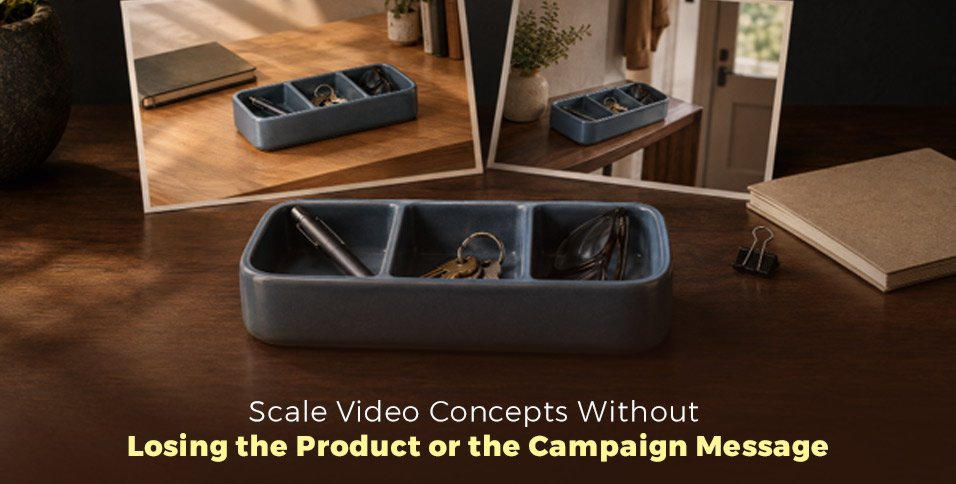
Consider a hypothetical launch for a slate-blue desktop organizer. Its campaign promise is simple: give everyday essentials a regular place. The product has a shallow rectangular body and three compartments. Those features must stay recognizable across the campaign.
Record the intended audience, approved product references, message, offer, and destination page together. Treat any new feature claim as a separate decision. A scene showing keys in a tray supports an organization message; it does not establish that the product saves a measured amount of time.
Leave room for creative variation. The same organizer can appear on a work desk or an entryway table without changing its design or inventing another benefit.
Build the Matrix Before Counting Files
Define a concept by its customer situation and central argument. A hook changes how that argument begins. A delivery version adapts an approved execution for a placement.
For this planning example, the team proposes:
| Concept | Hook variation | Core demonstration | Planned deliveries |
| Desk reset | Open with a search for a pen | Return desk essentials to assigned compartments | 9:16 and 16:9 |
| Desk reset | Open on scattered desk items | Show the same organizing routine and payoff | 9:16 and 16:9 |
| Leaving home | Open with missing keys | Establish a regular place for keys near the door | 9:16 and 16:9 |
| Leaving home | Open with keys ready to collect | Show the same departure routine and payoff | 9:16 and 16:9 |
This produces eight planned files, four combinations of concept and hook, and two concepts. None is a performance result.
The distinction affects budgets. If the team needs a new customer argument, commissioning another crop will not answer that request. If the argument is already approved, reopening the whole concept for every export wastes review capacity.
Check the Demonstration Before Expanding It
A product-video workflow published by Astorie describes a fictional portable lamp whose first lighting demonstration began in an already bright room. The author reported that the lamp switched on, but the visible change was weak. A later version began at night and made the transition clearer.
That case gives reviewers a useful question: can viewers see the benefit the concept promises? Following the requested action is only part of the decision.
For the organizer, inspect a representative execution from each concept before commissioning the full matrix. Check that the compartment layout remains accurate, the relevant item is visible, and the ending communicates the intended routine. Polished materials or camera movement cannot compensate for an unclear argument.
Give Each Reviewer a Defined Boundary
The marketing lead approves the audience, concept, message, offer, and learning question. Product or brand reviewers approve appearance and factual accuracy. The producer owns execution inside those limits; the editor owns delivery adaptations that preserve the approved meaning.
Agree on escalation triggers. Replacing the opening pen close-up with scattered desk items stays within the desk-reset concept. Introducing a travel-use claim needs review. Changing a caption’s placement can be an editing decision; changing what the caption promises reopens message approval.
A new generation also needs a fresh product check, even when its request sounds minor. A wider frame may reveal an invented fourth compartment. A shorter cut may remove the action that explains the payoff.
Give each file a concept ID, hook ID, delivery format, source-reference version, and approval status. An approval for one version should identify exactly what it covers.
Expand What the Next Round Can Teach You
Approve a representative execution before producing its delivery versions. Stop expansion when the product is inaccurate or the demonstration fails to communicate the promise.
After launch, compare versions against a stated learning question. Are viewers responding to the desk routine or the departure routine? Is a different opening helping within one concept? Keep audience, placement, and offer differences visible when interpreting results.
Report approved concepts, hook variations, delivery files, and unresolved rejections separately. Leaders can then see whether the team is exploring a useful new argument, improving an existing one, or preparing material for distribution.