When marketers compare advertising channels, they reach instinctively for cost per impression: how much does it cost to put your brand in front of one pair of eyes once. It is the metric that lets you weigh a billboard against a social ad against a magazine spread. It is applied far less often to promotional merchandise, which is a shame, because on that metric a well-chosen printed tote quietly outperforms channels that command far larger budgets. Understanding why turns the bag from a novelty into a serious line on a media plan.
The logic is straightforward. A digital or print advertisement delivers its impressions and then stops; you pay again for the next flight. A physical item you have already paid for keeps delivering impressions for as long as it survives and is used, at no additional cost. So the cost per impression of a promotional product falls every single time it is used again. A bag used once is expensive per impression. The same bag used for two years is astonishingly cheap per impression, because the one-off cost is divided across thousands of exposures. The whole trick is buying bags that get used for two years rather than one afternoon.
This is exactly why the promotional industry’s own research consistently places bags among the very best-value items available. Across the sector’s long-running consumer studies, bags rank among the highest for how long they are kept and how frequently they are used, and consequently among the lowest for cost per impression of any promotional category. The precise figures come from large consumer surveys and are best treated as directional pattern rather than a single quotable number, but the direction is unambiguous and repeated across editions: bags are kept for a long time, used often, and therefore deliver reach at a very low unit cost. A knowledgeable supplier such as this UK promotional-merchandise supplier will help you choose the styles that maximise exactly that.
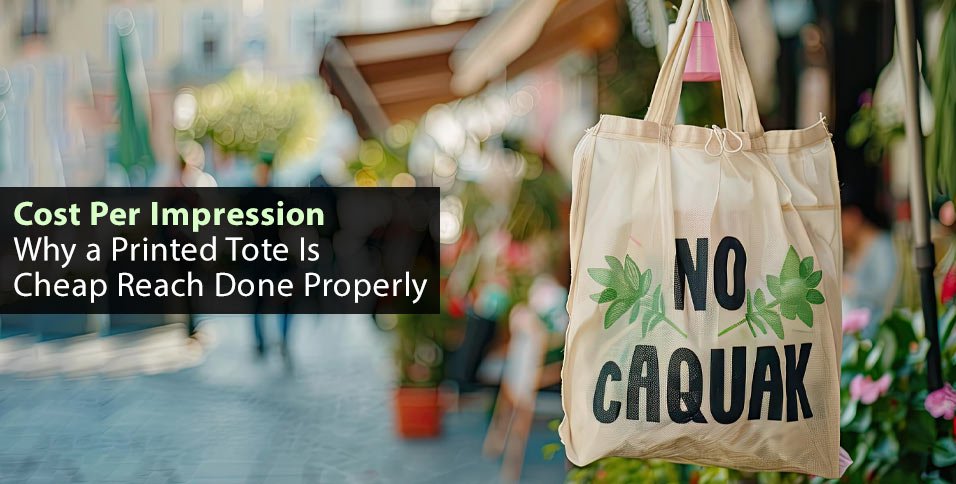
The reason bags do so well on this metric, rather than pens or keyrings, comes down to visibility per use. A keyring lives in a pocket. A pen sits in a drawer. A bag is carried in public, over the shoulder, through streets and shops and stations, which means each use generates not one impression but many, to everyone in visual range of the person carrying it. The bag is doing outdoor advertising on a human chassis, and it does it every time the owner leaves the house with it. That is a category of exposure most desk-bound merchandise simply cannot match.
There is a caveat that keeps this honest, and it is the same one that governs every claim about promotional bags. All of this value is contingent on the bag being kept and used. The cost-per-impression case collapses entirely if the bag is binned after one event, because then you paid the full cost for a single afternoon of exposure, which is a terrible deal. This is why the quality of the bag is not a nice-to-have but the very thing that determines whether the economics work. Durability, comfort and a design worth carrying are what convert the theoretical low cost per impression into a real one.
It also reframes how you should think about unit price when comparing quotes. The cheapest bag per unit is frequently the worst bag per impression, because a flimsy bag is the one most likely to be discarded quickly, ending its impression-earning life early. A slightly more expensive bag that gets kept for years delivers a dramatically lower cost per impression despite the higher sticker price. Buying on unit price alone optimises the wrong number. The number that matters is cost per impression across the bag’s whole life, and that rewards quality.
The shape of the exposure over time is worth dwelling on, because it is the opposite of most paid media. A digital or out-of-home campaign front-loads its impressions during the paid flight and then drops to nothing the moment the budget stops. A printed bag does the reverse: it starts slowly, with a single owner, and then accumulates impressions steadily for months or years as that owner carries it around. It is a long, flat tail rather than a sharp spike. For brand-building, where familiarity is built by repetition over time rather than by a single burst, that durable tail is arguably a better exposure profile than the spike, and it is one you have already fully paid for.
For a marketer building a case internally, this is a useful way to frame the spend. Rather than presenting printed totes as a soft branding nicety, present them as a reach channel with a genuinely competitive cost per impression and an unusually long tail, provided the specification is good enough to guarantee reuse. That framing puts the bag on the same analytical footing as your paid media, which is where it belongs, and it makes the case for spending a little more per unit to secure the reuse that the whole model depends on.
None of this requires exaggeration, which is part of its appeal. You do not need to inflate the numbers to make printed bags look good on cost per impression; the honest, sector-verified pattern already makes the case. Choose bags built to be kept, price the campaign per impression rather than per unit, and a printed tote stops looking like a giveaway and starts looking like one of the more efficient reach buys on the table.