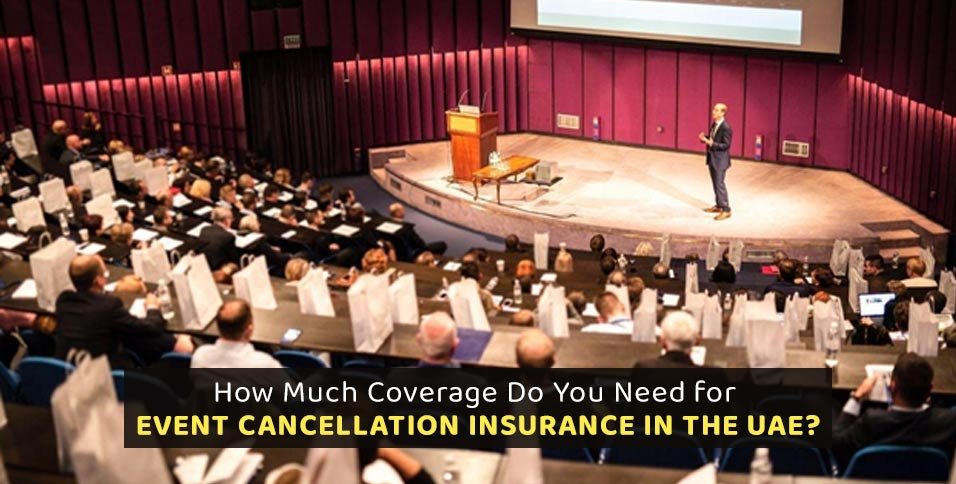
When an event is cancelled the financial impact is not at all limited to the money you have spent on the venue.
By the time an event reaches the final stages of planning the organiser may already have committed substantial amounts to catering, production, entertainment, marketing, travel, staffing, equipment, and many other services needed for having an event live.
Some of the costs may be recovered but many are tied with the contracts and payment schedules that leave little room for a refund once a certain date has passed.
That is what makes deciding on the right level of event cancellation insurance more complicated than simply matching the policy limit to the overall event budget. The real question behind all this is how much the organiser could lose if the event had to be cancelled, postponed, or abandoned because of an insured event.
For organisers planning a corporate conference, exhibition, concert, wedding, product launch, or another major event in the UAE the correct and right answer will depend on the structure of the event and the financial commitments behind it.
Seven Insurance Brokers, a leading insurance broker in the UAE, can help businesses and event organisers assess these requirements and understand the insurance options available for their particular event.
Start With What You Could Actually Lose
The total cost of an event and the amount of money at risk are not always the same.
Let us consider a big event happening with a budget of AED 500,000. If the event is cancelled a few months before the scheduled date, some suppliers may return deposits or allow the booking to be moved without a major financial penalty.
However, as the event gets closer, larger payments may become due and previously refundable deposits may become non-refundable. The organiser’s financial exposure can therefore increase considerably even when the overall event budget remains unchanged.
A good starting point is to always review every major commitment and identify what would happen if the event could not go ahead.
This usually includes costs such as:
- Venue hire and deposits
- Catering and hospitality arrangements
- Entertainment, performers or the speaker fees
- Event marketing and promotional expenses
- Security and event staffing
- Travel and accommodation
- Decorations and event design
- Technology, registration, or ticketing platforms
- Other supplier deposits and contractual obligations
The objective is not simply to add every figure together. It is to understand which costs would genuinely become a loss and which ones could potentially be recovered, transferred to a new date, or cancelled without a substantial penalty.
That distinction can make a significant difference when deciding on the amount of cover required.
Your Financial Exposure Can Change as the Event Gets Closer
One of the things organisers often overlook is that event-related financial exposure is not fixed from the moment planning begins.
A company organising a conference six months in advance might initially have only paid a venue deposit and committed to a few of the suppliers. As planning progresses however the contracts for catering, production, speakers, accommodation, transport, and marketing may all become binding.
By the final few weeks, cancelling the event could mean losing a substantial portion of the money invested in it.
This is particularly relevant for large events where payments are made in stages. An organiser for such an event can arrange insurance based on an early estimate of the financial exposure, only for the budget to increase significantly as the event develops.
It is therefore better to review the insurance requirement when there are major changes to the event like if there is an increase in the scale of production, the number of attendees, the value of supplier contracts, or the overall budget.
The same consideration applies when the event is moved to a different venue or a new location, as those changes may affect both the financial exposure and the nature of the risks involved.
Supplier Contracts Can Have a Major Impact on the Coverage You Need
The terms agreed with suppliers can often tell you more about your potential financial exposure than the event budget itself.
A venue might allow an event to be postponed while a catering company may retain a percentage of the total payment if cancellation takes place within a particular period.
An entertainer may have a contract that requires payment even if the event does not go ahead, and a production company may charge for work that has already been completed.
Before deciding how much event insurance coverage you need it is worth reviewing the main contracts and checking:
- Which deposits are non-refundable
- When cancellation charges begin to apply
- Whether the booking can be transferred to another date
- Whether full or partial payment remains payable after cancellation
- What happens if the key supplier becomes unavailable
- Whether additional costs could arise if the event is postponed
This review can also show where the biggest financial risks are there. An event may involve ten suppliers, but perhaps only three of those contracts create substantial non-refundable obligations.
Understanding that difference can help the organiser make a more informed assessment rather than choosing an arbitrary coverage amount.
Cancellation Is Not Always the Most Expensive Scenario
Postponing an event can sometimes create a financial problem of its own.
If a big event like an Ai conference is cancelled completely then some of the costs would stop at the same time. For an event which is postponed to a different date or time the organiser will still need to find a new venue, rebook suppliers, extend marketing activity, rearrange travel and communicate the changes to all the concerned people.
The original venue may not be available on the new date while a key speaker or performer could already have other commitments. In some cases the organiser may have to pay additional charges to secure replacement services or repeat parts of the planning process.
This is why it is important to consider the potential cost of postponement as part of the overall financial assessment. The loss is not always limited to money that has already been spent. There may also be additional costs involved in putting the event back together.
When reviewing event cancellation insurance, organisers should understand how cancellation and postponement are treated under the particular policy being considered, as the scope of cover will depend on the policy wording, terms, conditions, limits, and exclusions.
Commercial Events May Also Have Revenue at Risk
For ticketed or commercial events, the financial impact may extend beyond the expenses already committed.
A conference organiser may expect to receive registration fees, while an exhibition may depend on exhibitor payments and sponsorship income. A concert or entertainment event may rely heavily on ticket sales. If the event cannot proceed, the organiser may face both committed expenses and the loss of anticipated revenue.
Whether such losses are covered will depend on the specific insurance arrangement and the circumstances surrounding the cancellation. It should not be assumed that every type of financial loss will automatically fall within an event cancellation policy.
This is one of the reasons why large commercial events often require a more detailed assessment before arranging insurance. The organiser needs to look at the entire financial structure of the event rather than focusing only on how much has already been spent.
The Nature of the Event Also Matters
Two events with the same budget can have very different insurance requirements. A private event held at a single venue with a small number of local suppliers may be relatively straightforward to assess.
A multi-day conference involving international speakers, travel arrangements, several contractors, exhibitors, sponsors, and expensive technical production has a much more complex set of financial commitments.
The level of coverage required may be influenced by factors such as the duration of the event, the number of suppliers involved, the location, the value of the contracts, and whether participants or equipment are coming from outside the UAE.
An outdoor event may also involve considerations that do not apply to an indoor conference, while an event that depends heavily on the availability of a particular speaker, performer, or venue may have its own areas of exposure.
Rather than applying the same formula to every event, it is more useful to assess what makes that particular event financially vulnerable.
It Is Not Just About Choosing a Higher Coverage Limit
A larger coverage amount does not necessarily mean that every possible reason for cancellation will be covered.
The circumstances that lead to the cancellation matter, as do the specific terms and exclusions contained in the policy. Organisers should therefore avoid making a decision based only on the maximum amount shown on the insurance proposal.
The more important questions that should be asked are whether the policy is suitable for the nature of the event and whether the key risks have been properly considered.
Depending on the event the organisers may want to discuss circumstances that could affect:
- The venue or event location
- Travel and transportation arrangements
- Key speakers, performers, or participants
- Access to the venue
- Event infrastructure and equipment
The available cover and exclusions will vary depending on the policy and insurer, so the specific policy wording should always be reviewed carefully before making assumptions about what is included.
Allow for Changes in the Event Budget
Events in the real world rarely remain exactly as they were originally planned. An organiser may decide to increase capacity, move to a larger venue, add entertainment, upgrade the production, or bring in additional speakers. These changes can increase the financial exposure considerably.
If the coverage amount was based on the original budget and the event later becomes significantly more expensive, the existing cover may no longer reflect the actual value of the commitments being made.
For this reason, the insurance arrangements should be reviewed when there are material changes to the event. These could include a change in date, venue, scale, supplier contracts, or overall budget.
It is also important to understand whether such changes need to be communicated to the insurer or broker under the terms of the policy.
A Practical Way to Work Out Your Coverage Requirement
The process of estimating the right amount of cover does not need to be unnecessarily complicated. It begins with creating a clear picture of the financial commitments associated with the event.
An organiser can list the major expenses, review the cancellation terms attached to each one, and identify the amount that would potentially be lost if the event could not take place. Once that figure has been estimated, the organiser can consider whether postponement could create additional costs and whether the event involves commercial revenue that should also be taken into account.
The final figure should then be discussed alongside the actual risks facing the event. This is important because the amount of coverage and the circumstances covered are two separate aspects of an insurance arrangement. A policy may have a sufficient limit but still not address a risk that is particularly relevant to the event.
For larger or more complex events, working with an insurance broker can make this assessment easier because the organiser can review the structure of the event, supplier commitments, potential losses, and insurance requirements together rather than trying to select a policy based solely on price or a general coverage estimate.
What Things to Check Before Getting Event Cancellation Insurance
Before finalising the insurance and the company it is worth making sure that the key aspects of the policy are understood clearly. In particular, organisers should check:
- The circumstances in which a claim may be made
- The financial losses that may be covered
- How cancellation and postponement are treated
- Any relevant exclusions or limitations
- Whether non-refundable deposits are included
- Any excess or deductible that may apply
- The requirements for notifying the insurer of changes to the event
- Whether the policy period reflects the event planning timeline
These details can be just as important as the overall coverage limit.
Finding the Right Level of Protection
No fixed amount of event cancellation insurance is suitable for every event in the UAE. The appropriate level of cover depends on the financial commitments that have been made, the terms of the supplier contracts, the potential cost of cancellation or postponement, and the particular risks associated with the event.
A smaller event with flexible booking arrangements may require a very different approach from a major exhibition or conference involving substantial non-refundable commitments. The most useful starting point is therefore to understand the financial exposure before selecting a coverage amount.
Seven Insurance Brokers can assist businesses and event organisers in the UAE with assessing their insurance requirements and exploring suitable event cancellation insurance options based on the specific circumstances of their event.
By reviewing the financial commitments early, keeping track of how those commitments change during the planning process, and understanding the terms of the available cover, organisers can approach event cancellation insurance as part of a wider risk management plan rather than simply adding another item to the event checklist.