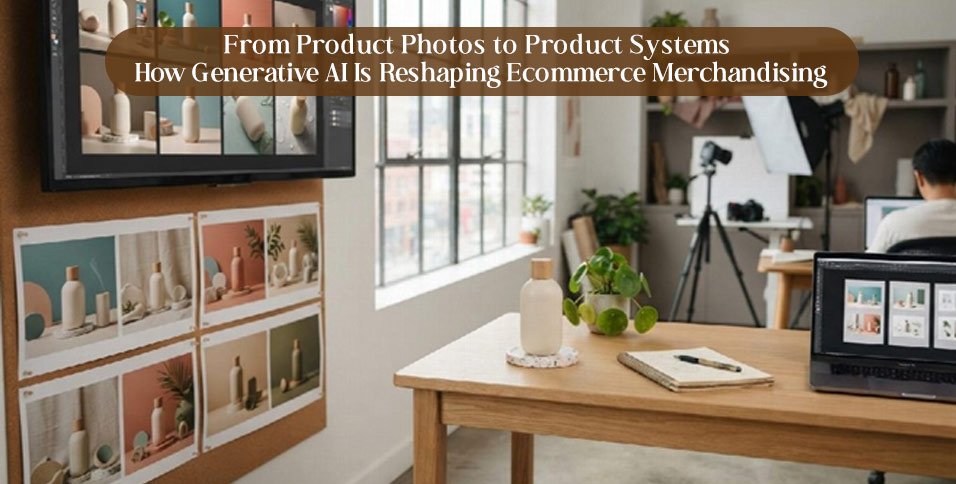
For most ecommerce teams, product imagery has long been a production bottleneck. A new collection needs a hero shot, a product-detail gallery, advertising crops, social variants, seasonal updates, and often versions for several markets. Each request travels through a familiar chain of samples, photography, retouching, approvals, and export. The individual steps are defensible; the accumulated delay is not.
Generative AI is beginning to change that operating model. The interesting opportunity is not to replace a studio with a prompt box, or to fill a storefront with synthetic images. It is to turn a product image from a one-time deliverable into the starting point of a controlled visual system.
That distinction matters. Teams that see AI as a way to make more pictures can easily create inconsistency at scale. Teams that use it to define, reuse, and govern a product’s visual rules can make their creative production more responsive without losing the trust that product imagery is meant to create.
A product photo is becoming a source asset
Traditional ecommerce photography is organized around final files. A campaign needs a square social image, a marketplace needs a white-background packshot, and a product-detail page needs a set of specific crops. Once those files are delivered, the process restarts when the season, promotion, channel, or market changes.
The better use of AI image generation starts with a different question: what should remain true about this product wherever it appears?
That answer can include the product’s silhouette, color accuracy, material behavior, camera angle, approved contexts, lighting direction, and the amount of room available for accompanying copy. It can also include what is prohibited: invented features, misleading scale, impossible textures, or settings that conflict with the brand’s claims.
Together, those decisions form a product visual brief. A carefully selected product reference, combined with that brief, gives a team a repeatable way to create channel-specific variants while keeping a common source of truth. Rather than commissioning entirely separate assets, the team can extend one visual foundation into a larger set of approved uses.
This does not eliminate the value of a strong original shoot. It increases its leverage. The studio image remains the evidence of the product; generation can help adapt that evidence to the many places commerce now happens.
Speed only matters when consistency survives it
Ecommerce leaders often describe AI in terms of speed. That is understandable, especially when launches and promotions are constrained by creative capacity. But speed becomes expensive when it produces images that disagree with one another.
A customer who sees one color on an ad, another on a product page, and a third in an email is not experiencing efficient production. They are experiencing uncertainty. The same risk applies when a generated lifestyle scene makes a small product look large, shows a fabric with the wrong finish, or suggests a use case the item cannot support.
The practical response is not a blanket ban on generated imagery. It is a defined approval system. Before a team scales production, it should establish a small set of non-negotiables for each product family:
- A reference image that represents the approved product appearance.
- A short description of the visual attributes that must not change.
- Approved compositions and environments for the relevant channels.
- Clear rules for claims, people, props, and post-production.
- A named reviewer who can reject inaccurate or off-brand variations.
These guardrails make the review process faster because reviewers are judging against an agreed system, not reacting to each image from scratch. They also make it easier to learn which products and categories are appropriate for AI-assisted production. A simple accessory or packaged product may work well for controlled contextual variations. A product whose fit, finish, or safety characteristics need exact representation may require a much higher threshold of human review.
The workflow shifts from asset requests to reusable recipes
One approved source can support consistent channel-specific visual variations.
The strongest operational change is a shift from individual creative requests to reusable recipes.
Consider a home-goods retailer launching a new table lamp. The old workflow might create a studio packshot, then open separate tickets for a marketplace crop, a paid-social scene, an email header, and a holiday refresh. Each ticket introduces new interpretation and new waiting time.
In a product-system workflow, the team creates an approved reference set and a concise recipe: the lamp’s finish, proportions, illumination, preferred room styles, camera height, prohibited props, safe cropping zones, and channel-specific formats. That recipe can guide several variants while preserving the same product identity.
The gain is not merely volume. It is better coordination. Merchandising can request a category-specific context, paid media can test a format without rebuilding the image from zero, and localization teams can adjust a scene for a market while retaining the product’s core presentation. A content operations lead can also see which versions are derived from which approved source, instead of managing a scattered folder of near-duplicates.
This is where an image-generation workflow can be useful: not as a replacement for product truth, but as a way to test whether a defined visual recipe is reliable before putting it into a broader production workflow.
Human judgment becomes more valuable, not less
Human review keeps product imagery tied to an approved physical reference.
There is a tempting but unhelpful story that AI removes creative judgment from ecommerce. In reality, the work moves earlier in the process and becomes more consequential.
Someone still has to decide which product reference is authoritative. Someone has to define the brand’s visual vocabulary, spot an unrealistic material or shadow, and determine whether a variation is suitable for a customer-facing claim. Those are editorial and commercial decisions, not just production tasks.
The most durable teams therefore put human review at the points of highest risk. They do not ask a reviewer to inspect every minor derivative with equal attention. They create escalation rules: exact product representation, regulated categories, new product families, and high-visibility campaign assets receive the closest scrutiny. Lower-risk channel adaptations can move through a lighter approval path once the recipe has proven dependable.
That approach also makes accountability clearer. If a generated image is inaccurate, the question is not which tool made it. The question is whether the product reference, generation instructions, and approval rules were strong enough for that use.
Trust is the real performance metric
The quality of ecommerce imagery is usually measured through production metrics: cost per asset, turnaround time, number of variants, or click-through rate. Those are useful, but they do not capture the whole outcome.
Product imagery is a promise. It helps a customer understand what will arrive, how it will look, and whether it belongs in their life. A visual system should therefore be evaluated against trust as well as efficiency.
Teams can watch for signals such as product-page conversion, return reasons, customer-service questions about appearance, and the performance of different visual contexts. They should also track whether the same product is being represented consistently across channels. A fast creative workflow that increases uncertainty is not an improvement.
Accessibility deserves the same care. Alt text and other metadata can be drafted or checked as part of an asset workflow, but they must be reviewed by people who understand the product and the customer. Image generation alone cannot be assumed to produce accurate descriptions, appropriate context, or compliant claims.
Start with a contained test, then build the operating model
The sensible adoption path is narrow. Choose a product range with stable visual attributes, a known library of approved reference images, and a genuine need for multiple channel variants. Define the visual rules, run a limited set of outputs through the ordinary review process, and compare the result with the existing workflow.
The purpose of that test is not to declare every product ready for generation. It is to learn where the system is dependable, where human review adds the most value, and what information is missing from the product brief. The best outcome is a clearer creative operation, whether or not every asset is generated.
Generative AI will not make merchandising less disciplined. It will reward the teams that make their product truth, visual standards, and approval criteria explicit. The companies that benefit most will not be those that create the most images. They will be those that build the most reliable product systems.
About the Author
The author works on AI-assisted visual production workflows for ecommerce teams, with a focus on turning approved product references into consistent, reviewable content across commercial channels.