Mirror Review
July 23, 2026
Tesla Q2 2026 results showed strong growth in vehicle production and deliveries, even as profitability remained under pressure from heavy investments in artificial intelligence (AI), manufacturing, and future products.
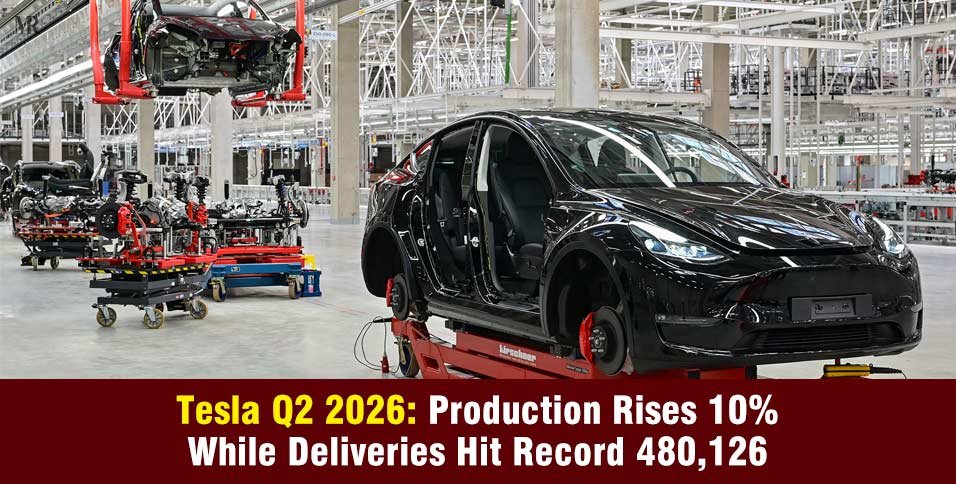
In the second quarter of 2026, Tesla produced 451,758 vehicles, up 10% year over year, and delivered a record 480,126 vehicles, a 25% increase from the same quarter last year. Total revenue rose 26% to $28.24 billion, driven by higher vehicle sales, growth in its energy storage business, and expanding software subscriptions.
According to Tesla’s official shareholder update, the company also crossed $100 billion in trailing 12-month revenue for the first time while continuing to invest heavily in Robotaxi, Cybercab, and AI infrastructure.
Tesla Q2 2026 earnings show record deliveries
The biggest highlight of the Tesla Q2 2026 earnings was its highest-ever second-quarter vehicle deliveries. Tesla delivered 480,126 vehicles, compared to 384,122 in Q2 2025. Production also climbed to 451,758 vehicles, reflecting improved manufacturing efficiency across its global factories.
Most deliveries came from the Model 3 and Model Y, which accounted for 467,762 units, while other models, including the Cybertruck and premium vehicles, contributed 12,364 deliveries.
Tesla also reported 13.5 GWh of energy storage deployments, a 41% year-over-year increase, highlighting continued demand for its Megapack business.
According to the company, record deliveries were supported by strong demand in both established and newer markets. South Korea, Australia, Japan, Colombia, Portugal, Taiwan, Thailand, Chile, Slovenia, Lithuania, and the Philippines all achieved record quarterly deliveries.
Tesla also introduced the Model YL in the U.S. during July, following positive customer response in international markets.
Tesla Q2 profit declined despite higher revenue
Although deliveries reached a record, Tesla Q2 profit reflected the cost of the company’s aggressive expansion strategy.
Tesla reported $28.24 billion in total revenue, representing 26% year-over-year growth. Automotive revenue increased 23% to $20.52 billion, while Services and Other revenue rose 50% to $4.58 billion. Energy generation and storage revenue also grew 13% to $3.14 billion.
However, profitability weakened during the quarter. Operating income declined 57% to $398 million, reducing the operating margin to 1.4%. Operating expenses increased 47% as Tesla continued investing in AI research, infrastructure, manufacturing expansion, and employee compensation.
Capital expenditures surged 142% to $5.79 billion, resulting in negative free cash flow of $1.09 billion, despite generating $4.7 billion in operating cash flow.
Tesla said lower average selling prices and reduced regulatory credit revenue also weighed on profitability, even as higher deliveries, software subscriptions, and services helped support overall revenue growth.
Tesla is investing heavily in AI and autonomous technology
Beyond the Tesla Q2 2026 results, the company emphasized that its long-term strategy extends well beyond electric vehicles. Tesla continued investing in artificial intelligence, robotics, autonomous driving, battery production, and manufacturing capacity, even though these investments weighed on short-term profitability.
According to the official shareholder update, Cybercab production has begun at Gigafactory Texas, while the Tesla Semi remains on track to enter production later this year. Construction also continued on facilities supporting Optimus, Tesla’s humanoid robot, after the company decommissioned Model S and Model X production lines at its Fremont factory.
Tesla also expanded its AI capabilities during the quarter. The company said it more than doubled its AI training compute capacity in Texas during the first half of 2026 to support Full Self-Driving (FSD) software and Optimus development. Meanwhile, active FSD subscriptions reached 1.48 million, up 56% year over year, showing growing customer adoption of Tesla’s software offerings.
The company also confirmed that Robotaxi operations are now active across several U.S. cities, with additional expansion planned.
Tesla said it has begun production of Cybercab, its purpose-built autonomous vehicle, and has already started employee test rides at Gigafactory Texas before a wider commercial rollout.
Tesla and SpaceX merger speculation resurfaces
During the earnings call, CEO Elon Musk addressed renewed speculation about a possible merger between Tesla and SpaceX.
While he said the companies cannot discuss a merger directly, he acknowledged that the two businesses are working more closely together as their technologies increasingly overlap.
According to Reuters, Musk said there is “more and more overlap” between Tesla and SpaceX, particularly in artificial intelligence, manufacturing, robotics, and engineering talent.
However, he did not indicate that any merger plans are currently under consideration.
The comments followed reports that Tesla’s AI ambitions increasingly rely on technologies that benefit from expertise shared across Musk’s companies.
Analysts noted that while operational collaboration may continue to grow, any formal merger would face significant regulatory, governance, and shareholder hurdles.
What Tesla Q2 2026 results mean for investors
The Tesla earnings report highlights two different stories unfolding at the same time.
On one hand, Tesla achieved record deliveries, higher revenue, growing energy deployments, and continued expansion of its software business.
On the other hand, rising investments reduced short-term profitability as the company accelerated spending on AI infrastructure, autonomous vehicles, semiconductor manufacturing, and robotics.
This approach is consistent with Tesla’s long-term strategy as one of the biggest automakers in the world.
Instead of maximizing quarterly profits, the company continues to prioritize technologies that it believes will generate future growth. Its outlook also states that hardware profits are expected to be increasingly complemented by AI, software, and fleet-based revenue over time.
End Note
The Tesla Q2 2026 report shows a company balancing strong operational growth with aggressive long-term investment. Record deliveries of 480,126 vehicles, a 10% increase in production, and 26% revenue growth demonstrate continued demand for Tesla’s products.
At the same time, lower operating profit reflects the cost of building the next phase of the company’s business, including Robotaxi, Optimus, AI infrastructure, and semiconductor manufacturing.
While investors may remain focused on near-term margins, Tesla’s strategy suggests that future growth will increasingly depend on software, autonomous driving, robotics, and energy solutions rather than vehicle sales alone.
The coming quarters will determine whether these investments can translate into sustainable earnings growth while maintaining Tesla’s leadership in the evolving mobility and AI markets.
Maria Isabel Rodrigues