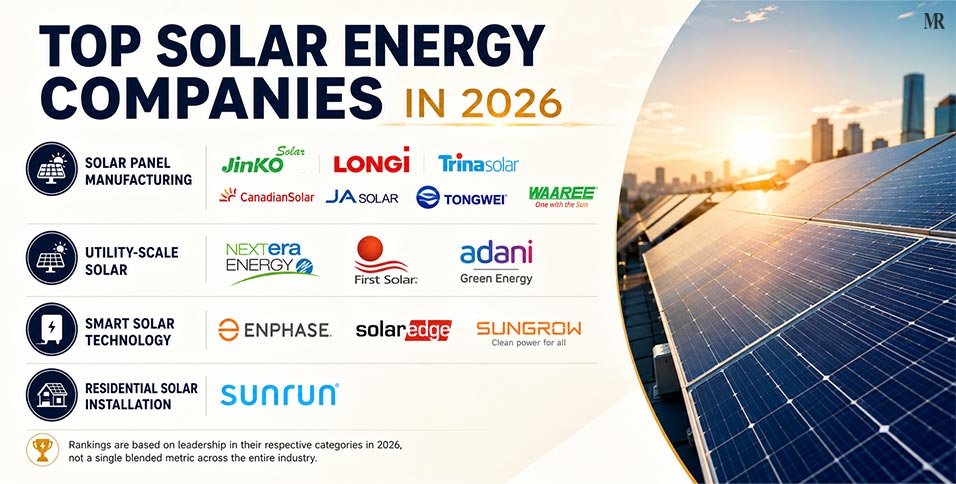
In 2026, the solar industry has become more specialized than ever. Different companies lead in different parts of the business, and that’s exactly why picking the top solar energy companies in 2026 means naming a leader in each category, not just one overall champion.
Some companies build the panels that go on rooftops and solar farms. Others develop and run massive utility-scale solar plants. A third group builds the smart technology, inverters, batteries, and home systems that turn raw solar power into something a grid or a household can actually use.
Here’s a look at the top solar energy companies of 2026 and what they actually do best.
Top Solar Energy Companies by Category in 2026
| Category | Leading Companies (2026) |
| Solar Panel Manufacturing | JinkoSolar, LONGi Green Energy Technology, Trina Solar, Canadian Solar, JA Solar Technology, Tongwei, Waaree Energies |
| Utility-Scale Solar | NextEra Energy, First Solar, Adani Green Energy |
| Smart Solar Technology | Enphase Energy, SolarEdge Technologies, Sungrow Power Supply |
| Residential Solar Installation | Sunrun |
The rankings of these top Solar Energy companies are grouped by manufacturing scale, technology leadership, utility-scale project ownership, residential reach, and 2026 financial performance, not a single blended metric. A company can lead its category without topping every metric in the industry.
Each category represents a different part of the solar value chain. Let’s start with the manufacturers powering the global solar supply chain.
Top Solar Panel Manufacturing Companies in 2026
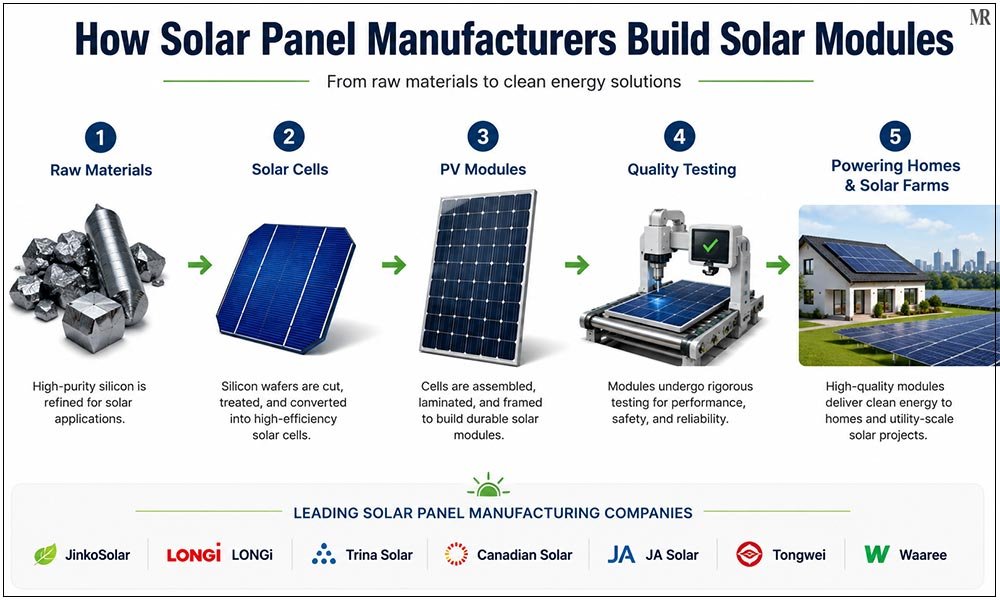
Solar Panel manufacturing companies design and manufacture the photovoltaic modules and solar cells that go into everything from rooftops to gigawatt-scale solar farms. The following are the top solar energy companies when it comes to panel manufacturing.
1. JinkoSolar Holding Co., Ltd.
JinkoSolar is one of the world’s largest solar panel manufacturers, leading the industry in annual module shipments and global installations. The Shangrao-based, NYSE-listed manufacturer shipped 86.8 GW of modules in 2025, marking its seventh consecutive year atop the industry. By early 2026, it had delivered more than 400 GW of panels worldwide, making it the first manufacturer to reach that milestone. Its flagship Tiger Neo 3.0 modules now exceed 670W, and the company expects nearly 100 GW of production capacity by the end of 2026.
2. LONGi Green Energy Technology Co., Ltd.
LONGi Green Energy is a global leader in high-efficiency monocrystalline solar technology and vertically integrated solar manufacturing. Founded in 2000 and headquartered in Xi’an, the company produces wafers, cells, modules, and energy storage solutions under one ecosystem. LONGi expects to ship around 100 GW of wafers and 80 GW of modules in 2026, with back-contact (BC) technology accounting for most of its premium product portfolio.
3. Trina Solar Co., Ltd.
Among the top solar energy companies, Trina Solar is one of the world’s leading photovoltaic (PV) manufacturers, known for high-performance utility-scale solar modules and energy storage solutions. Founded in 1997, the company pioneered 210 mm Vertex N wafer technology and has shipped a cumulative 292 GW of modules worldwide. It also continues expanding its energy storage business through TrinaStorage.
4. Canadian Solar Inc.
Canadian Solar is a global solar company that combines photovoltaic manufacturing with utility-scale solar and battery storage development. Founded in Ontario, the company manufactures across Asia and the Americas while supplying projects worldwide. In the first quarter of 2026, it reported $1.1 billion in revenue, alongside growing module and battery storage shipments.
5. JA Solar Technology Co., Ltd.
JA Solar is one of China’s ‘big five’ module makers, recognized for high-efficiency photovoltaic products and a strong international presence. Founded in Beijing in 2005, the company has delivered approximately 320 GW of cumulative shipments while expanding aggressively into overseas markets, where more than three-quarters of its 2026 first-quarter shipments were delivered.
6. Tongwei Co., Ltd.
Tongwei is a global leader in solar cell production and one of the world’s largest producers of high-purity polysilicon. While it began as a polysilicon manufacturer, the company has expanded into solar cells and modules, selling 103 GW of solar cells and 43 GW of modules in 2025. Tongwei continues to grow its international business as global demand rises.
7. Waaree Energies Limited
Waaree Energies is India’s largest solar module manufacturer and one of the world’s leading non-Chinese solar companies. The Mumbai-based company has rapidly expanded its manufacturing capacity to 26 GW while growing into wafers, solar cells, and battery storage. In FY2026, Waaree recorded 84% year-over-year revenue growth as it accelerated its global expansion.
Top Utility-Scale Solar Companies in 2026
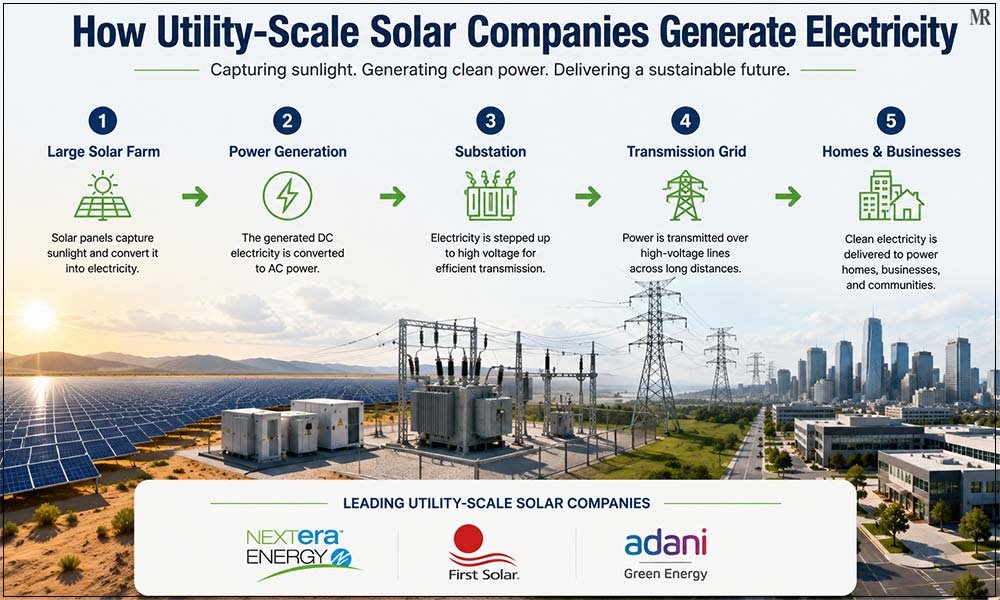
Utility-Scale solar companies develop, own, and operate large-scale solar farms, rather than just manufacturing the equipment that goes into them. Here are the top Utility-Scale solar companies in 2026.
1. NextEra Energy, Inc.
Among the top solar energy companies in the utility-scale segment, NextEra Energy doesn’t make solar panels, yet it owns and runs more solar and wind capacity than anyone else on the planet. The Florida-based parent of Florida Power & Light added a record 4 GW to its renewables and storage backlog in the first quarter of 2026 alone, pushing its total pipeline to roughly 33 GW. FPL’s own solar fleet has already crossed 8.5 GW, and the company plans to add another 12 GW of solar and 7 GW of battery storage by 2035.
2. First Solar, Inc.
First Solar is the largest US-based solar manufacturer, and the only major player still betting on thin-film cadmium telluride technology instead of silicon. Its backlog is enormous, 47.9 GW of contracted orders worth $14.4 billion as of March 2026, and first-quarter sales climbed 26% year-on-year to $1.04 billion, powered largely by demand from India. The company is now rolling out CuRe, its next-generation thin-film technology, to keep that lead intact.
3. Adani Green Energy Limited
Adani Green Energy has become India’s renewable energy powerhouse, crossing 20 GW of operational capacity in mid-2026 after adding a record 5 GW in a single fiscal year. Roughly 14 GW of that is solar, much of it coming from Khavda in Gujarat, the site of what will eventually be a 30 GW renewable park, one of the largest in the world. The company is aiming for 50 GW of total capacity by 2030.
Top Smart Solar Technology & Residential Solar Companies in 2026
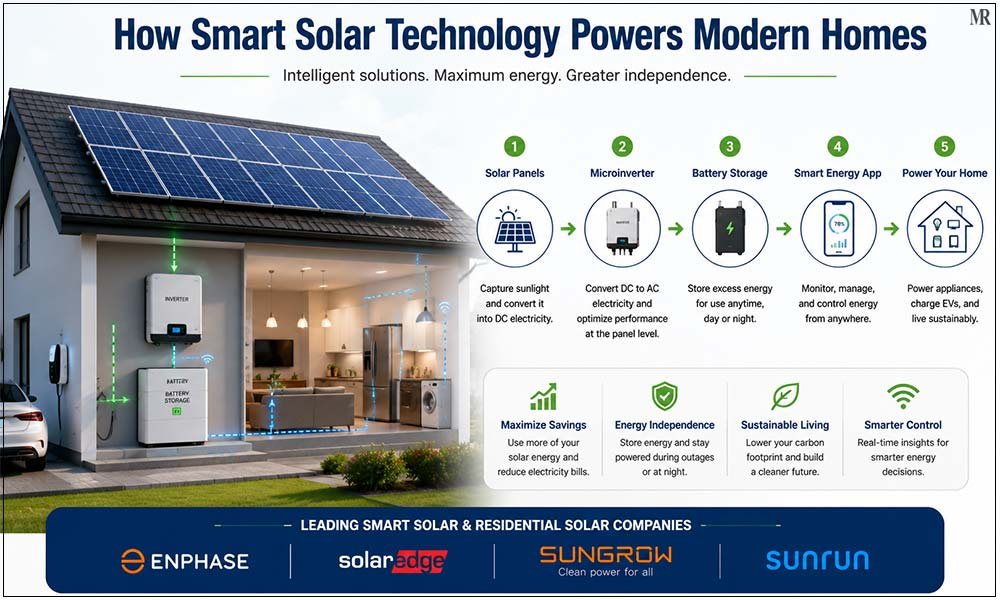
These companies specialize in inverters, microinverters, battery storage, and the residential installation services that turn solar panels into a working home energy system.
1. Enphase Energy, Inc.
Enphase Energy built the microinverter category and still leads it among the top solar energy companies. The California company shipped 1.41 million microinverters and 103 megawatt-hours of home batteries in the first quarter of 2026, bringing in $283 million in revenue. Enphase is now looking past rooftops entirely, developing a solid-state transformer platform aimed at powering AI data centers.
2. SolarEdge Technologies, Inc.
SolarEdge Technologies is a leading provider of smart solar inverter systems and energy management solutions for residential and commercial solar installations. The Israel-based company specializes in DC-optimized inverter technology that improves the performance and monitoring of photovoltaic (PV) systems. In the first quarter of 2026, SolarEdge reported revenue of $310.5 million, marking its sixth consecutive quarter of margin improvement while expanding its SolarEdge Nexis platform.
3. Sungrow Power Supply Co., Ltd.
Sungrow Power Supply is the world’s largest supplier of solar inverters and a global leader in battery energy storage systems. The company provides inverter technology and energy storage solutions for utility-scale, commercial, and residential solar projects worldwide. In 2025, Sungrow shipped 143 GW of solar inverters and 43 GWh of battery storage, while growing revenue 14.6% year over year to CNY 89.18 billion. BloombergNEF continues to rank Sungrow as the world’s most bankable inverter brand.
4. Sunrun Inc.
Sunrun is the largest dedicated residential solar and battery storage company in the United States. The company installs rooftop solar systems and home battery solutions, helping homeowners generate, store, and manage clean energy. In the first quarter of 2026, Sunrun reported $722 million in revenue, with 73% of new customers adding battery storage, expanding its network into one of the country’s largest residential virtual power plants.
Solar Energy Trends to Watch in 2026
According to the IEA, advances in technology, record renewable energy investments, and changing government policies are creating new opportunities for manufacturers, developers, and technology providers alike. Understanding these broader Solar Energy trends provides valuable context for why these companies continue to lead the market.
1. Solar PV Continues to Dominate Renewable Energy Growth
Solar photovoltaic (PV) remains the fastest-growing renewable energy technology worldwide. In 2025, global renewable capacity additions rose 16% to a record 800 GW, with solar PV contributing more than 75% of all new renewable capacity. Global solar installations also surpassed 600 GW in a single year, pushing cumulative installed capacity to around 2.8 TW.
2. Battery Energy Storage Is Becoming Essential
Top solar energy companies are increasingly pairing photovoltaic systems with battery storage to improve grid reliability and maximize renewable energy use. Battery storage capacity additions increased by around 40% in 2025, reaching nearly 110 GW, making it the fastest-growing power technology globally. This shift explains why companies such as Sungrow, Enphase Energy, and Sunrun are expanding their energy storage portfolios alongside solar solutions.
3. Utility-Scale Solar Projects Are Expanding Worldwide
Governments and utilities continue to invest in gigawatt-scale solar projects to accelerate the clean energy transition. China accounted for more than 60% of global renewable capacity growth in 2025, while India increased renewable additions by nearly 60%, commissioning almost 50 GW of new solar PV. Large-scale projects are also accelerating across Europe, the Middle East, and Africa.
Moreover, according to the World Energy Outlook 2025, nearly 80% of new energy demand by 2035 will come from regions with high solar potential, particularly India, Africa, and Southeast Asia.
4. High-Efficiency Solar Technologies Are Driving Innovation
Solar manufacturers are moving beyond conventional photovoltaic modules by investing in higher-efficiency technologies such as TOPCon, heterojunction (HJT), back-contact (BC), and thin-film solar cells. These innovations improve power output, reduce energy losses, and enhance performance for both utility-scale and rooftop installations, making next-generation panels increasingly competitive.
5. Emerging Markets Are Fueling the Next Wave of Growth
While China remains the largest solar market, countries such as India, Saudi Arabia, Pakistan, and several African nations are rapidly increasing solar deployment. As per Tata Power’s report, India has become one of the world’s fastest-growing solar markets, while distributed solar installations are expanding across emerging economies to improve energy access and reduce dependence on fossil fuels.
6. Grid Modernization and Energy Storage Are Becoming Top Priorities
Record solar deployment is increasing pressure on electricity grids, making grid upgrades just as important as new solar installations. Industry reports highlight transmission expansion, smarter grid management, and flexible energy storage systems as critical investments needed to support continued solar growth over the next decade.
7. AI and Digital Energy Management Are Improving Solar Performance
Artificial intelligence is playing a growing role in the solar industry through predictive maintenance, energy forecasting, grid optimization, and intelligent battery management. Smart energy platforms are helping utilities and homeowners maximize solar generation, reduce operating costs, and improve system reliability as renewable electricity becomes a larger share of the global energy mix.
These advancements are also creating new opportunities for green entrepreneurship, enabling startups and clean-tech innovators to develop smarter solar technologies, energy management platforms, and sustainable business models.
Conclusion
There is no single ‘best’ among the top solar energy companies in 2026. Manufacturing leadership belongs to JinkoSolar, LONGi Green Energy Technology, and Trina Solar. Utility-scale power runs through NextEra Energy, First Solar, and Adani Green Energy. Smart solar technology is led by Enphase Energy, SolarEdge Technologies, and Sungrow, while Sunrun leads US residential installs. Whichever segment matters to you, the top solar energy companies of 2026 share one trait: they’re betting heavily on storage, not just panels, to power what comes next.
Maria Isabel Rodrigues
FAQs
- Who are Tier 1 solar manufacturers in 2026?
Tier 1 solar manufacturers in 2026 are companies recognized for their financial strength, manufacturing scale, and bankability by organizations such as BloombergNEF. Leading Tier 1 manufacturers include LONGi Green Energy, JinkoSolar, Trina Solar, Adani Solar, and Canadian Solar, with Waaree Energies emerging as a major player in India.
- Who is the largest solar panel manufacturer globally in 2026?
JinkoSolar and LONGi Green Energy are among the largest solar panel manufacturers globally in 2026, based on annual module shipment volume. Both companies ship around 80–90 GW of solar modules annually and continue to lead the industry in manufacturing capacity and technology.
- What is the difference between a solar manufacturer and a utility-scale solar company?
A solar manufacturer produces photovoltaic (PV) panels, solar cells, and related equipment used in solar energy systems. A utility-scale solar company develops, owns, and operates large solar farms that generate electricity for utilities, businesses, and power grids.
- What is the difference between a solar panel manufacturer and a smart solar technology company?
A solar panel manufacturer designs and produces photovoltaic modules that convert sunlight into electricity. A smart solar technology company develops products such as inverters, battery storage systems, and energy management software that optimize how solar power is stored and used.
- Who is the biggest residential solar company?
Sunrun is the largest dedicated residential solar and battery storage company in the United States, serving more than one million customers. Companies such as Enphase Energy and SolarEdge Technologies also play a key role in residential solar by supplying the microinverters and smart energy systems used in home installations.