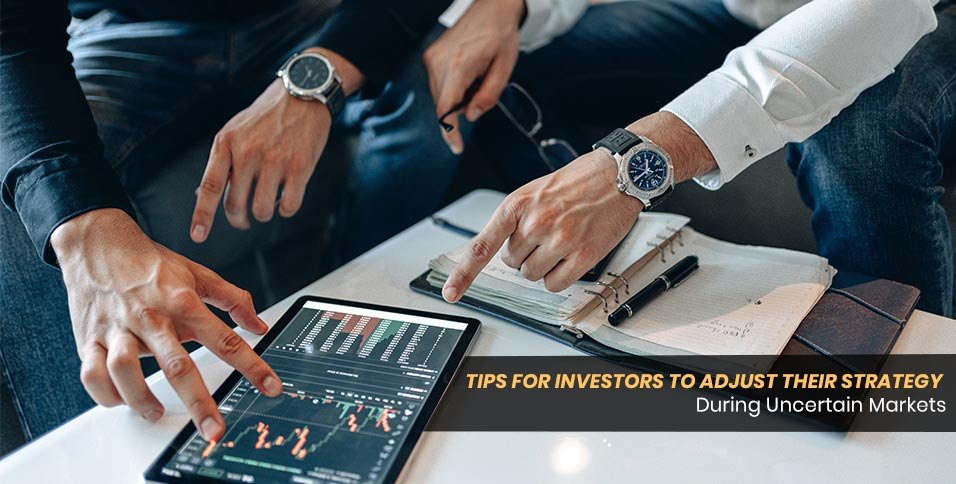
Anyone watching the news right now can see the stock market is swinging wildly up and down.
The Nasdaq is moving with rare turbulence. In June 2026, the index averaged daily swings of 2.1%, towering over its typical five-year average of just 1%. Much of that instability stems from Friday’s brutal 4% drop, which stands as the sharpest market decline since the tariff turmoil in April 2025.
It feels scary to watch your savings ride this roller coaster. You might feel like you need to change everything right now. Smart investors don’t do that. Instead, they make adjustments to protect their cash.
Below, we’ll share a few tips that can help you adjust your strategy when the market is uncertain.
#1 Rethink Your Asset Mix Without Panicking
The worst thing you can do is sell everything in a panic when the market gets unpredictable. A retail investor study by the J.P. Morgan Chase Institute showed that retail investor transfers into investment accounts peaked in early 2025. It touched $470.
Why must you not panic? Because history shows markets recover, often with sharp V-reversals.
When markets begin to rebound, many investors immediately ask, “Is the bear market dead?” The reality is that no one can answer that question with certainty in real time.
ValueTrend advises avoiding extreme assumptions because neither every dip is a buy nor every drop is a crisis. Patience, discipline, and historical context remain your best assets.
Instead of panicking, blend stocks, bonds, alternatives (like real assets or infrastructure), and some cash or short-term Treasuries.
During inflation spikes or growth worries, traditional 60/40 portfolios faced higher volatility (around 12% annualized post-pandemic vs. 7% before).
You can look into high-yield savings accounts or short-term government bonds. These options offer a reliable, steady stream of interest without the wild, stomach-churning swings of the stock market.
#2 Shift Focus from Growth to Resilient Value
Growth stocks, especially high-flying tech and AI favorites, thrive in booming bull markets, but they can cut deep when market uncertainty hits.
According to the J.P. Morgan 2026 Mid-Year Outlook, the public markets have begun punishing companies that spend too heavily without clear, short-term payouts. Investors are getting tired of big promises that take years to come true.
It’s because of this shift that investors are moving their money into resilient value companies. What does that mean? It means they look for companies that make things people need every single day. This includes electricity, groceries, medicine, and basic household items.
These are called defensive or value companies. They have steady businesses and plenty of cash in the bank. They also tend to pay dividends. A dividend is a small cash payment a company gives you just for owning its stock.
Dividends are invaluable during market downturns. Even as stock prices fluctuate, they deliver a steady stream of cash to your account. That way, you get the capital you need to buy more shares at a discount.
#3 Find Your Footing with the Classic Barbell Strategy
If you cannot decide between being totally safe and taking some risks, you do not have to choose. You can use a method called the barbell strategy.
In investing, a barbell strategy means you split your money into two extreme categories. You put a big chunk into ultra-safe investments. Then, you put another chunk into opportunistic investments. You completely avoid the middle ground.
Why do investors do this? Because the middle ground can be a dangerous trap during uncertain times.
Middle-of-the-road investments have average risk but might give poor returns when markets get weird. They are not safe enough to protect you, and they are not strong enough to grow your wealth.
On one heavy end of your barbell, you put your money into low-risk investments. This could be cash, short-term government bonds, or high-yield savings accounts. This side of the barbell protects your cash and ensures you have money ready if there is an emergency.
On the other heavy end of the barbell, you invest a small amount into high-risk, high-reward options. This might include top-tier companies using Artificial Intelligence or firms creating vital global infrastructure.
“AI is currently the subject of great enthusiasm. If that enthusiasm doesn’t produce a bubble conforming to the historical pattern, that will be a first,” quotes Howard Marks in Seeking Alpha.
FAQs
1. Is it better to hold cash or invest during high market volatility?
Holding modest cash preserves liquidity and provides dry powder, but staying invested ensures you do not miss eventual, rapid market recoveries.
2. How often should I rebalance my portfolio in an uncertain market?
Avoid constant tweaking. Review your asset allocation semi-annually or only when market swings push your targets off course by over 5%.
3. Does high market volatility predict a bad year for stocks?
No. Historical data proves that sharp intra-year drops are common and frequently precede strong, double-digit positive returns by year-end.
Key Statistics
| Metric / Indicator | Statistic | Context / Timeframe |
| Nasdaq Average Daily Swings | 2.10% | June 2026 |
| Nasdaq Typical Daily Swings | 1% | Five-year average |
| Sharpest Market Decline | 4% drop | June 2026 (Sharpest since April 2025) |
| Retail Investor Account Transfers Peak | $470 | Early 2025 (J.P. Morgan Chase Institute) |
| Post-Pandemic 60/40 Portfolio Volatility | ~12% annualized | During inflation spikes / growth worries |
| Pre-Pandemic 60/40 Portfolio Volatility | 7% annualized | Baseline comparison |
Market uncertainty is not permanent. Every single rocky market in U.S. history has eventually settled down. Do not let the daily news headlines scare you into making fast moves. The investors who win are simply the ones who stay calm and stick to their rules.
Make these moves when the market is uncertain. Also, talk to a professional advisor if you feel stuck. You are fully capable of handling this market. Stay calm, stay patient, and keep your goals in mind.