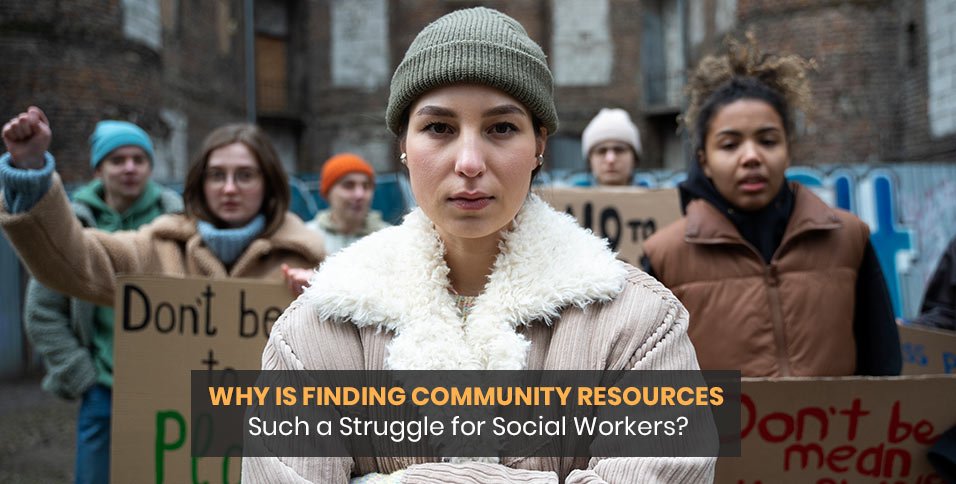
Social workers are often tasked with helping people access housing assistance, healthcare services, mental health support, and countless other forms of aid. Yet one of the greatest ironies of the profession is that locating and navigating those resources can be one of the most difficult parts of the job itself.
It doesn’t help that social work as an industry is significantly understaffed. As one report by the Association of Social Workers notes, there are over 463,000 licensed social workers in the United States. Of these, 59% were clinical social workers, employed in health care settings, while 26% were self-employed. Meanwhile, advanced generalist social workers accounted for only 4.53% of the total number and worked in administrative and managerial roles.
The fact is that resource navigation is an increasingly specialized skill. Even experienced social workers often spend years learning which sources are reliable and actually available when needed. Why has it come to this? Today, we’ll aim to understand some of the factors behind these challenges.
Information Exists, but It Is Scattered Everywhere
Many people assume that social workers struggle because community resources are scarce. While shortages certainly exist, another major problem is that information about available services is often spread across dozens or even hundreds of separate organizations. Often, each palace maintains its own systems, requirements, and communication channels.
Keeping track of these resources can be surprisingly difficult. Eligibility rules change, funding cycles alter program capacity, and websites may not always reflect current availability. So, a program that accepted referrals six months ago may have a waitlist today or may no longer be operating in the same capacity.
Because of this uncertainty, many social workers rely heavily on professional relationships and personal experience rather than official directories alone. However, people can quit, and such knowledge leaves with them. This is why social services software has been getting more love in recent times. They help non-profits keep things super organized and also make funding support easier to attain.
In the grander scheme of things, it also helps to have a thorough documentation system. As Community CareLink notes, social service agencies are often under significant pressure and need to follow specific documentation and reporting requirements.
Key Takeaways:
- Resource information is often fragmented across many organizations, making it difficult for social workers to stay updated on available services, eligibility requirements, and program capacity.
- Constant changes to funding, referral policies, and service availability can quickly make directories outdated, forcing social workers to rely on personal networks and institutional knowledge.
- Social services software and strong documentation systems help organizations centralize information and preserve knowledge when staff leave. They also make reporting and compliance requirements more effective.
Referral Fulfillment Is Not Guaranteed
Many social service systems place significant emphasis on making referrals. Once a client is connected with an organization or program, the referral may be documented and considered complete from an administrative perspective. In practice, however, the most difficult part often begins after the referral is submitted.
Clients frequently encounter barriers that prevent them from successfully accessing services. Transportation challenges, language differences, childcare responsibilities, paperwork requirements, and more are legitimate factors. Even highly motivated individuals may struggle to navigate multiple intake procedures across different organizations.
Research highlights how large this gap can become. According to one study that analyzed 115,316 referrals, only 65% of patients actually received the help they were referred to. What’s more, when federal funding and community health worker support were scaled back, that success rate plunged to 38%. This was despite the referral system marking cases as closed.
These findings reveal a disconnect between administrative reporting and real-world outcomes. A referral entered into a database may satisfy a reporting requirement, but it does not automatically mean a client received meaningful support.
Stronger follow-up systems can help bridge this gap. Automated reminders, coordinated communication between organizations, and community health worker support can improve engagement and increase the likelihood that clients ultimately receive the assistance they need.
Key Takeaways:
- Completing a referral does not guarantee a client receives help.
- Research shows a significant gap between referrals and successful service access.
- Better follow-up systems, such as automated reminders, cross-agency communication, and ongoing client support, increase the likelihood that services are actually received.
Capacity Problems Can Be a Major Bottleneck
Locating an appropriate service is often only the first step. Even when social workers successfully identify the right resource, capacity limitations can prevent clients from receiving timely assistance.
Behavioral health services provide a clear example of this challenge. Data shows that the national average wait time for behavioral health services is 48 days. The problem gets worse outside urban areas, as nearly 45% of rural counties in America lack psychologists. What’s more, 22% of rural counties did not have access to social workers, who might have helped connect people to other resources.
These capacity shortages create significant obstacles for individuals seeking support. A referral may be technically correct, yet a lengthy waitlist can make the service inaccessible when help is needed most urgently.
Capacity bottlenecks are often made worse by funding instability and workforce shortages. As Tom Collishaw, CEO of Self-Help Enterprises, notes, there’s a lot of fear in the non-profit sector on several levels. Part of it comes from funding concerns, while staffing shortages also affect how effectively programs can operate. He points out how changing federal government spending priorities are now threatening a wide range of social service programs.
This is why there is often an illusion of abundance in social work. Resource directories may list numerous programs, but availability on paper does not always translate into availability in practice. Social workers, therefore, spend considerable time evaluating which services are realistically accessible right now rather than simply identifying which programs exist.
Key Takeaways:
- Finding the right service does not guarantee access, as many programs face capacity constraints, long waitlists, and staffing shortages that delay assistance.
- Behavioral health services are particularly affected, with long average wait times and limited access to psychologists and social workers in many rural communities.
- Funding uncertainty and workforce challenges can reduce the effectiveness of social service programs, creating a gap between the number of resources listed in directories and the services that are actually available to clients.
Frequently Asked Questions
1. How do social workers stay updated on new community resources?
Many social workers stay informed through professional networks, local coalitions, community meetings, and relationships with service providers. They also use resource databases, newsletters, and referral platforms. Naturally, regular communication with nonprofits and government agencies helps them learn about program changes, new services, and eligibility updates.
2. How can smaller nonprofits improve coordination with social service agencies?
Smaller nonprofits can improve coordination by building relationships with local agencies, participating in community partnerships, and maintaining clear referral processes. Sharing accurate program information, responding promptly to referrals, and using collaborative technology tools can make it easier for organizations to work together and support clients effectively.
3. What is resource mapping in social work?
Resource mapping is the process of identifying and organizing services available within a community. Social workers use it to understand what support exists, where service gaps may be present, and how different organizations can help clients. It creates a clearer picture of the local support network.
Key Numbers & Facts at a Glance
| Licensed social workers in the United States | 463,000+ |
| Clients who successfully received referred services | 65% |
| Referral success rate after funding and support reductions | 38% |
| National average wait time for behavioral health services | 48 days |
Ultimately, the difficulty of resource navigation extends far beyond locating phone numbers, websites, or agency names. Social workers must continuously adapt to fragmented information systems and changing eligibility requirements. Thankfully, technology and improved coordination do help in reducing many of the administrative challenges that complicate resource navigation.
However, the battle is still ongoing, given how understaffed and underfunded social workers are. Creating a stronger support network for communities requires attention to both sides of the equation. Information must be easier to access and share, but resources must also remain adequately funded, staffed, and available.