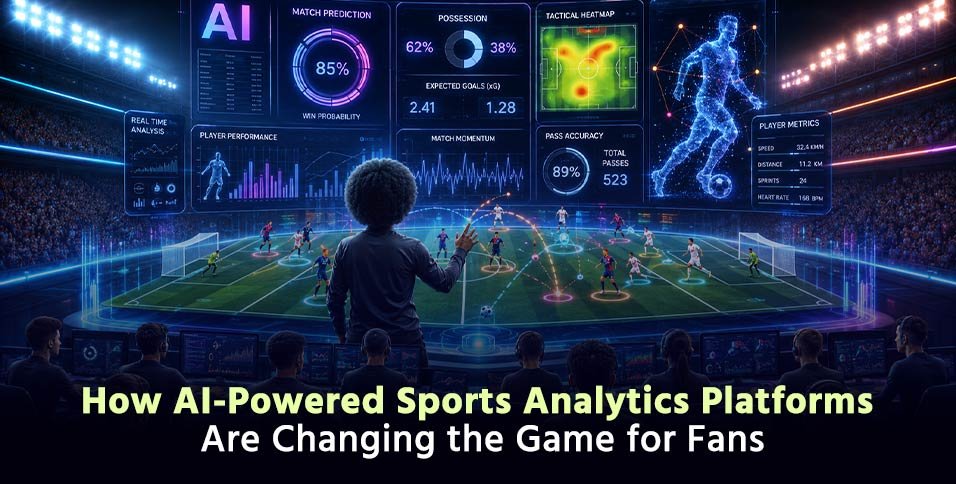
Sports has always been about more than the final score. It is about narrative, anticipation, and the shared experience of watching something unfold in real time. But in the past decade, a quiet revolution has reshaped how fans engage with the games they love. Artificial intelligence, machine learning, and big data have moved out of corporate boardrooms and into the living rooms – and smartphone screens – of ordinary supporters worldwide.
The result is an entirely new category of digital product: the AI-powered sports analytics platform. These tools aggregate vast quantities of match data, player statistics, historical records, and contextual variables, then surface insights that were previously available only to professional coaching staffs with dedicated analysis departments. Today, any fan with internet access can explore the same depth of information that was once reserved for the elite.
The Data Revolution in Sport
Professional sport generates an extraordinary volume of data. A single football match produces tens of thousands of data points – every pass, every sprint, every shot on goal is tracked, timestamped, and stored. Camera systems, GPS sensors embedded in players’ bibs, and optical tracking software combine to create a granular picture of athletic performance that would have been unimaginable two decades ago.
Initially, this data was the exclusive property of clubs and broadcasters. Clubs used it to scout opponents, manage player fitness, and fine-tune tactical plans. Broadcasters turned it into on-screen graphics that enriched television coverage. But as data collection became cheaper and more standardised, third-party platforms emerged to process and redistribute this information to a wider audience.
The democratisation of sports data has had a profound cultural effect. Fans who once relied purely on commentary and intuition now have access to expected goals models, pass completion heat maps, and predictive performance indices. The conversation around sport has changed accordingly – pundits cite metrics, supporters debate data, and the old argument of “the eye test versus the numbers” has become a genuine intellectual discourse.
How AI Changes the Fan Experience
From Passive Watching to Active Analysis
Traditional sports consumption was passive. You watched, you reacted, you discussed. AI platforms have shifted the fan from spectator to analyst. When a supporter can access a predictive model that evaluates the probable outcome of a match based on current form, head-to-head records, squad availability, and dozens of other variables, the pre-match experience changes completely. The anticipation builds not just from excitement but from informed expectation.
This shift mirrors what happened in financial markets decades ago when retail investors gained access to analytical tools previously available only to institutional traders. The tools did not replace judgment; they informed it. Sports analytics platforms are doing the same thing for fans.
Personalisation at Scale
AI also enables personalisation that was previously impossible. A platform can learn which leagues a user follows, which teams they support, and what types of insights they find most useful, then surface relevant data proactively. Instead of a generic statistics page, the fan receives a curated analytical experience tailored to their interests.
This level of personalisation increases engagement significantly. Studies consistently show that users who receive personalised content spend more time on platforms and return more frequently. For sports platforms, this translates to a more loyal, more engaged audience community.
The Technology Stack Powering Modern Platforms
Behind the clean interfaces of today’s sports analytics platforms lies a sophisticated technical architecture. Understanding it reveals why these tools have become so powerful, and why the gap between the best platforms and mediocre ones is so large.
Data Ingestion and Processing
The first challenge is simply acquiring reliable data at scale and speed. Leading platforms maintain integrations with multiple data providers, cross-referencing sources to ensure accuracy. Real-time data feeds require robust engineering to handle spikes in demand – millions of users checking the same match simultaneously demands infrastructure that most media companies would recognise as enterprise-grade.
Machine Learning Models
The analytical layer is where AI truly distinguishes sophisticated platforms from simple statistics aggregators. Modern sports analytics systems use ensemble models that combine multiple machine learning approaches – gradient boosting, neural networks, Bayesian inference – to generate predictions with stated confidence intervals. These models are trained on years of historical data and continuously updated as new results come in.
The best models do not merely look at recent form. They account for contextual variables: venue effects, travel fatigue, managerial tenure, transfer window disruption, and even weather conditions. The result is a nuanced probabilistic assessment rather than a simple prediction.
User-Facing Design
Technical sophistication means nothing if the platform is difficult to use. The most successful sports analytics tools have invested heavily in UX design, translating complex probabilistic outputs into clear, accessible visualisations. A confidence meter, a probability distribution chart, or a simple percentage figure can communicate the same underlying calculation, but each serves a different type of user.
Platforms like 365sport.tv exemplify this balance – combining data-driven analysis with an interface designed for real sports fans rather than data scientists, making sophisticated sports insights genuinely accessible to a broad audience.
Business Model Implications for the Sports Industry
The rise of AI sports analytics platforms has significant business model implications across the sports ecosystem. Clubs, leagues, broadcasters, and technology companies are all navigating a landscape that is evolving faster than most strategic plans can accommodate.
The Second Screen Economy
Sports broadcasters have long recognised the “second screen” phenomenon – fans watching matches while simultaneously browsing their phones. Analytics platforms have become a dominant second-screen application, and savvy broadcasters have begun to integrate data partnerships that keep fans within their ecosystem rather than migrating to standalone apps.
Fan Engagement as a Revenue Driver
Clubs have discovered that deeper fan engagement translates to measurable commercial outcomes. The fan who spends an hour exploring analytics before a match is more invested in the outcome, more likely to watch the full broadcast, and more likely to make purchases in the club’s commercial ecosystem. Data engagement is not separate from business performance – it is increasingly central to it.
Ethical Considerations and Responsible Use
The widespread availability of sophisticated sports analytics does raise genuine ethical questions that the industry is still working through. Predictive models, however sophisticated, cannot foresee every outcome – and platforms have a responsibility to communicate uncertainty clearly rather than projecting false confidence.
There is also a broader question about the relationship between analytical tools and the culture of sport. Numbers can enrich the fan experience without replacing the irreducible human drama of competition. The best platforms understand this instinctively: they use data to deepen appreciation of the sport rather than to reduce it to a series of probability calculations.
Responsible platforms present their analysis as one lens among many, encouraging users to combine data insights with their own football knowledge, contextual awareness, and love of the game. When used this way, analytics enhances rather than diminishes the sporting experience.
What the Future Looks Like
The trajectory of AI in sports analytics points toward even deeper integration between data and the fan experience. Augmented reality applications that overlay live statistics during broadcast are already in development. Conversational AI interfaces that allow fans to ask natural language questions about teams and players are moving from prototype to product. Personalised highlight reels generated by AI based on individual fan preferences are already commercially available.
As these technologies mature, the distinction between “watching sport” and “engaging with sport data” will continue to blur. The fan of 2030 will likely experience games through a layer of real-time analytical context that feels as natural as today’s on-screen score graphics.
For the platforms building this future, the competitive advantage will belong to those who combine technical rigour with genuine understanding of what fans actually want: not more data for its own sake, but insight that makes the games they love more meaningful, more engaging, and more enjoyable to follow.
Conclusion
AI-powered sports analytics platforms represent one of the most significant transformations in how fans relate to sport since the advent of television broadcasting. By making professional-grade data analysis accessible to ordinary supporters, these platforms have elevated the standard of fan discourse, deepened engagement, and created new commercial possibilities across the sports ecosystem.
The technology is impressive, but the real story is cultural: fans worldwide are embracing a more analytical, more informed relationship with the sports they love. As AI tools become more sophisticated and more widely available, that cultural shift will only accelerate – and the platforms that serve it best will play an increasingly important role in how sport is experienced globally.