Mirror Review
May 22, 2026
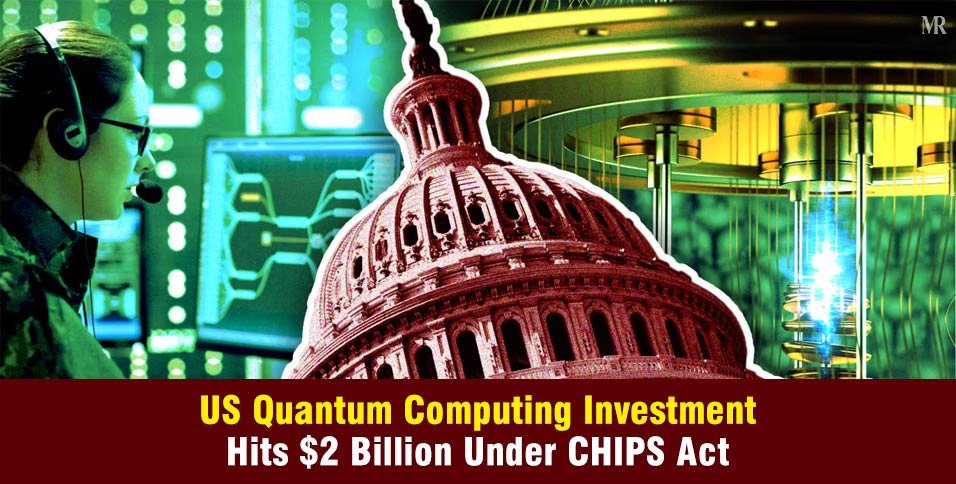
The US Department of Commerce signed letters of intent to provide $2.013 billion in federal incentives to nine quantum computing companies. This massive US Quantum Computing Investment uses funds from the CHIPS and Science Act to secure national security and domestic manufacturing. Under this initiative, the federal government will take minority, non-controlling equity stakes in the funded companies to protect taxpayer returns.
This historic funding round addresses the unresolved engineering challenges across multiple quantum modalities. The package divides support between establishing high-volume quantum foundries and accelerating pure-play quantum hardware developers.
When Did The US Start Tech Equity Investments
Taking equity in private tech firms represents a new shift in US economic policy. Traditionally, the federal government relied on research grants, tax credits, or defense contracts to stimulate technological breakthroughs. Direct equity investments were rare and reserved for severe economic crises.
The strategy changed during the return of the Trump administration in 2025. The federal government began using direct capital injections to secure vulnerable supply chains and counter foreign dominance.
- July 2025: The Pentagon became the largest shareholder in rare earths mining company MP Materials. This move countered China’s monopoly on critical minerals.
- Late 2025: The government expanded this approach into the semiconductor industry by taking a 10% equity stake in Intel. This made the federal government the third-largest shareholder in the legacy chipmaker.
- May 2026: The Department of Commerce applied this strategy to quantum computing.
The CHIPS and Science Act originally aimed to bring traditional semiconductor manufacturing back to American soil. By using these funds for equity in quantum firms, the US is actively choosing winners in the next frontier of global computation.
“With today’s CHIPS Research and Development investments in quantum computing, the Trump administration is leading the world into a new era of American innovation. These strategic quantum technology investments will build on our domestic industry, creating thousands of high-paying American jobs while advancing American quantum capabilities,” said Howard Lutnick, Secretary of Commerce.
Why Is The US Funding Quantum Computing Infrastructure
Quantum computers use the principles of quantum mechanics to process information in ways that classical supercomputers cannot match. Instead of standard binary bits, they use qubits to run complex simulations. This technology will change several critical industries.
| Industry | Potential Impact and Applications |
| National Defense | Breaking traditional encryption protocols and securing military communications. |
| Biopharmaceuticals | Simulating molecular structures to discover lifesaving drugs rapidly. |
| Advanced Materials | Designing efficient battery chemistries and new industrial polymers. |
| Financial Modeling | Running risk assessments and optimizing global logistics networks. |
A weak domestic supply chain creates severe national security vulnerabilities. Currently, the US leads in quantum research, but it relies on foreign manufacturing for specialized components. This federal program builds domestic capacity, so American innovators do not depend on overseas foundries.
IBM to Build First Pure-Play Foundry in the US
Legacy tech giant IBM secures the largest portion of the federal funding package. The US is to invest $2 billion in IBM and its standalone subsidiary through a combined public-private venture.
IBM will use its $1 billion federal grant alongside $1 billion of its own cash and intellectual property to launch Anderon. Headquartered in Albany, New York, Anderon will operate as the first pure-play, 300-millimeter quantum wafer foundry in the country.
Anderon will mass-produce quantum-grade superconducting wafers. Crucially, Anderon will operate as an open foundry. It will supply specialized wafers to multiple hardware vendors across the global quantum ecosystem.
This project helps the United States manufacture the majority of the world’s quantum wafers. Moreover, IBM plans to deploy the first large-scale, fault-tolerant quantum computer for commercial clients by 2029.
Capital Distribution Across Us Quantum Computing Firms
The Department of Commerce is using a portfolio approach to support multiple quantum modalities simultaneously. This distribution ensures that the US does not rely on a single architectural design.
The $2.013 billion package funds nine specific U.S. quantum computing firms. The capital distribution targets specific engineering bottlenecks.
Advanced Manufacturing Foundries
- IBM ($1 Billion): Establishing the Anderon foundry for 300mm superconducting quantum wafer fabrication.
- GlobalFoundries ($375 Million): Building a secure domestic foundry supporting multiple architectures, including trapped ion, photonic, and silicon spin modalities. The government takes a 1% ownership stake here.
Pure-Play Quantum Computing Developers
- Atom Computing ($100 Million): Overcoming systems integration barriers to control and manipulate tens of thousands of qubits in neutral-atom systems.
- D-Wave Quantum ($100 Million): Advancing annealing and gate-model superconducting systems through advanced packaging and interface control. D-Wave confirmed its entire funding counts as an equity investment.
- Infleqtion ($100 Million): Developing high-powered optical systems and error correction for large-scale neutral-atom architectures.
- PsiQuantum ($100 Million): Solving cryogenic systems integration and packaging for photonic quantum computing.
- Quantinuum ($100 Million): Eliminating manufacturing bottlenecks for fault-tolerant trapped-ion systems.
- Rigetti Computing ($100 Million): Miniaturizing next-generation cryostat architectures and readout electronics for superconducting systems.
- Diraq ($38 Million): Scaling quantum logic units and qubit arrays for silicon-spin quantum computing.
“The CHIPS R&D Office is taking a portfolio approach to strengthen and accelerate U.S. leadership across multiple quantum modalities at once, while focusing each award on discrete technological problems of genuine consequence,” stated Bill Frauenhofer, Executive Director of Semiconductor Investment and Innovation.
Market Reaction to Quantum Stocks
Wall Street reacted immediately to the $2 billion US Quantum Computing Investment news. Quantum stocks across the board experienced massive single-day gains as trading opened on Thursday.
The injection of government validation turned around a sluggish 2026 performance for the sector. The smaller, pure-play public companies outpaced the gains of legacy firms.
- Infleqtion: Led the sector-wide rally with a staggering 42% surge during midday trading.
- Rigetti Computing: Jumped 28% following the confirmation of its equity deal.
- D-Wave Quantum: Gained 27% as investors cheered the clear funding structure.
- GlobalFoundries: Rose 12% after disclosing its 1% government equity agreement.
- IBM: The IBM stock climbed over 4.6% in morning trading, eventually tracking up to 7% later in the day.
Industry analysts noted that federal equity stakes reduce default risks for young companies. The government funding secures their research roadmaps for the next few years.
Matt Kinsella, Infleqtion CEO, noted, “Quantum computing is emerging as a foundational technology for economic competitiveness, technological leadership, and national security. This investment reflects the transformative potential of quantum innovation, and we’re honored to work with the Department of Commerce to accelerate U.S. leadership in quantum computing.”
What Lies Ahead for the Quantum Industry
The massive US Quantum Computing Investment worth $2 billion provides the financial runway needed to move quantum computers out of research labs and onto factory floors. By addressing specific engineering issues like error rates and cryogenic cooling, these firms can scale up their hardware much faster.
The unique equity-taking structure shows that the US treats quantum technology as a critical resource for national defense and economic survival. If these foundries successfully scale manufacturing by 2029, the United States will control the physical core of the global quantum economy. Taxpayers now hold a direct stake in the commercial success of the quantum computing revolution.
Maria Isabel Rodrigues