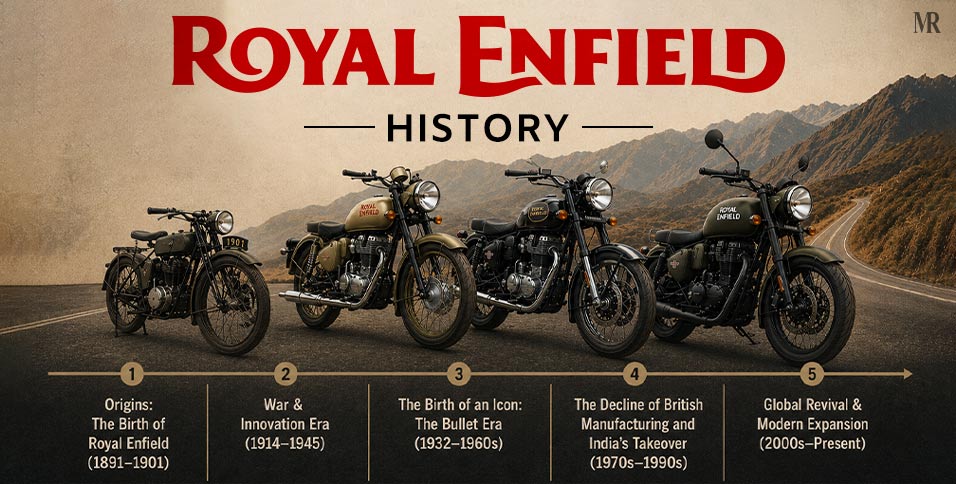
Royal Enfield is one of the oldest motorcycle brands in the world, with a history that dates back to 1901 in the United Kingdom. Known for its signature thump and classic design, the company evolved from a British bicycle manufacturer into a global motorcycle icon.
Over more than a century, Royal Enfield has survived wars, factory closures, and ownership changes, eventually finding new life in India, where it became a dominant force in the mid-size motorcycle segment.
This article breaks down the complete Royal Enfield history, from its early beginnings and wartime contributions to the rise of the Bullet, its near-decline, and its modern global revival.
Royal Enfield’s History: From British Roots to Global Motorcycle Icon
1. Origins: The Birth of Royal Enfield (1891–1901)
In 1891, entrepreneurs Bob Walker Smith and Albert Eadie acquired George Townsend & Co. in Redditch, a needle manufacturer that had recently started making bicycles. Within two years, the company won a contract to supply precision rifle parts to the Royal Small Arms Factory in Enfield, Middlesex. That contract defined everything that followed.
To honour the partnership, Smith and Eadie renamed the company and branded their bicycles “Royal Enfield.” They also introduced the tagline Made Like a Gun, a claim that pointed directly at precision engineering and reliability. These were not marketing words. They reflected the standards the company applied to every machine it built.
By 1898, Bob Walker Smith designed the company’s first motorised vehicle, a quadricycle powered by a 1.5 hp De Dion engine. In 1900, that quadricycle won a silver medal at the inaugural 1000-Mile Reliability Trial, a gruelling cross-country route from London to Edinburgh and back.
Then, in 1901, Royal Enfield launched its first true motorcycle at the Stanley Cycle Show in London, a 1.75 hp machine designed by Smith and French engineer Jules Gobiet, priced at £50. This laid the foundation of the fascinating Royal Enfield’s History.
2. War & Innovation Era (1914–1945)
Royal Enfield supplied motorcycles to multiple armies during World War I. The company’s 770cc 6 hp V-twin went into priority production for the British, Belgian, French, United States, and Imperial Russian armies. This wartime output established the brand’s reputation for machines that perform under extreme stress.
During World War II, the company produced over 55,000 military motorcycles. Its most remarkable contribution was the Flying Flea, a 125cc two-stroke lightweight designed to be parachuted behind enemy lines alongside airborne troops. Engineers built the machine specifically to withstand impact landings, silenced the engine to reduce noise, and ensured it could run on multiple fuel types. The Flying Flea saw action ahead of the D-Day landings and during Operation Market Garden, the largest airborne assault in history.
The wartime demands forced Royal Enfield to expand manufacturing across the UK, including an underground factory 90 feet below ground in Wiltshire. This period of engineering under pressure shaped the company’s identity, building machines that work when everything else fails.
3. The Birth of an Icon: The Bullet Era (1932–1960s)
Royal Enfield launched the Bullet in 1932 in three engine sizes of 250, 350, and 500cc. All three versions featured inclined “sloper” engines, twin-ported cylinder heads, and high-compression pistons. Moreover, the 500cc variant produced 90 mph, while nothing about it was average.
The Bullet’s defining feature was its durability. In 1948, Royal Enfield redesigned it with oil-damped swingarm rear suspension, the first production motorcycle by any manufacturer to use this design. Within a few years, every major motorcycle manufacturer in the world had adopted it.
In 1952, the Indian Army ordered 800 units of the 350cc Bullet to patrol its borders in Kashmir and Rajasthan. The machine proved ideal for rough mountain terrain, and several large orders followed.
By 1955, Royal Enfield partnered with Madras Motors in India to form Enfield India, establishing a dedicated factory at Tiruvottiyur near Madras (now Chennai). And by 1962, all Bullet components were manufactured in India.
The Royal Enfield Bullet holds the record as the longest-running motorcycle model in history, continuously in production since 1948.
4. The Decline of British Manufacturing and India’s Takeover (1970s–1990s)
By 1970, Royal Enfield’s UK manufacturing operation collapsed. Japanese motorcycle brands like Honda, Yamaha, Suzuki, and Kawasaki had entered the market with cheaper, faster, and more reliable machines. British motorcycle manufacturers could not compete, and the Royal Enfield’s Redditch factory closed in 1970, thus ending 70 years of British production. This is where the history of Royal Enfield in India began.
It was Royal Enfield’s Indian operation that kept the brand alive and became one of the most famous Indian Brands. Enfield India continued building Bullets through the 1970s, and by 1977, it began exporting the 350cc Bullet back to the UK and Europe, where classic motorcycle enthusiasts embraced it immediately. The brand that Britain could no longer sustain was now being exported from India back to its country of origin.
In 1994, the Eicher Group, an Indian commercial vehicle and automotive manufacturer, acquired Enfield India and renamed it Royal Enfield Motors Limited. Eicher made a decisive strategic call: discontinue lightweight motorcycle production and focus exclusively on the mid-size motorcycle segment. That decision set the foundation for everything that came next in the Royal Enfield History.
5. Global Revival & Modern Expansion (2000s–Present)
Royal Enfield’s modern comeback started with product clarity. The Classic 350 launched in 2009 and immediately achieved cult status, a retro-styled motorcycle with a modern engine that riders connected with emotionally, not just mechanically. Sales grew rapidly. By 2015, Royal Enfield surpassed Harley-Davidson in global motorcycle sales.
The company expanded its range with the purpose:
- The Thunderbird addressed highway cruising.
- The Himalayan, launched in 2016, gave Royal Enfield its first purpose-built adventure motorcycle designed for roads, off-roads, and mountain trails.
- The Interceptor 650 and Continental GT 650, unveiled at EICMA Milan in 2017, brought twin-cylinder performance to the mid-size segment and won Motorcycle of the Year awards in India, Thailand, and the UK.
Royal Enfield invested in engineering infrastructure to back up its ambition. In 2015, it acquired Harris Performance, a British motorcycle design firm that had developed the Continental GT chassis.
In 2017, the company opened the UK Technology Centre at Bruntingthorpe Proving Ground in Leicestershire, employing over 170 engineers and designers. The same year, Royal Enfield inaugurated a third manufacturing plant at Vallam Vadagal near Chennai, with a capacity of 600,000 motorcycles per year.
Today, Royal Enfield sells motorcycles in more than 50 countries. Its current lineup spans classic roadsters, adventure tourers, café racers, cruisers, and performance roadsters. The Guerrilla 450, launched in Barcelona in 2024, marks the brand’s entry into the performance roadster segment.
Furthermore, the Flying Flea electric concept signals Royal Enfield’s planned move into EVs, a full-circle moment, reviving a wartime name for a new era of motorcycling.
Royal Enfield Current & Key Motorcycle Models (2026)
Below is an overview of Royal Enfield’s main motorcycles across segments today:
| Segment | Model | Engine | Key Positioning |
| Modern Classics | Royal Enfield Classic 350 | 349cc | Iconic retro design, highest-selling model |
| Royal Enfield Bullet 350 | 349cc | Oldest legacy model, minimalist classic | |
| Royal Enfield Meteor 350 | 349cc | Comfortable cruiser for long rides | |
| Royal Enfield Hunter 350 | 349cc | Urban, lightweight, youth-focused | |
| Cruiser / Touring | Royal Enfield Super Meteor 650 | 648cc | Premium cruiser with highway focus |
| Royal Enfield Thunderbird | 350cc/500cc | Predecessor to Meteor (discontinued) | |
| Adventure | Royal Enfield Himalayan 450 | 452cc | Purpose-built ADV for all terrains |
| Royal Enfield Himalayan | 411cc | Original ADV model (phased out) | |
| Roadster / Performance | Royal Enfield Guerrilla 450 | 452cc | New-age performance roadster |
| Twin Cylinder (650 Platform) | Royal Enfield Interceptor 650 | 648cc | Retro roadster, global success |
| Royal Enfield Continental GT 650 | 648cc | Café racer styling, sporty ergonomics | |
| Royal Enfield Shotgun 650 | 648cc | Factory custom-inspired bobber | |
| Electric (Concept) | Royal Enfield Flying Flea Electric | Electric | Upcoming EV segment entry |
Why Royal Enfield Still Matters Today
Royal Enfield’s history of 120 years of survival is not an accident. The brand built machines tough enough for war, useful enough for military deployment across difficult terrain, and desirable enough to sustain a global cult following long after its British manufacturers shut down.
What makes Royal Enfield’s History different from every other motorcycle brand is what it does not compete on. It does not chase top speed or lap times. It sells character, experience, and identity.
Riders across generations, from Indian Army soldiers patrolling Himalayan passes to weekend riders in Milwaukee and motorcyclists crossing Europe, choose Royal Enfield because of what it represents, not just what it does.
The history of Royal Enfield is a story of engineering precision, resilience, and a brand identity strong enough to survive wars, factory closures, and industry disruption. It started with a gun parts contract in 1892, and it is still building motorcycles today. That is what Made Like a Gun actually means!
Maria Isabel Rodrigues
FAQs
- Is Royal Enfield British or Indian?
Royal Enfield is a British-origin motorcycle brand founded in 1901, now owned by India’s Eicher Group and headquartered in Chennai, making it an Indian company with British heritage.
- Why is Royal Enfield called “Made Like a Gun”?
The slogan originated after the company secured a contract with the Royal Small Arms Factory. It reflects precision engineering, durability, and reliability—qualities expected from firearms and carried into their motorcycles.
- Why does Royal Enfield focus on mid-size motorcycles?
Royal Enfield strategically dominates the 250cc–750cc segment, where it faces less direct competition while appealing to riders seeking a balance of performance, affordability, and classic design.