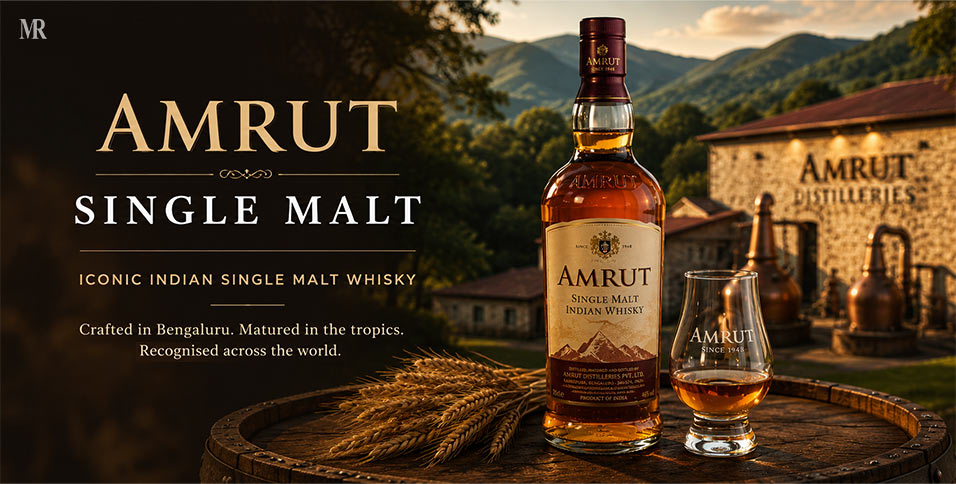
In 1948, when India had just gained independence, a small bottling unit opened in Bangalore to supply spirits to the Indian Army’s Canteen Stores Department. That unit was Amrut Laboratories, the seed of what would grow into Amrut Distilleries, today one of the world’s most awarded single malt producers.
From army canteens to 67 countries, the Amrut Single Malt story is not just about whisky. It is about a deliberate, generation-spanning business model that turned geographic disadvantage into a global edge.
So let’s explore the Amrut Distilleries business model that balances scale with premium ambition.
How Did Amrut Labs Go From Defense Supplier to Global Distillery
Amrut Distilleries did not start with premium ambitions. Under its founder, Shri J.N. Radhakrishna, known widely as JNR, Amrut Distilleries established itself as a dominant supplier of Indian Made Foreign Liquor (IMFL) across Karnataka, especially in the old Mysore area. The defense market gave the company early scale and financial stability. That foundation proved critical.
After JNR’s death in 1976, his son Shri Neelakanta Rao Jagdale took over as Chairman and Managing Director. His tenure shifted the company’s trajectory decisively toward premiumisation and global credibility. He paired family-rooted craftsmanship with transparent IMFL industry practices. This combination has built trust across both domestic regulators and international buyers.
The third generation arrived with Rakshit N. Jagdale, who holds an MBA from the University of Newcastle Upon Tyne. His MBA thesis, a business plan to market Amrut Single Malt in Scotland, the home of whisky, was not an academic exercise. He imported duty-paid samples and test-marketed them in 85 Indian restaurants across the UK. That research directly shaped Amrut’s global launch strategy.
The Amrut Single Malt Launch: Scotland First, India Later
In 2004, Amrut made a calculated move. Instead of launching its single malt in India, it debuted in Glasgow, Scotland, the heartland of Scotch whisky.
The logic was clear: if a whisky can earn respect where the world’s toughest critics live, it can earn it anywhere. Critics at the launch called it extraordinary. Word spread fast.
Amrut did not enter the Indian premium segment until 2010. By then, the brand had already accumulated international validation. That sequencing, build credibility abroad, then bring prestige home, is a deliberate business strategy. It allowed Amrut Single Malt to enter the Indian shelves with a global reputation already established.
Tropical Maturation: Amrut’s Unfair Advantage
Conventional wisdom in whisky production favors cool, damp climates like Scotland for slow, even maturation. Amrut turned that logic upside down. Bangalore’s warm climate accelerates the interaction between spirit and oak, producing what is called tropical maturation.
In Scotland, evaporation, known as the angel’s share, runs at 2 to 3% annually. In Bangalore, that figure reaches 11 to 12% per year. The result is a more concentrated, intensely flavored spirit in significantly less time, making Amrut Single Malt one of the world’s best single malt whiskies despite its non-Scottish origin.
A shorter maturation cycle means:
- Faster inventory turnover
- Lower carrying costs
- A product that tastes richer, not rougher
This is not a workaround. It is a structural competitive advantage built into the distillery’s geography. Amrut did not fight its climate, but it made the climate central to its product identity and brand story.
The Dual-Track Business Model
Amrut Distilleries runs two distinct revenue streams simultaneously, and that balance is the engine of its financial model.
- The first track is volume-driven mass-market IMFL. Products like Silver Oak Brandy and Old Port Rum generate the bulk of revenue. Karnataka alone contributes roughly 45% of Amrut’s total portfolio sales. The Canteen Stores Department of the Indian government accounts for approximately 30% of revenue, a relationship that dates back to the company’s founding.
- The second track is the premium and luxury single malt segment. Amrut produces over 50 variants of single malt, available across 67 countries. These products do not drive volume. They drive brand equity, global presence, and pricing power. Together, the two tracks create a business that is both stable and aspirational, mass-market revenues fund premium innovation, and premium prestige lifts the entire brand.
Managing Director Rakshit N. Jagdale put it plainly: mass-market brands and luxury single malts have both performed well, while the mid-premium segment has remained fairly stable. That insight shapes where the company invests and innovates.
City Editions and Limited Releases: Prestige Without Volume
Amrut’s limited-edition city releases represent a sharp branding play within its premium strategy.
The company launched ‘City of Joy,’ a single malt dedicated to Kolkata, followed by ‘Mumbai Chi Maaya,‘ priced at around ₹12,500 and available only within Mumbai. These releases are not volume drivers. Each city edition generates approximately 5,000 extra cases and between ₹2.5 to ₹5 crore in incremental revenue, which are modest numbers in isolation.
The real return is brand recall and consumer engagement. City-specific editions create media coverage, collector demand, and cultural alignment. They also open doors with hospitality partners. Amrut’s collaboration with Taj Palace in Mumbai, producing a bespoke Taj Palace Reserve, is a direct extension of this strategy: exclusive, curated, and distribution-controlled.
Scaling Production To Future-Proof Supply
Amrut is raising its malt distillation capacity by approximately 30% in FY26, increasing annual output from 900,000 litres to roughly 1.3 million litres. The company plans to invest ₹12 crore over the next two financial years, focused on incremental upgrades and operational efficiencies.
The rationale is straightforward:
- Premiumisation requires a consistent, high-quality supply.
- Export-led growth requires reliability at scale.
Capacity expansion now future-proofs both.
The pioneer of indian single malt, Amrut Distilleries, ended the last financial year with net sales of around ₹550 crore and has set a target of ₹700 to ₹750 crore in net revenue by 2030.
Expanding Into International Markets
Amrut currently operates in 67 countries, with exports contributing roughly 5% of overall revenues, including the UK, US, and EU. Those numbers may seem modest, but the strategic purpose of international presence is not primarily revenue, it is brand positioning.
The company now plans to expand into Latin America, targeting markets such as Mexico, Brazil, Argentina, and Chile. As Indian single malts gain global traction, early market entry in emerging premium spirits markets creates long-term positioning advantages that pure revenue metrics do not capture.This makes Amrut Single Malt one of the most famous “Made In India” brands.
Family Ownership and Operational Agility
Amrut remains a closely held family business now in its third generation. That structure confers a specific strategic advantage: faster decisions.
Where multinational competitors cycle strategies through layers of corporate governance, Amrut can pivot on product launches, market entries, and partnerships with speed.
On the topic of external partnerships and fundraising, Rakshit N. Jagdale has acknowledged that multinational interest exists, but no final decision has been made. Partnerships, he noted, require careful consideration at the family board level.
That caution preserves both ownership control and strategic flexibility, which are hallmarks of a business that knows the value of what it has built.
What Makes Amrut a Business Case Worth Studying
Amrut Distilleries is not simply a whisky brand. It is a multi-generational business that
- Leveraged a government supply relationship to build scale
- Used climate as a production differentiator
- Sequenced global market entry intelligently,
- Built a dual-track revenue model that funds both growth and prestige
The Pioneer of Indian Single Malt did not emerge by accident. It emerged because each generation of the Jagdale family asked the same question: how do we upgrade what people are consuming, and how do we make the world notice? Amrut Single Malt is their clearest answer yet.
If you found this breakdown insightful, share it with fellow whisky enthusiasts and anyone curious about how Indian brands are winning globally!
Maria Isabel Rodrigues
FAQs
- Which is the first single malt whiskey in India?
Amrut Single Malt is widely recognized as the first Indian single malt whisky to gain global acceptance after its official launch in 2004 in Scotland.
- Which is better, Amrut or Indri?
Amrut is more globally established with a longer track record and wider international recognition, while Indri is a newer Indian single malt brand gaining attention for its unique triple-wood maturation. The choice depends on taste preference and experience level.
- What makes Amrut Single Malt unique?
Amrut Single Malt stands out due to tropical maturation in Bangalore, which accelerates aging and creates richer flavor profiles in a shorter time compared to Scotch whiskies.
- What is the Amrut Distilleries business model?
Amrut operates a dual-track model: high-volume IMFL products generate steady cash flow, while premium single malts build global brand equity and pricing power.