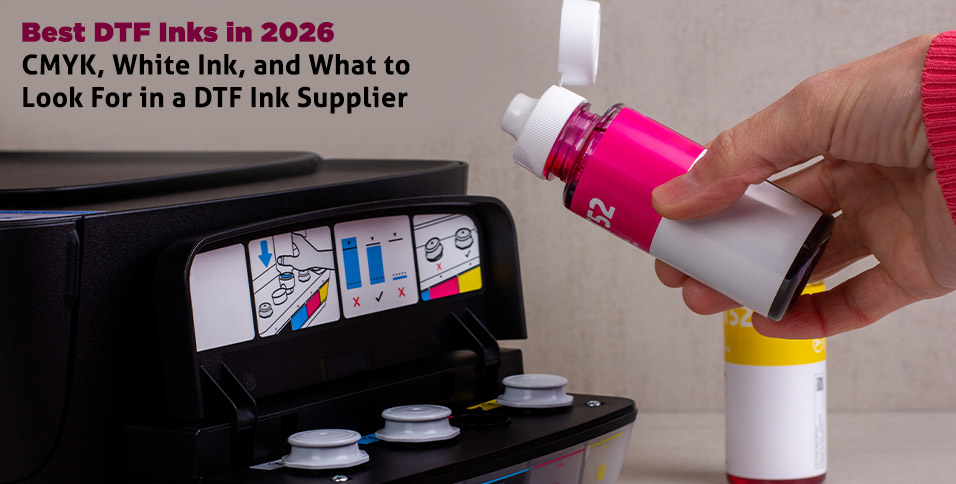
Direct-to-film printing has become one of the most popular decoration methods for custom apparel, and for good reason. The process is fast, versatile across fabric types, and produces transfers with vivid color and strong wash durability. But the quality of the final transfer depends heavily on one variable that often gets overlooked during equipment shopping: the ink.
Not all DTF inks are created equal. Choosing the wrong formulation can lead to dull prints, poor adhesion, premature fading, or print head damage that costs far more to fix than the ink savings ever justified. This buyer’s guide breaks down the two main ink categories used in DTF printing, what separates quality formulas from cheap alternatives, and what to look for when evaluating a supplier.
CMYK Inks: The Color Foundation of Every Transfer
CMYK inks — cyan, magenta, yellow, and black — are the four color channels that produce every hue in a DTF print. In most DTF workflows, the printer lays down CMYK color first, then white ink on top as an underbase before the film is coated with powder and cured.
What separates a good CMYK DTF ink from a poor one comes down to three factors: pigment density, viscosity consistency, and chemical compatibility with the print head. Pigment density affects how vivid and saturated colors appear after transfer. Inks with low pigment loading tend to print dull and may require multiple passes to achieve acceptable color saturation, which increases ink consumption and slows throughput.
Viscosity matters because DTF printers use precision piezo print heads (most commonly Epson I-series heads) that are engineered to fire ink droplets within a specific viscosity range. Ink that is too thick clogs the heads. Ink that is too thin causes dot gain and color bleed. Quality DTF inks are formulated to remain in the correct viscosity range across typical operating temperatures, and reputable suppliers will publish these specs.
Chemical compatibility is a concern that affects head longevity. Some lower-cost inks use pigment dispersants or additives that are corrosive to the internal components of print heads over time. This is not always obvious in the short term, but print shops running high volumes will notice the difference in head replacement frequency.
For buyers doing the math on cost per print, CMYK ink cost is relatively straightforward. At a supplier like DTF Printer USA, CMYK dtf ink is priced at $24.55 per liter. A shop running moderate volume can estimate usage based on coverage percentage per print, and most mid-size shops will find that ink cost per transfer lands well under a dollar even on larger designs.
White Ink: The Most Critical Ink in the System
White ink is where most DTF print quality issues originate. Unlike CMYK channels, white ink serves a unique structural role in the DTF process. It is printed as an underbase beneath the color channels and acts as the opaque layer that allows the design to pop on dark or colored fabrics. Without a properly applied white layer, colors appear washed out or transparent on anything other than a white garment.
White DTF ink is also the ink most prone to settling in the cartridge, clogging the print head, and creating consistency issues if not managed correctly. Quality white ink formulations address this with optimized pigment particle size, stabilized suspension agents, and viscosity profiles that minimize settling during idle periods.
When evaluating a white ink supplier, look for formulas that are specifically designed for the print head type in your machine, verified print head compatibility data, and suppliers who offer technical support when issues arise.
What to Look For in a DTF Ink Supplier
Beyond the chemistry of the ink itself, the supplier relationship matters. Here are the key factors to evaluate:
Stock availability. A supplier that frequently runs out of white ink is a supplier that will stop your production. Look for companies that carry consistent on-hand inventory rather than sourcing on demand.
Volume pricing. Consumable costs compound quickly at production scale. Suppliers that offer tiered pricing based on order volume give print shops a path to improving margins as they grow.
Technical support. Ink problems often look like printer problems. A good ink supplier should be able to help diagnose whether an issue is ink-related or hardware-related.
Transparent specifications. Reputable suppliers publish viscosity ranges, compatible printer models, and storage requirements. If this information is hard to find, that is a reason for caution.
DTF Printer USA is one supplier that checks these boxes for buyers in the U.S. market. They stock both CMYK and white inks with published pricing ($24.55/liter CMYK, $12.55/liter white), ship nationally from their Stafford, Texas facility, and carry a full range of complementary supplies. For buyers with technical questions before ordering, the company’s blog posts cover common ink compatibility and usage questions.
Final Thoughts
The ink is not the place to cut corners in a DTF setup. Print quality, head longevity, and per-print economics all run through this one consumable. Taking the time to evaluate suppliers based on formula quality, availability, and pricing structure will pay off in more consistent output and fewer production interruptions over the long run.
For print shops at any stage, from first-time buyers to high-volume commercial operations, the best approach is to test a small quantity from a new supplier before committing to large orders, and to pay attention to how the ink performs across the full print cycle from filling to curing.