Mirror Review
March 10, 2026
As oil prices spike amid renewed tensions in the Middle East, the G7 Finance Ministers convened to discuss whether to release emergency oil reserves, a move that could stabilize energy markets worldwide.
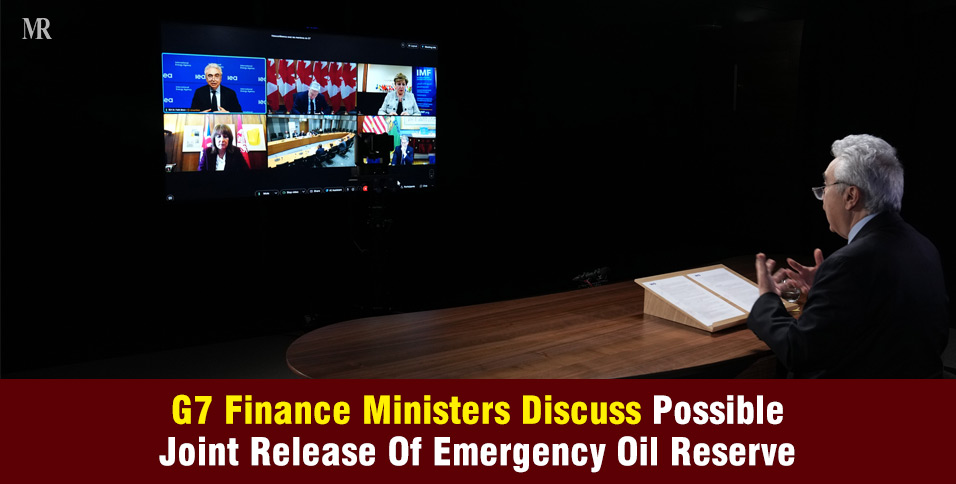
The virtual G7 meeting 2026 brought together finance leaders from the world’s largest advanced economies, along with the head of the International Energy Agency (IEA), Fatih Birol. The discussions focused on the ongoing conflict involving Iran, which has disrupted oil supplies, and the possibility of a coordinated release of strategic crude stocks.
Who are the G7?
The Group of Seven (G7) is an informal alliance of seven of the world’s most advanced economies: the United States, Canada, France, Germany, Italy, Japan, and the United Kingdom.
These countries meet regularly to coordinate economic policy, respond to global crises, and discuss issues that affect the world economy.
Rising Oil Prices Trigger Urgent Talks
Global oil prices surged earlier this week, with Brent crude touching nearly $120 per barrel, a level not seen since major disruptions caused by previous geopolitical conflicts.
This sudden spike came after the US and Israel launched airstrikes across Iran, targeting multiple sites, including oil depots.
Iran retaliated by striking energy infrastructure in neighboring Gulf states, while Saudi Arabia reported intercepting waves of drones heading for major oilfields.
The disruption is severe because roughly 20% of the world’s oil supply typically passes through the Strait of Hormuz, a narrow but vital shipping channel.
Since the outbreak of the conflict, traffic through this crucial passage has largely halted, raising fears of long-term supply shortages.
Higher oil prices feed into inflation, increase transportation and manufacturing costs, and put pressure on governments to respond.
In this context, the G7 emergency meeting is a critical effort to stabilize markets before the crisis deepens.
What the G7 Finance Ministers Discussed
At the G7 emergency meeting, finance ministers explored several options, including a coordinated release of strategic petroleum reserves (SPR).
Fatih Birol, the IEA Executive Director, emphasized that global oil markets “have deteriorated in recent days” due to both logistical disruptions and reduced production.
The IEA reports that member countries currently hold over 1.2 billion barrels of public emergency oil stocks, with an additional 600 million barrels held by industry under government obligation.
Releasing a portion of these reserves could help offset supply disruptions, at least temporarily, and relieve pressure on global oil markets.
However, as French Finance Minister Roland Lescure noted, “we are not there yet” when it comes to actually releasing these reserves.
The G7 statement following the meeting clarified:
“We stand ready to take necessary measures, including to support global supply of energy, such as stockpile release.”
Similarly, UK Chancellor Rachel Reeves highlighted that the meeting was also an opportunity to push for “immediate de-escalation” in the Middle East and ensure the safety of shipping lanes. She added, “I stand ready to support a co-ordinated release of collective IEA oil reserves.”
Why The G7 Emergency Releases Matter
The last time the G7 coordinated an emergency release of oil was in 2022, following Russia’s full-scale invasion of Ukraine.
At that time, crude oil prices spiked dramatically, threatening both consumer affordability and economic stability.
The coordinated release helped temper the market and provided reassurance to industries reliant on energy.
Historically, G7 interventions in energy markets have served three main purposes:
- Stabilizing prices temporarily during sudden supply shocks.
- Signaling market confidence that governments are monitoring risks.
- Encouraging diplomatic solutions by reducing the immediate economic pressure on conflict zones.
This makes the current G7 emergency meeting particularly significant.
Market Reactions
Oil markets reacted sharply to the G7 talks.
On Monday, Brent crude climbed over 25% in early Asian trading, reaching $119.50 per barrel, before falling back below $90 after President Trump commented that the US Iran war would “very quickly end,” offering reassurance to the markets.
Trump’s comments highlight another layer of complexity: public statements by political leaders can have as much impact as actual policy measures.
Traders monitor G7 statements and presidential remarks alike, adjusting positions rapidly based on perceived risks and potential interventions.
Considerations for the G7
While releasing emergency oil reserves could help reduce immediate price pressures, the G7 Finance Ministers are weighing multiple factors:
- Amount and Timing: Releasing too little may have minimal impact, while releasing too much could disrupt long-term market balance.
- Geopolitical Implications: A release could strain relations with oil-producing countries, particularly in the Gulf region.
- Long-term Energy Policy: SPR releases are a temporary solution; G7 countries are also discussing investments in renewable energy and alternative supply sources.
Additionally, high oil prices affect broader economic decisions. Central banks may delay interest rate cuts if inflation remains high, potentially slowing economic recovery.
Consumers could face higher fuel costs, which may impact spending on other goods and services.
What’s Next?
The G7 nations have signaled they are ready to act, but for now, no decision has been made.
Market watchers will be closely following:
- Any formal announcement of an oil reserve release.
- Updates from the IEA on global stockpile levels.
- Diplomatic developments in the Middle East that could impact oil supply.
- Statements from President Trump and other G7 leaders regarding market stabilization efforts.
The coming days will be critical in determining whether the G7’s potential intervention can calm markets or if prices will remain volatile.
End Note
Rising oil prices, caused by escalating conflict in Iran, threaten global inflation, energy security, and economic growth.
While the option of releasing emergency oil reserves was discussed by the G7 Finance Ministers, no immediate action has been taken.
What is clear is that the G7 countries are closely monitoring the situation and remain ready to act to stabilize global energy markets.
For consumers, businesses, and investors, the decisions made in this G7 meeting today could shape oil prices and economic trends in the months ahead.
As history has shown, coordinated action by the world’s leading economies can temporarily calm volatile markets and signal international resolve.
Maria Isabel Rodrigues